
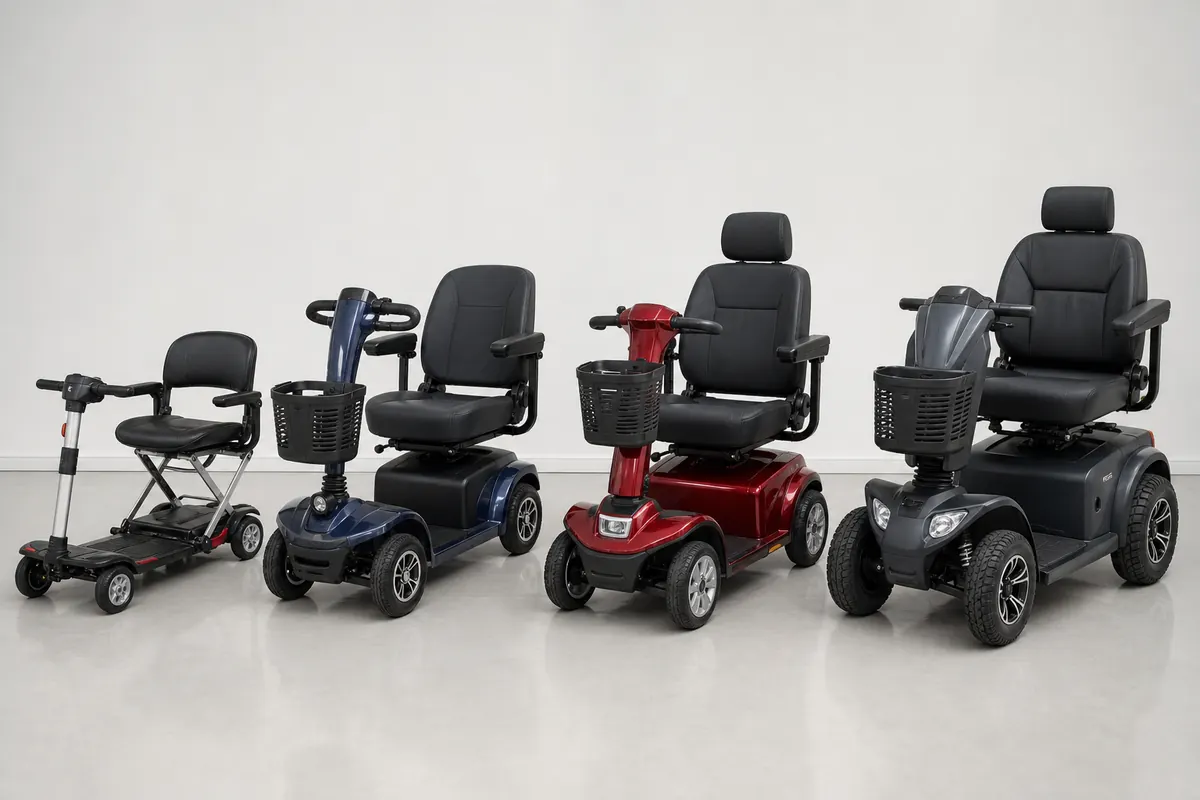
Quick answer: Travel mobility scooters prioritize portability and compact storage. They can work well for shopping, vacations, cruise terminals, hotels, and short mixed indoor trips when their verified capacity, dimensions, range, surfaces, and transport method match the user. Their smaller size can also mean tighter seating, less ground clearance, and fewer comfort features.
“Travel scooter” is a shopping category, not a complete technical specification. Some models separate into components, some fold, and some are simply compact. Compare the exact model and configuration rather than assuming every travel-labeled scooter can be lifted, flown, or used on the same terrain.
What counts as a travel mobility scooter?
Manufacturers use the term for scooters designed to be easier to move or store than larger models. Common designs include scooters that disassemble without major tools, scooters that fold into one unit, and compact rigid scooters intended for vehicle lifts or accessible transportation.
Those designs create different tasks. A disassembling model requires repeated alignment, connection, and handling of parts. A folding model may avoid assembly but remain heavy as one object. A compact rigid model can be straightforward to operate but may require a ramp or powered lift.
Main benefits
Compact footprint
A narrower or shorter scooter may be easier to store in an apartment, maneuver in a hotel room, or position in an accessible vehicle. Overall width is only one dimension: also compare length, turning space, tiller shape, seat overhang, and the room needed to mount or transfer.
Transport options
Removable seats, battery packs, and frames may let the user divide the scooter into manageable pieces. Folding designs can reduce setup steps. Both approaches can make occasional car travel more practical when the actual parts fit the cargo area and the people handling them can do so safely.
Simpler short-trip use
For smooth, accessible routes, a travel scooter may provide the needed seating and powered mobility without the footprint of a road-oriented model. It can be useful at a museum, mall, family gathering, resort, or conference after route and venue rules are checked.
Important limits and tradeoffs
Seat and control fit
Compact scooters often have less seat, footboard, and knee room. Check usable seat width and depth, armrest spacing, tiller reach, throttle type, and foot placement. A rider below the capacity rating can still have a poor fit. Optional seating may change overall size, capacity, transport weight, or folding procedure.
Ride comfort
Small wheels, short wheelbases, tire type, and limited suspension can make cracks, joints, gravel, or uneven paving more noticeable. Do not infer comfort from wheel count or product photographs. Try the exact configuration on an allowed surface similar to the real route when possible.
Clearance and obstacle handling
Travel scooters may be intended mainly for firm, level surfaces. Verify the manual’s ground-clearance, slope, curb, threshold, and surface guidance. Never assume that “outdoor capable” permits loose sand, deep gravel, wet grass, high curbs, or damaged paths.
Range under real conditions
Advertised range is not a guaranteed trip distance. The manufacturer’s test conditions may differ from the rider’s load, temperature, stops, slopes, tire condition, battery age, and surface. Plan from documented conditions, learn the scooter’s behavior gradually, and keep a conservative route reserve instead of running the gauge down deliberately.
Disassembling versus folding
For a disassembling scooter, ask for the number of parts, heaviest component weight, component dimensions, connection method, and assembly check. Watch a complete demonstration and repeat it without rushing. Determine where each part will be secured in the vehicle so it cannot move during travel.
For a folding scooter, record folded dimensions, total lifting weight in the carried configuration, required hand positions, latch indicators, and whether the battery must be removed. Check whether the folded unit rolls as luggage and whether that method is approved. A product that folds is not automatically safe for one person to lift.
The mobility scooter weight guide explains total versus component weight.
Car, taxi, bus, and train planning
Measure door openings, cargo-floor length and height, seatback clearance, and lift or ramp limits. Account for batteries and accessories in the transported configuration. Protect controls and loose parts as the manufacturer directs, and never lift by the seat, armrests, tiller, or body panels unless they are documented lifting points.
For public transportation, check the current operator’s size, weight, securement, booking, and boarding rules. A compact scooter may still exceed a particular lift or space. Ask how the freewheel setting and securement are handled, then return the scooter to drive mode before use according to its manual.
Air travel and battery documentation
Do not interpret “airline approved” as guaranteed acceptance. Airlines and airports need current information about the device, battery type, battery rating or energy documentation where applicable, removability, protection from accidental activation, and handling procedure. Requirements can vary by itinerary and aircraft.
Contact the operating airline before travel, follow its current instructions, and carry model-specific documents and photographs. Never relabel, open, or improvise a battery pack. Start with Can You Take a Mobility Scooter on a Plane?
Best-use scenarios
- Primarily smooth indoor routes with measured doorways and turning areas
- Short errands where the route has accessible curb ramps and surfaces
- Car trips when every component has a safe, repeatable handling plan
- Hotels, attractions, and events whose access rules are confirmed
- Travel as a secondary scooter when its fit and capability remain adequate
A travel scooter may be the wrong match for frequent rough paths, deep outdoor surface changes, a rider needing a larger supportive seat, or a household with no safe way to load it. For alternatives, compare heavy-duty mobility scooters and the broader types of mobility scooters guide.
Shopping questions that reveal the real tradeoffs
- What is the full model number and exact configuration?
- What load does the capacity rating include?
- What are the open, folded, and component dimensions?
- What is the heaviest part, and how must it be lifted?
- Which surfaces, slopes, thresholds, and weather conditions are permitted?
- What battery and charger are approved?
- Does the seat fit the rider for the expected trip time?
- Can the model be serviced near home or at the destination?
- What do the warranty and return policy exclude?
Practical pre-purchase checklist
- Measure the rider, home access, storage, and cargo area.
- Save the current manual and official specifications.
- Verify capacity using a realistic total load.
- Try seating, controls, mounting, and turning at low speed.
- Rehearse folding or disassembly with the actual scooter.
- Confirm the heaviest lift is manageable with the planned help or equipment.
- Compare the real route with documented surface and slope limits.
- Verify battery, charging, public transport, and airline details separately.
- Identify service support and price common replacement items.
- Get the full delivered price and return terms in writing.
Frequently asked questions
Are travel mobility scooters only for indoor use?
No. Some models permit certain outdoor surfaces, but allowed conditions are model-specific. Use the manual and evaluate the actual route rather than relying on the category name.
Can one person lift a folding scooter?
That depends on the scooter’s carried weight and shape, the approved lift points, the person, and the environment. Folding does not mean lightweight. Use a ramp, lift, or assistance when the handling task is not safely manageable.
Do smaller scooters have shorter range?
Not as a universal rule. Compare published figures and test conditions for exact models. Battery option, load, surface, temperature, stops, and battery condition affect real trips.
Is a three-wheel travel scooter better for tight spaces?
Some have a smaller published turning measurement, but layout and technique matter. Compare documented dimensions and test in the intended space. Follow the manual’s turning and slope instructions for either wheel arrangement.
Can I take any travel scooter on a plane?
No category label guarantees carriage. Provide the operating airline with the exact device and battery information and follow its current process for the itinerary.
Last reviewed: July 22, 2026. Verify current specifications, transport rules, and operating instructions for the exact scooter and battery before purchase or travel.

Questions and reader comments