
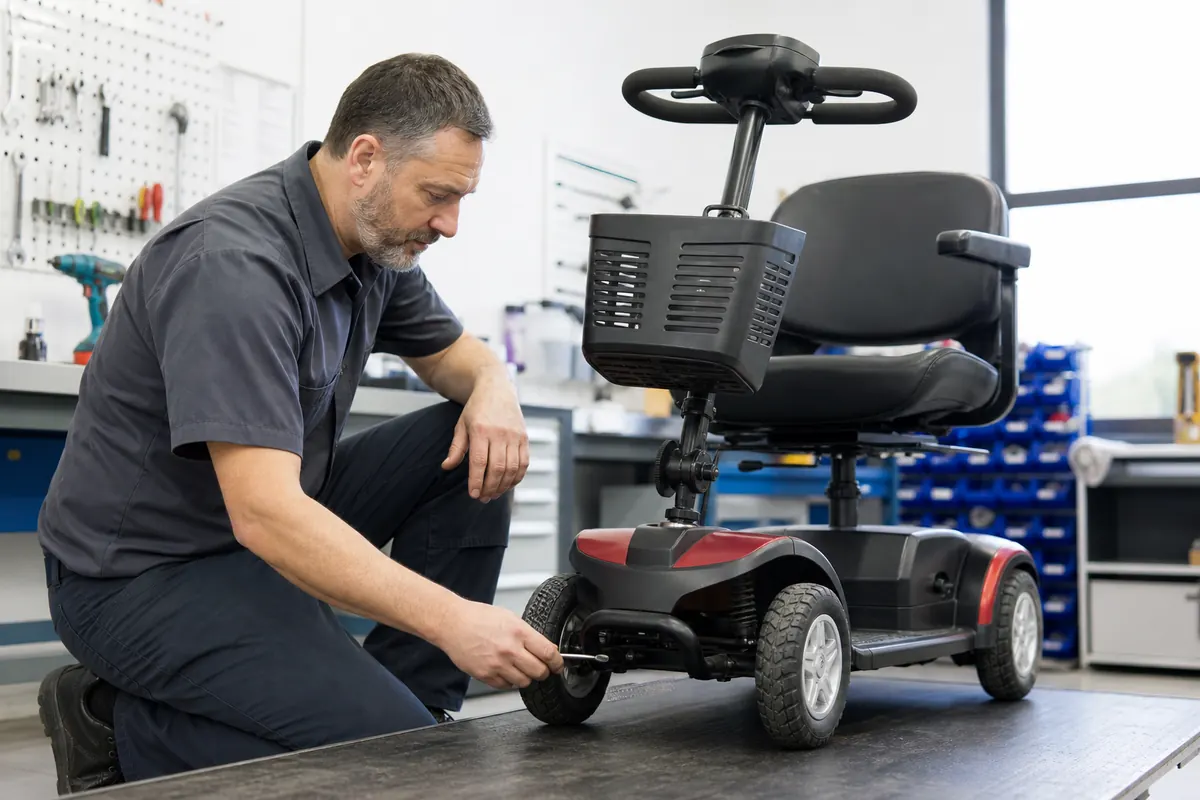
Quick answer: Charge a mobility scooter only with the charger approved for its exact scooter and battery, in a dry and suitably ventilated location, using the sequence and temperature limits in the current manuals. Inspect the charger, cord, plug, outlet, battery case, and charging port first. Stop if you find damage, swelling, leakage, unusual heat, smoke, a burning odor, or an unexplained fault.
A connector that fits does not prove electrical compatibility. Voltage, polarity, current, charging profile, battery chemistry, and battery-management electronics all matter. Safe charging therefore begins with identification, not with a generic time estimate.
Build a model-specific charging record
Keep the scooter model and serial number, battery chemistry and rating, approved charger model, current manuals, and provider contact together. Photograph readable labels without removing covers. If the scooter uses a removable pack, note whether the manufacturer permits charging on the scooter, off the scooter, or both.
Replace a lost or failed charger through the manufacturer or a provider that confirms the exact approved part. Pride Mobility’s lithium-ion FAQ, for example, prohibits using a different charger with the covered products. The U.S. Consumer Product Safety Commission has also warned that chargers marketed as “universal” for micromobility products may fit yet remain incompatible. CPSC’s advice focuses on e-bikes, stand-up e-scooters, hoverboards, and related products, so it is supporting context rather than a substitute for a mobility scooter manual.
Choose a suitable home charging area
- Use an indoor, dry location if the charger manual specifies indoor use.
- Provide the ventilation and clear space required around the charger and battery.
- Place the charger on the surface and in the orientation approved by its instructions.
- Keep paper, fabrics, aerosols, fuel, and other combustible or heat-sensitive items away.
- Keep cords out of doorways, stairs, and walking routes.
- Maintain access to an exit; do not turn a hallway or doorway into a charging bay.
- Keep the setup away from rain, sprinklers, sinks, standing water, and condensation.
Do not cover the charger or put it in a closed cabinet unless the manufacturer designed and approved that arrangement. Do not charge in a parked vehicle, hot shed, or freezing area when those conditions fall outside the documented limits.
Inspect before every charging session
Power the scooter down as directed and look at the battery case, accessible connectors, charge port, charger housing, input and output cords, and plugs. Do not use equipment with crushed insulation, exposed conductors, bent or loose pins, corrosion, darkening, melting, a cracked case, or signs of liquid entry.
Check that the wall receptacle is secure and appropriate for the charger. Do not stack adapters, defeat a grounding pin, or use a power strip merely because it is convenient. If the manual does not expressly permit an extension cord, arrange a suitable outlet rather than improvising. Have a questionable, hot, sparking, or loose outlet evaluated by a qualified electrician.
Follow the documented connection sequence
Use the exact order in the charger and scooter manuals. A manufacturer procedure may require connecting the charger to the scooter before the wall outlet and disconnecting from the wall before the scooter, but sequences can differ. Keep plugs aligned, grasp the plug rather than pulling the cord, and never force a connector.
Confirm that the expected power and charging indicators appear. Record an error code or unexpected light pattern before switching anything off, then use only the troubleshooting steps assigned to the owner. Do not open the charger, bypass an interlock, replace an internal fuse without an authorized procedure, or repeatedly reconnect a system that reports a fault.
Monitor the charge without guessing
Stay able to notice an abnormal odor, noise, heat, indicator, or change in the equipment. CPSC’s current micromobility guidance advises consumers to be present during charging and not to charge while sleeping. Because that guidance does not define every mobility scooter system, owners should also follow the exact manufacturer instructions and any applicable building, housing, or care-facility rules.
“Automatic” does not mean every charger can remain connected forever. When the manual says charging is complete, follow its shutdown and disconnection procedure. Do not extend a charge to compensate for reduced range, and do not assume that a green light proves measured battery capacity.
Know the stop signs
Stop charging for a persistent fault light, repeated breaker trip, damaged cable, loose or discolored connection, unusual heat, new odor, hissing, swelling, leakage, smoke, or flame. Do not open or puncture a suspect battery, and do not handle or try to move equipment that is smoking or burning.
If there is smoke, fire, or an immediate threat, prioritize people, leave the area, and call emergency services from a safe location. For a non-emergency defect, keep the equipment out of use and contact the manufacturer or qualified mobility-equipment provider. Check the CPSC recall database and the manufacturer’s notices using the exact model.
Handle infrequent use and storage separately
A scooter used only occasionally still needs the documented battery routine. Some manufacturers call for periodic charging; some lithium packs enter a storage or shutdown mode; some systems have specific disconnection instructions. Do not invent a universal weekly schedule or leave a battery depleted. See the mobility scooter storage and battery-care guide for a planning template.
Practical home charging checklist
- Confirm scooter, battery, and approved charger identities.
- Read the current charging sequence, indicators, and temperature limits.
- Choose a dry, ventilated place that does not block an exit.
- Remove nearby clutter and protect the cord from traffic or pinching.
- Inspect the battery case, port, charger, cords, plugs, and outlet.
- Power down and place the scooter in the mode the manual requires.
- Connect in the documented order without forcing a plug.
- Verify normal indicators and remain able to monitor the session.
- Disconnect in the documented order when charging is complete.
- Log faults or unusual behavior and keep the scooter out of use until resolved.
Charging in apartments and shared homes
Ask management for the written policy and a reasonable, accessible charging location before a conflict occurs. A safe plan needs an appropriate outlet, clear egress, enough turning space, cord protection, and access that does not depend on lifting the scooter. Do not assume that a public hallway outlet is authorized or suitable.
In a shared-care arrangement, label the approved charger and keep one charging log. Everyone assisting should know the normal indicator pattern, disconnection sequence, and stop signs. They should not substitute chargers or attempt electrical repairs.
Frequently asked questions
Can I use a charger with the same plug?
Not on plug shape alone. Use only a charger the scooter or battery manufacturer identifies as compatible with the exact system.
Is it safe to charge overnight?
Check the exact manufacturer instructions and applicable local rules. CPSC advises against sleeping while charging the micromobility products covered by its guidance. Do not assume that an automatic charger removes the need for a documented plan.
Can I use an extension cord?
Only if the charger manufacturer permits it and specifies suitable equipment. Otherwise, use an appropriate wall receptacle or have the location evaluated.
Why does the charger become warm?
Some temperature rise may occur in normal operation, but acceptable temperature and ventilation are product-specific. Stop for unusual or increasing heat, odor, discoloration, or a fault indication.
Does a full light mean the battery is healthy?
No. It reports a charger state, not necessarily tested capacity under load. A technician may need to evaluate the battery, charger, connections, and scooter.
What should I do with a replaced lithium battery?
Do not place it in household trash or ordinary recycling. Follow the manufacturer and local hazardous-waste or battery-recycling instructions.
Sources and further reading
- Pride Mobility official battery charger manual collection
- Pride Mobility lithium-ion battery FAQ
- U.S. CPSC micromobility battery charging safety guidance (September 2025)
- U.S. CPSC high-energy-density battery standards work
- Mobility Scooter Battery Technology Trends
Last reviewed: July 22, 2026. This checklist is general education. The current scooter, battery, and charger manuals control; battery diagnosis and electrical repair belong with qualified personnel.

Questions and reader comments