
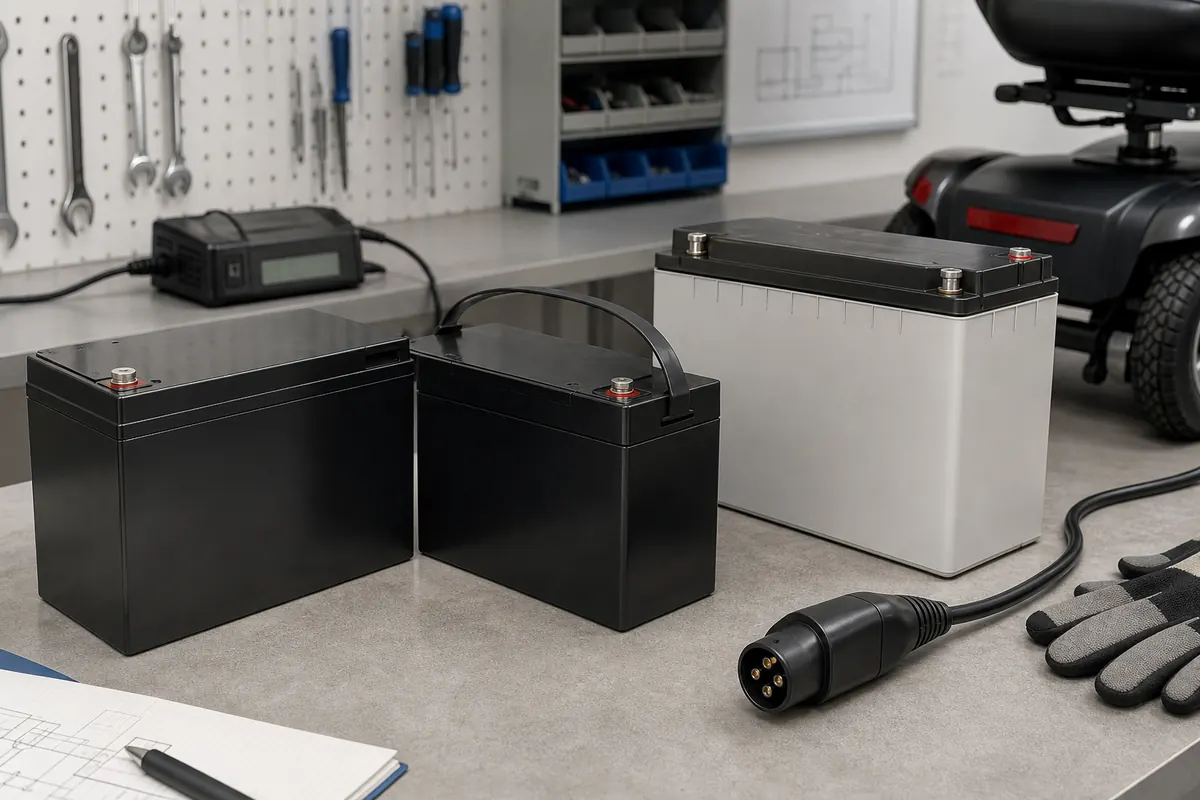
Quick answer: Mobility scooter battery technology is moving toward lighter lithium-ion packs, clearer battery-management electronics, removable modules, and better travel documentation, while sealed lead-acid batteries remain common because they are familiar, widely serviceable, and cost-effective. The best technology is the one approved for the scooter and supported by the correct charger, replacement supply, service network, and travel documents.
Battery headlines often focus on chemistry. For owners, the complete system matters more: cells, enclosure, battery-management system, connectors, charger, scooter controller, mounting, labeling, warranty, and service. A new chemistry is not an upgrade when it is not approved for the device.
The established baseline: sealed lead-acid
Absorbent glass mat (AGM) and gel batteries are types of valve-regulated lead-acid batteries commonly used in mobility equipment. They are heavy compared with many lithium systems, but established supply chains and familiar service procedures can make replacement straightforward.
AGM and gel are not automatically interchangeable. Charging profiles, capacity, dimensions, terminal layout, and manufacturer approval matter. Many scooters use a matched two-battery set; follow the manual rather than mixing ages or types.
Why lithium-ion is more visible
Lithium-ion systems can reduce weight and pack size for a given design target. That supports folding and travel scooters where lifting and storage matter. A properly designed pack also uses a battery-management system to monitor conditions and protect the cells within its design limits.
The tradeoffs include a need for exact charger compatibility, model-specific electronics, clear watt-hour documentation, safe transport procedures, and an available approved replacement. Owners should not replace a lead-acid pack with lithium unless the scooter manufacturer explicitly supports the conversion.
Battery-management systems
A battery-management system, or BMS, can monitor cell voltage, current, and temperature and interrupt operation outside allowed conditions. Its presence does not make a battery indestructible or eliminate the manual’s storage and charging rules. It also means a generic pack with similar voltage may not communicate or behave correctly in a particular scooter.
Better diagnostics can help a technician distinguish battery aging, charger faults, and other system problems. Useful owner-facing design shows clear status without encouraging users to open the pack.
Removable and modular packs
Removable packs can make indoor charging, vehicle loading, and airline preparation easier. A well-designed module has secure latching, protected terminals, an understandable handle, and a readable label. The rider must still be able to lift and carry it safely.
Modularity also creates a documentation responsibility. The scooter model, pack model, chemistry, voltage, amp-hours, watt-hours, and approved charger should be easy to match. A battery that separates from a folding scooter is not automatically airline accepted.
Air travel is shaping documentation
The FAA distinguishes batteries that remain installed and protected from batteries that must be removed and carried in the cabin. For applicable lithium-ion mobility-device batteries, current U.S. guidance uses a 300 Wh limit and specific spare-battery conditions. Review the current FAA PackSafe guidance and contact the operating airline.
This makes a durable, readable battery label and manufacturer travel sheet valuable product features. See our mobility scooter battery airline rules before booking.
Charging technology: compatibility before speed
Charging systems may become smaller, smarter, or more informative, but safe compatibility is the priority. The charger must match the battery chemistry and system requirements. Faster charging can create heat and stress when it is not part of the approved design.
Use the supplied or manufacturer-approved charger, read its indicators, keep required ventilation clear, and stop using damaged equipment. A universal-looking plug is not proof of compatibility.
Range displays and diagnostics
Traditional gauges can be approximate. More sophisticated systems may estimate state of charge and log faults, but no display can predict every route. Hills, temperature, load, tire pressure, battery age, speed, and surface affect actual runtime.
Owners should continue planning with a reserve and recording real performance on familiar routes. Our guide to how long mobility scooter batteries last explains the difference between runtime and service life.
Safety design and physical protection
Technology improvements are not only about cells. A strong enclosure, secure mounting, protected wiring, strain relief, short-circuit protection, thermal management, and clear shutdown instructions are important. The pack should remain protected during normal scooter use and expected transport.
Do not use a swollen, leaking, unusually hot, damaged, or recalled battery. Stop charging and contact the manufacturer, supplier, or qualified service provider.
Serviceability and replacement availability
A battery system is useful only if an approved replacement and qualified service remain available. Before buying, ask how the pack is identified, who can diagnose it, what the warranty covers, how long replacements are expected to be supplied, and how it will be recycled.
Proprietary packs may simplify installation yet limit alternative sources. Standard lead-acid formats may be widely available, but the exact specification and matched set still matter. Compare the full ownership path, not just initial weight or price.
Recycling and end-of-life handling
Lead-acid and lithium-ion batteries require appropriate recycling or hazardous-material handling. Do not place them in household trash. Use the manufacturer, dealer, municipal program, or qualified recycler and follow local requirements. Tape, packaging, and transport instructions can differ by chemistry and condition.
What to compare on a new scooter
| Question | Why it matters |
|---|---|
| What is the exact chemistry and watt-hour rating? | Determines care, replacement, and travel documentation |
| Is the pack designed for user removal? | Affects lifting, charging location, and airline handling |
| Which charger is approved? | Prevents incompatible charging |
| Who diagnoses and replaces the system? | Defines downtime and service access |
| How is the pack labeled and warranted? | Supports identification, claims, and travel |
| What is the storage temperature and procedure? | Protects dependable service during non-use |
Frequently asked questions
Is lithium-ion always better than lead-acid?
No. Lithium may reduce weight, while lead-acid may offer familiar service and lower initial cost. Approved compatibility, route, transport, support, and ownership cost decide the better fit.
Can I convert my scooter to lithium?
Only when the scooter manufacturer explicitly approves the battery, charger, mounting, and electrical configuration. Do not make an informal conversion.
Does a BMS eliminate maintenance?
No. The scooter still needs correct charging, storage, inspection, route planning, and qualified service. Read the maintenance checklist.
Will a new battery restore advertised range?
Not necessarily. Actual range depends on the whole scooter, route, load, tires, temperature, and test conditions.
What is the most useful future improvement?
For many users, clear documentation, dependable diagnostics, safe removable design, long-term replacement supply, and repair access may matter more than a headline chemistry change.
Last reviewed: July 21, 2026. This trend analysis uses current official transportation guidance and general engineering principles; it does not predict unannounced products or guarantee performance.

Questions and reader comments