
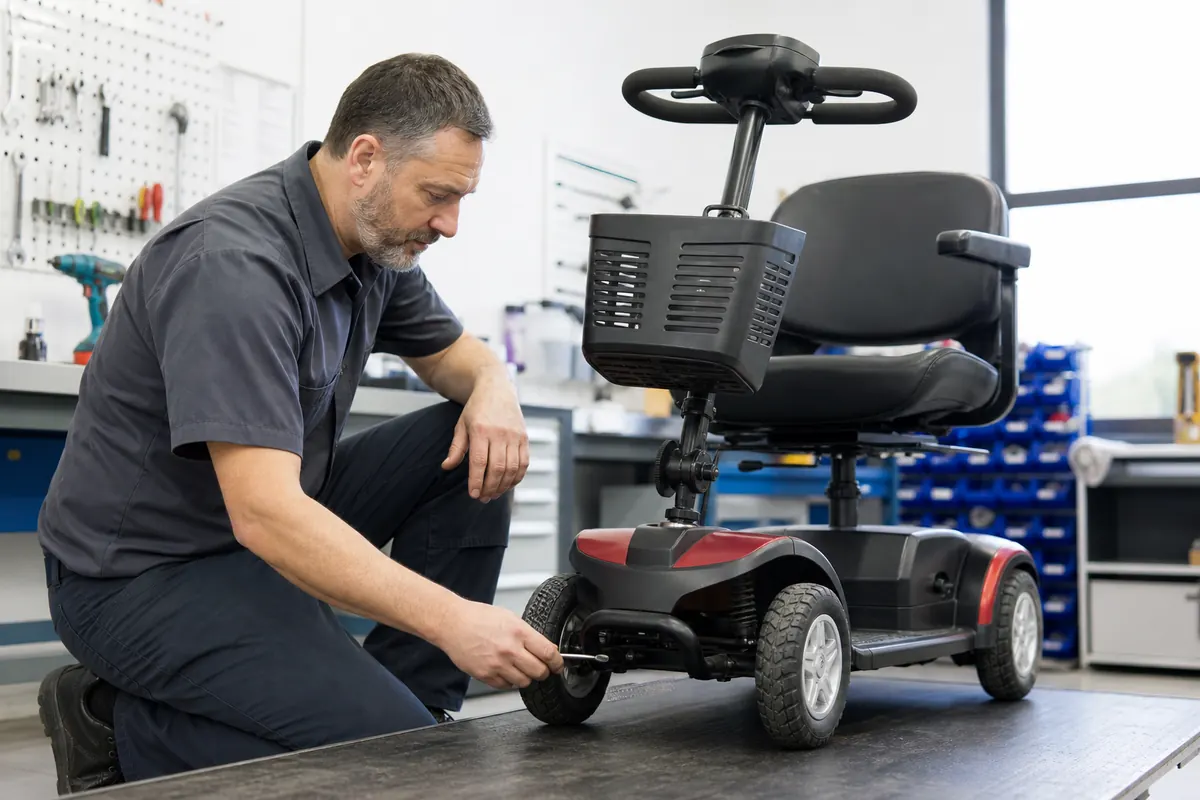
Quick answer: A useful mobility scooter maintenance checklist combines a short pre-ride safety check with scheduled cleaning, tire, battery, control, fastener, and professional service tasks. The owner’s manual is the controlling schedule. Stop using the scooter when steering, braking, controls, tires, structure, battery, or charger appear unsafe.
Regular checks help find changes before they become breakdowns. They do not authorize the owner to open sealed electrical parts, adjust brakes, modify wiring, or exceed the service tasks in the manual. When a procedure is not specifically assigned to the user, use a qualified mobility-equipment technician.
Before every ride: two-minute safety check
- Look around the scooter. Check for loose parts, damage, fluid, unusual odor, or anything caught near the wheels.
- Check tires and wheels. Look for low pressure, cuts, flat spots, embedded objects, loose hardware, or a wheel that does not sit normally.
- Confirm the seat is locked. Verify the seat, armrests, tiller, basket, and approved accessories are secure.
- Place the scooter in drive mode. Follow the manual for the freewheel lever. Never ride in freewheel.
- Check battery indication. Confirm enough charge for the route plus a conservative reserve.
- Test controls at low speed. In a clear area, verify steering, forward, reverse, throttle return, stopping, horn, lights, and indicators.
- Review the route. Consider weather, curb ramps, construction, crowds, slopes, and a safe return path.
Weekly owner checks
Clean high-contact surfaces
With the scooter powered off, wipe the tiller, controls, armrests, seat, and deck using the method approved in the manual. Do not spray liquid into controls, connectors, motors, or charger openings. Avoid solvents that can damage plastics, labels, upholstery, or electrical insulation.
Inspect the charging equipment
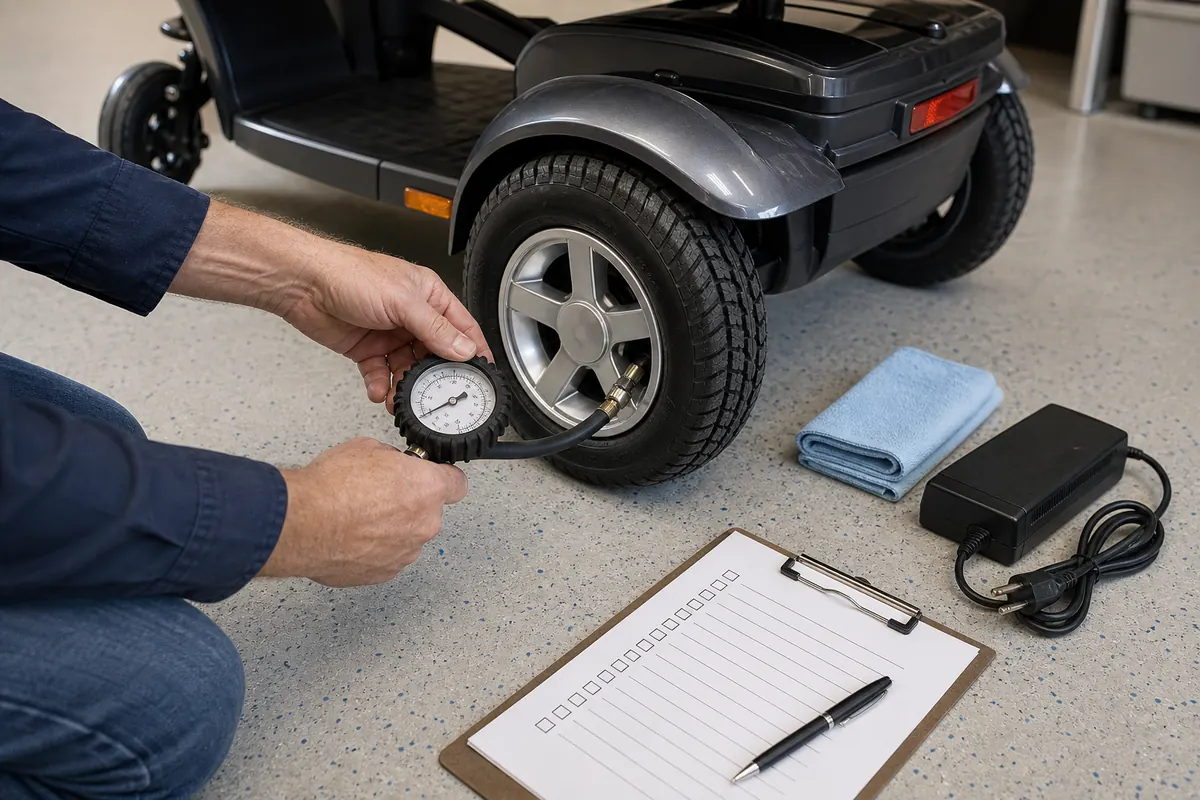
Look for a damaged plug, frayed cable, crushed insulation, loose connector, discoloration, or unusual heat. Stop using damaged charging equipment. Use only the approved charger and plug it into the type of outlet specified by the manufacturer. Do not cover the charger or place it on a surface that blocks required ventilation.
Check pneumatic tire pressure
If the scooter uses pneumatic tires, check pressure when the manual recommends and use the value printed on the tire or scooter documentation. Underinflation can increase rolling resistance and affect range and handling; overinflation can reduce contact and damage components. Solid tires do not require air but still need inspection for cuts, separation, or flat spots.
Observe range and behavior
Note changes in range, acceleration, steering effort, vibration, noise, braking, or control response. A simple trip log makes gradual deterioration easier to recognize. Do not compensate for a new problem by increasing speed or taking a longer run.
Monthly checklist
- Inspect accessible battery connectors for looseness, contamination, or corrosion without opening sealed housings.
- Check that all user-adjustable seat, armrest, mirror, basket, and tiller hardware locks securely.
- Inspect reflectors, lights, and the horn.
- Check anti-tip wheels and visible frame areas for damage or missing parts.
- Inspect upholstery seams and seat-swivel operation.
- Look at wheel tread and caster or fork areas for unusual wear.
- Review the owner’s manual for model-specific lubrication or “do not lubricate” instructions.
- Confirm the manual, serial number, service contact, and emergency plan remain accessible.
Do not tighten unknown fasteners to a guessed torque. A bolt may secure a safety-critical or adjustable component. If the manual does not provide an owner procedure, ask a technician.
Battery maintenance
Battery care begins with identification. Record chemistry, rated voltage, capacity, installation date, approved charger, and replacement specification. Follow the charging instructions supplied with the scooter, charger, and battery. The manufacturer—not a generic internet schedule—defines the correct routine.
Keep batteries and connectors dry and protected. Do not open sealed batteries, bridge terminals, mix old and new batteries, or combine different chemistries or capacities. Many two-battery lead-acid systems require matched replacements.
If the scooter will not be used for an extended period, use the documented storage procedure and temperature range. Schedule reminders so the battery is not forgotten in a depleted state. Read How Long Do Mobility Scooter Batteries Last? for capacity and replacement guidance.
Tire and wheel maintenance
Tires influence steering, braking, comfort, range, and stability. Compare left and right wear, examine the tread and sidewalls, and remove only loose surface debris that can be handled safely. A deeply embedded object may be plugging a puncture; leave it in place and arrange service rather than creating sudden deflation.
Have a technician inspect wobble, repeated pressure loss, cracked wheels, loose bearings, abnormal noise, or uneven wear. Replace tires with the size and type approved for the scooter.
Steering, throttle, and braking
At the beginning of a ride, steering should move predictably without new play, binding, or noise. The throttle should return when released, and the scooter should stop as designed. Test at the lowest practical speed in a clear area.
Stop using the scooter if it moves without a deliberate command, fails to stop predictably, pulls strongly, shows intermittent controls, or has a damaged tiller. Do not open the console or adjust electronic braking without approved training and documentation.
Seat, transfer, and tiller checks
Verify that the seat-swivel latch engages, the seat post is secure, armrests lock, and the tiller adjustment holds its position. A loose seat or tiller can change control reach during movement. Inspect transfer handles and approved supports before relying on them.
Changes in the rider’s posture, strength, grip, vision, or transfer ability may require a new fit assessment even when the scooter itself has not changed. The scooter selection guide includes seated-fit checkpoints.
Frame, shrouds, and anti-tip components
Inspect visible frame sections after an impact, transport incident, or rough trip. Look for cracks, deformation, missing hardware, rubbing, or panels that no longer align. Shrouds protect components but can also hide damage; have a technician inspect after a significant collision or drop.
Anti-tip wheels and stability components are safety equipment. Do not remove or reposition them except through an authorized procedure.
Cleaning after rain or dirt
Mobility scooters are not generally waterproof. If the scooter is unexpectedly exposed to rain, follow the manual, move to shelter, power down when safe, and allow appropriate drying before storage, charging, or reuse. Some manufacturer manuals specifically direct users to dry the scooter thoroughly after exposure.
Use a soft cloth or brush for surface dirt. Avoid pressure washers, hoses, steam, compressed air directed at seals, and liquid cleaners around controls or connectors.
Seasonal maintenance
Before cold weather
- Review battery performance and temperature limits.
- Plan shorter routes with a larger reserve.
- Check tires, lights, reflectors, and weather protection.
- Avoid ice, snow, standing water, and routes outside the manual.
Before hot weather
- Avoid storage in an overheated vehicle or direct sun outside approved limits.
- Inspect tires and battery behavior more often.
- Plan shade, hydration, and emergency communication for the rider.
After long-term storage
- Inspect for damage, pests, moisture, corrosion, and tire changes.
- Charge and test exactly as the manual directs.
- Complete a low-speed functional check before a normal trip.
- Arrange service if the battery or controls behave unexpectedly.
Annual or manufacturer-scheduled service
Arrange professional service at the interval in the manual and sooner when the scooter is heavily used, exposed to demanding conditions, or shows a change. A qualified inspection may include battery load or capacity testing, charger verification, diagnostic codes, motor and transaxle assessment, brake operation, steering, bearings, wiring, structural fasteners, tire wear, and a road test.
Ask for a written service record identifying findings, work performed, replacement parts, and the next interval. Keep invoices with the serial number and warranty documents.
Maintenance after transport
After car, bus, train, or airline transport, inspect the scooter before riding. Check the tiller, seat, frame, wheels, controls, freewheel lever, battery area, and loose accessories. Compare with pre-transport photographs. Report damage promptly and do not operate an unsafe device.
For flights, use the mobility scooter air-travel guide and current airline instructions.
When to stop riding immediately
- Uncommanded movement or unpredictable stopping.
- Steering that binds, wobbles, or has new excessive play.
- A loose seat, tiller, wheel, or structural part.
- A flat, separating, or severely damaged tire.
- Battery swelling, leakage, smoke, unusual heat, or burning odor.
- Damaged charger insulation, plug, or connector.
- Cracked frame, severe impact damage, or exposed wiring.
- A persistent error code or repeated power loss.
Move away from traffic or another immediate hazard if this can be done safely. Power the scooter off, avoid charging a suspect battery, and contact qualified help.
Tasks owners should not improvise
Unless the manufacturer explicitly assigns and documents the procedure for the owner, do not open the controller, motor, transaxle, sealed battery, or charger; bypass a fuse or safety switch; alter speed settings; repair damaged wiring; weld the frame; change tire or battery specifications; or install unapproved seating and carriers.
Printable maintenance schedule
| Interval | Checks | Action |
|---|---|---|
| Before every ride | Tires, seat, tiller, freewheel, charge, controls, route | Do not ride if a safety check fails |
| Weekly | Clean surfaces, charger, tire pressure, range changes | Record changes and arrange service when needed |
| Monthly | Accessible connections, locks, lights, horn, frame, upholstery | Use only manual-approved owner procedures |
| Seasonally | Battery condition, storage, weather preparation, route | Adjust trip planning and complete a controlled test |
| Manual/annual service | Battery test, charger, brakes, steering, drive, structure, diagnostics | Qualified technician and written service record |
Maintenance record template
- Date and odometer, if equipped
- Battery gauge before and after a familiar route
- Tire pressure and visible condition
- New sound, vibration, odor, heat, or error code
- Charging start, finish, and indicator result
- Service provider, work, parts, and next due date
Shared-use and caregiver handoff
When more than one person helps with the scooter, use one written routine. Record where the key, charger, manual, travel sheet, and service information are kept. Show each helper the correct power switch, freewheel lever, charging sequence, approved lifting points, and signs that mean the scooter must not be used.
Do not rely on memory after a hospital stay, long trip, repair, or change in caregiver. Ask the service provider to demonstrate any new part or procedure, and place a concise checklist near the storage area without covering labels or controls. The rider should be included in decisions and training to the greatest extent possible.
If a scooter is used in a residential community, workplace, or day program, identify who performs the pre-ride check, who reports a fault, and who may authorize service. A clear handoff prevents a low battery, freewheel setting, loose seat, or damaged charger from being passed silently to the next person.
Preparing for a service appointment
Bring the scooter, approved charger, key, battery information, serial number, manual, recent maintenance record, and a clear description of the route or condition that produces the problem. Note whether the issue occurs only under load, after charging, on a slope, in cold weather, or after a certain distance. Accurate observations can reduce guesswork without requiring the owner to perform electrical diagnosis.
Battery condition affects reliability between scheduled checks. Use How Long Do Mobility Scooter Batteries Last? to distinguish routine range changes from signs that need qualified testing.
Frequently asked questions
How often should a mobility scooter be serviced?
Use the interval in the owner’s manual. Arrange earlier service after damage, heavy use, demanding conditions, or any change in steering, stopping, controls, tires, battery, or structure.
Can I wash a mobility scooter with a hose?
Generally, no. Water can enter controls, connectors, bearings, or electronics. Use the cleaning method in the manual and avoid pressure washing.
What tire pressure should I use?
Use the pressure stated for the exact scooter and tire. Do not copy a number from another model. Solid tires require condition checks rather than inflation.
Can I lubricate squeaking parts?
Only where the manual specifically directs and with the specified product. Lubricant in brakes, tires, controls, or electrical components can create hazards.
How do I know whether the battery or charger is failing?
Document range, indicators, errors, and charging behavior, then have the system tested. A dashboard gauge alone cannot confirm capacity or charger performance.
What should I carry on a trip?
Carry identification, a charged phone, service contact, route plan, weather-appropriate supplies, and only manufacturer-approved tools or accessories. Do not carry loose metal items near removable battery terminals.
Maintenance begins with choosing equipment suited to the route. Review The Complete Mobility Scooter Buying Guide and Types of Mobility Scooters Explained for that foundation.
Last reviewed: July 21, 2026. This checklist is general education. The scooter, battery, and charger manuals control; electrical, brake, steering, structural, and diagnostic work belongs with a qualified service provider.

Questions and reader comments