
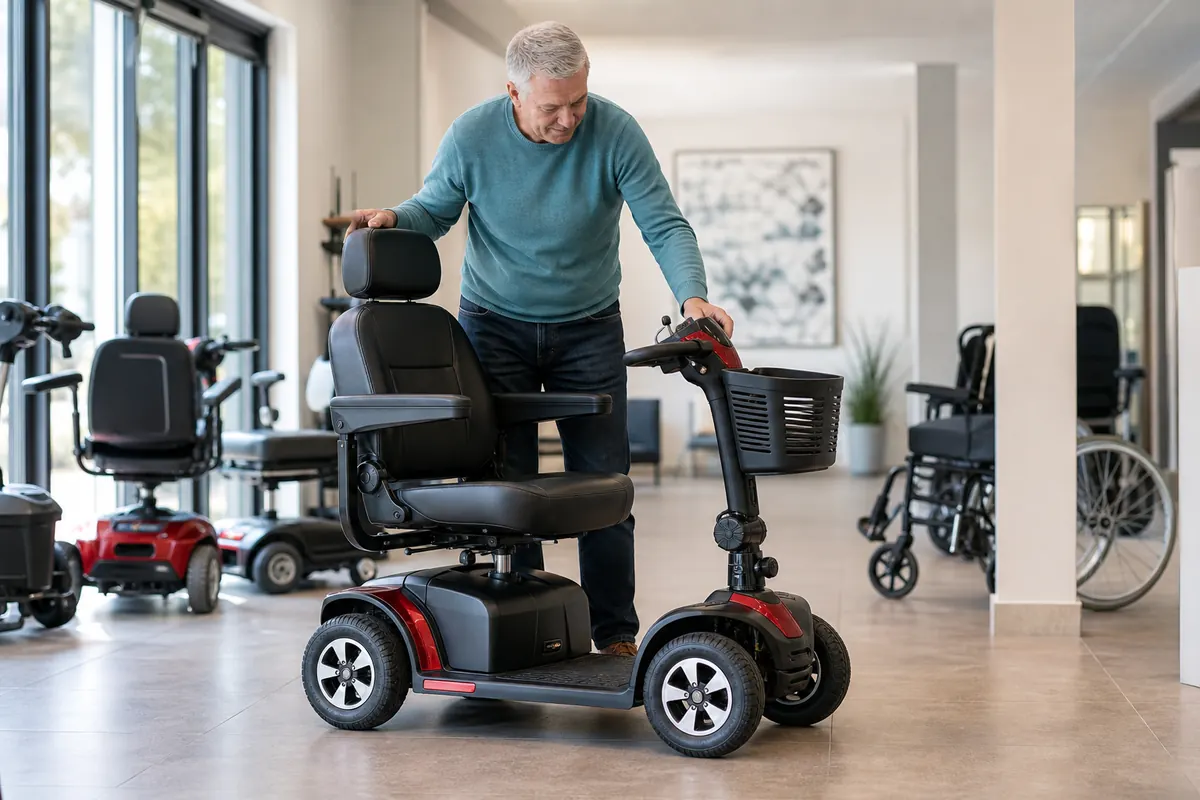
Quick answer: The right mobility scooter is the one that safely fits the rider, the places it will be used, and the way it will be transported and stored. Begin with body fit and weight capacity, then compare turning space, terrain, range, lifting weight, battery type, service support, and total ownership cost. Do not choose from advertised range or appearance alone.
A mobility scooter can make everyday trips more practical, but it is not a one-size-fits-all purchase. This mobility scooter buying guide turns a long specification sheet into a repeatable decision process. It also explains when a scooter may not be the right device, which questions deserve a test drive, and how to avoid common buying mistakes.
Start with the rider, not the model
Write down the rider’s needs before opening product pages. Consider walking tolerance, balance, grip, vision, hearing, judgment, posture, ability to transfer, and ability to operate a tiller. A scooter normally requires the rider to sit upright, steer with both or one hand depending on the controls, and transfer onto a seat. A power wheelchair may be more appropriate when someone needs customized seating, joystick control, or more continuous mobility support. Our mobility scooter vs. power wheelchair comparison explains that distinction.
If a health condition affects safe operation, ask an occupational therapist, physical therapist, physician, or qualified mobility professional for an individual assessment. The goal is not to obtain a diagnosis online. It is to identify practical requirements that a product must meet.
Define the real trips
List three to five trips the scooter must handle: moving through the home, visiting a grocery store, reaching a neighborhood destination, crossing a parking lot, traveling by car, or taking public transportation. For each trip, record:
- the narrowest doorway, aisle, elevator, or turn;
- the steepest grade and any curb cuts or thresholds;
- the surface, including carpet, smooth pavement, broken sidewalks, grass, or gravel;
- the distance, plus a conservative return-trip reserve;
- where the scooter will be charged and stored;
- whether another person must lift, disassemble, or secure it.
This trip map is more useful than a generic label such as “travel” or “heavy duty.” A compact scooter may be easy to load yet uncomfortable on uneven pavement. A larger scooter may feel stable outdoors but be impossible to turn in a small apartment.
Understand the main scooter classes
| Type | Typical strength | Important tradeoff |
|---|---|---|
| Folding or ultra-compact | Storage and short trips | Smaller wheels and a simpler seat can reduce comfort on rough surfaces |
| Travel or disassembling | Vehicle transport in separate pieces | The heaviest piece still may be too much for one person to lift |
| Mid-size | Balanced everyday indoor/outdoor use | Requires more storage and turning room |
| Full-size or outdoor | Comfort, ground clearance, and longer trips | Heavier, wider, and harder to transport |
| Three-wheel | Tighter turning and legroom | Stability depends heavily on design, speed, surface, and rider behavior |
| Four-wheel | A broad, confidence-inspiring footprint | Usually needs a wider turn |
Read Types of Mobility Scooters Explained for a fuller breakdown and 3-Wheel vs. 4-Wheel Mobility Scooters for the wheel-layout decision.
Check body fit in a seated position
A published weight capacity is only one part of fit. Seat width and depth, back support, tiller reach, armrest position, deck space, and transfer height all matter. The rider should be able to sit with stable support, keep feet on the intended platform, reach the controls without leaning forward, and turn the tiller without striking the knees.

Allow a meaningful margin below the stated maximum capacity for the rider plus clothing, oxygen equipment, bags, groceries, and accessories. Never hang heavy items from the tiller or seat unless the manufacturer provides an approved attachment and load limit.
Measure the home and storage route
Measure clear doorway width with the door open, hallway turns, elevator depth, ramp width, threshold height, and the charging location. Compare those measurements with the scooter’s full width, length, and turning radius. Include mirrors, baskets, armrests, and any carrier accessories.
The storage area should be dry, secure, ventilated as the manufacturer directs, and close to an appropriate electrical outlet. Avoid routing a charging cord across a walkway. Charging instructions vary, so use the supplied or approved charger and follow the manual.
Evaluate capacity, stability, and terrain
Capacity should never be treated as a performance target. Choose a model rated for the complete operating load and intended surface. Small wheels and low clearance suit smooth floors but can catch on broken pavement or tall thresholds. Larger pneumatic or well-suspended wheels may improve comfort outdoors, while introducing tire-pressure and maintenance requirements.
Maximum grade figures are often measured under controlled conditions. Real-world safety changes with surface, load, tire condition, battery state, speed, weather, and the direction of travel. Follow the manual, approach approved inclines straight, reduce speed before turns, and do not test limits on public routes.
Range is a planning number, not a promise
Advertised range is normally based on a test protocol. Temperature, battery age, rider and cargo weight, hills, surface resistance, tire pressure, speed, and stop-start use can reduce actual distance. Plan routes with a reserve rather than using every estimated mile. Ask the seller what test conditions produced the stated range.
Confirm battery chemistry, capacity, charging time, replacement availability, warranty, and whether the pack can be removed. If air travel is expected, record the battery’s chemistry and watt-hour rating from the manufacturer documentation. See our mobility scooter battery airline rules before booking.
Transport: weigh every piece
“Portable” does not necessarily mean easy for a particular person to lift. For a disassembling scooter, record the heaviest component—not only total weight. Rehearse the sequence without twisting or reaching into a deep trunk. Check vehicle opening dimensions and remaining cargo room. If a lift or carrier is used, verify vehicle, hitch, lift, and tie-down ratings with the relevant manufacturers and installer.
A folding mobility scooter can simplify storage, but some folding units remain heavy and awkward. A ramp, hoist, or different scooter class may be safer than repeated manual lifting.
Controls, braking, and visibility
During a supervised demonstration, test the key switch, speed control, forward and reverse levers, horn, lights if fitted, battery gauge, and freewheel mechanism. Confirm that the scooter stops predictably when the throttle is released. The rider should be able to reduce speed before turning and understand that a mobility scooter is not a road vehicle.
Visibility features do not create a right to use every roadway. Use pedestrian routes and crossings where permitted, follow local rules, and wear bright or reflective clothing when visibility is poor. The U.S. Department of Justice explains how mobility devices are treated in places covered by the ADA, while individual facilities may use legitimate safety requirements for other power-driven devices. See the ADA mobility devices guidance.
Comfort can change after 20 minutes
A brief showroom lap may hide pressure, vibration, tiller strain, or transfer difficulty. If possible, complete a longer trial over surfaces similar to the intended route. Check seat swivel, armrest movement, adjustability, suspension, noise, and how easily the rider can look behind before reversing. Specialized pressure management should be assessed by an appropriate professional.
Service, parts, and warranty
Before paying, ask who performs warranty work, whether service is available at home, how long batteries and tires are expected to remain available, and which costs are excluded. Get the model, serial number, battery specification, charger model, warranty terms, return policy, and delivery condition in writing.
A low purchase price can become expensive when batteries, shipping, assembly, or service are difficult to obtain. Compare the total cost of the scooter, approved accessories, lift or carrier, replacement batteries, routine maintenance, and insurance.
Medicare and insurance questions
Do not assume a retail scooter will be reimbursed. In the United States, Medicare coverage of power mobility devices depends on detailed eligibility, documentation, supplier, and medical-necessity rules. Begin with a treating practitioner and a Medicare-enrolled supplier rather than buying first and seeking reimbursement later. The CMS power mobility device documentation fact sheet describes the federal documentation framework. Private plans and Medicaid programs have their own requirements.
New, used, and online purchases
Buying new
New equipment usually offers the clearest warranty and battery history. Request a fitted delivery, operating demonstration, written inspection, and serial-number record.
Buying used
Ask for service records, verify ownership and serial information, inspect the frame, seat, tires, controls, charger, and freewheel function, and budget for a professional battery test. Never buy a damaged or recalled product without documented correction. A battery gauge that reaches “full” does not prove useful capacity.
Buying online
Confirm who handles setup, damage claims, returns, and warranty service locally. Measure the packed delivery route and understand whether curbside delivery includes assembly. Avoid sellers who cannot identify the exact model, manual, battery, parts source, or warranty provider.
Delivery-day acceptance checklist
- Match the model and serial number to the invoice.
- Inspect for shipping damage before signing when possible.
- Confirm tire condition and pressure as specified.
- Test steering, throttle, brake response, horn, lights, and battery gauge.
- Locate the freewheel lever and practice the correct position.
- Check seat, armrests, tiller, mirrors, and accessories for secure adjustment.
- Receive the manual, charger, keys, warranty, and service contact.
- Practice starting, stopping, turning, reversing, ramps, and transfers in a controlled area.
Buying red flags
- No readable model or battery documentation.
- Pressure to purchase without measuring the rider or route.
- Claims that range, grade, or capacity cannot be affected by conditions.
- An unapproved charger, damaged cable, swollen pack, corrosion, or improvised wiring.
- No clear return policy, warranty provider, or parts source.
- Air-travel promises without battery chemistry and watt-hour documentation.
A practical decision sequence
Use this order: confirm the rider can operate a scooter; map the real trips; measure fit and access; select an appropriate class; verify capacity and terrain; test controls and comfort; solve storage and transport; review battery and service support; then compare price. Our companion guide, How to Choose the Right Mobility Scooter, provides a shorter worksheet-style process.
Frequently asked questions
What is the most important mobility scooter specification?
No single number decides suitability. Safe rider fit, complete load capacity, control ability, route dimensions, and intended surface must work together.
How much extra range should I plan?
Use a conservative reserve appropriate to the trip and conditions. Do not plan to arrive with an empty battery, and remember that cold, hills, load, battery age, and soft surfaces can reduce range.
Is a four-wheel scooter always safer?
No. Layout is only one factor. Design, center of gravity, speed, turns, grade, load, surface, tires, and rider behavior all affect stability. Follow the specific manual.
Can I charge a scooter overnight?
Follow the manufacturer’s instructions for that scooter and charger. Use an approved charger in a dry, suitable location, keep cords clear, and do not charge visibly damaged equipment.
How often does a scooter need maintenance?
Use the schedule in the owner’s manual. Add a short pre-ride check and arrange service promptly for changes in braking, steering, tires, noise, range, or controls. Our maintenance checklist organizes those tasks.
How to compare dealer quotes fairly
Ask every seller to quote the same configuration. A scooter price can exclude the battery, charger, delivery, assembly, seat option, mirrors, basket, weather cover, or in-home demonstration. Create one written list and require each quote to identify what is included, the exact model number, battery specification, warranty provider, return terms, and estimated delivery method.
Separate required equipment from optional convenience items. A rated vehicle lift, approved oxygen holder, crutch holder, or rear basket can affect weight, length, visibility, and stability. Confirm every accessory with the scooter manufacturer and include it in the complete operating load and transport measurements.
Conduct a home and route trial when possible
A showroom cannot reproduce a narrow apartment turn, sloped driveway, rough curb ramp, or deep vehicle cargo area. Ask whether the dealer offers a supervised home demonstration or return period that permits a genuine fit check. Protect the product and follow the seller’s written trial conditions.
During the trial, use the rider’s normal footwear and carried equipment. Start at low speed, test the narrowest turn, approach approved thresholds straight, verify elevator access, and rehearse storage and charging. If a helper will load the scooter, that person should complete the real sequence. Record what required assistance and what the rider could do independently.
Plan for a breakdown before purchase
Ask how the rider would return home if the scooter stopped several miles away. Identify a service provider, accessible transportation option, emergency contact, and safe waiting location. Keep the model, serial number, insurer details, and dealer number with the scooter. A dependable ownership plan is part of suitability, particularly when the device supports essential daily activities.
Review the maintenance checklist with anyone who assists the rider. A short pre-ride inspection and early response to steering, braking, tire, control, or battery changes can prevent a minor problem from becoming a roadside failure.
Evaluate accessories as part of the system
Only use accessories approved for the exact model and installed as directed. A canopy can catch wind; a rear bag can shift weight; a cup holder can interfere with controls; a cushion can raise the rider and change tiller reach; and a large basket can extend the turning envelope. Recheck dimensions, load, visibility, and transfers after any addition.
Visibility accessories such as lights, reflectors, and flags can help other people notice the rider, but they do not make an unsafe route acceptable. Plan pedestrian routes and obey facility and local rules.
Review the purchase after the first month
After several weeks, compare actual trips with the original use profile. Note range, comfort, transfers, turning, charging, storage, loading, and service questions. Have the dealer correct setup issues within the allowed period. Update emergency contacts and the maintenance record, and retain the invoice, manual, battery documents, serial number, and warranty in one accessible place.
If the rider’s needs or environment change, reassess rather than forcing the original scooter into a new role. A move, vehicle change, new route, reduced control ability, or different seating need can alter suitability even when the scooter remains mechanically sound.
Final purchase checklist
- The rider can transfer, sit, steer, stop, and use every control safely.
- The scooter fits the complete load, narrowest access point, storage area, and vehicle plan.
- The exact route is within the manual’s surface, grade, obstacle, and weather limits.
- The battery, charger, range assumptions, replacement source, and travel documents are understood.
- The dealer has provided written delivery, return, warranty, and service terms.
- A pre-ride routine, breakdown plan, and qualified service contact are in place.
Use this checklist again before any later accessory, route, storage, vehicle, or rider change.
Last reviewed: July 21, 2026. This article is educational and does not replace the scooter manual, a qualified mobility assessment, or instructions from a clinician, airline, or transportation provider.

Questions and reader comments