
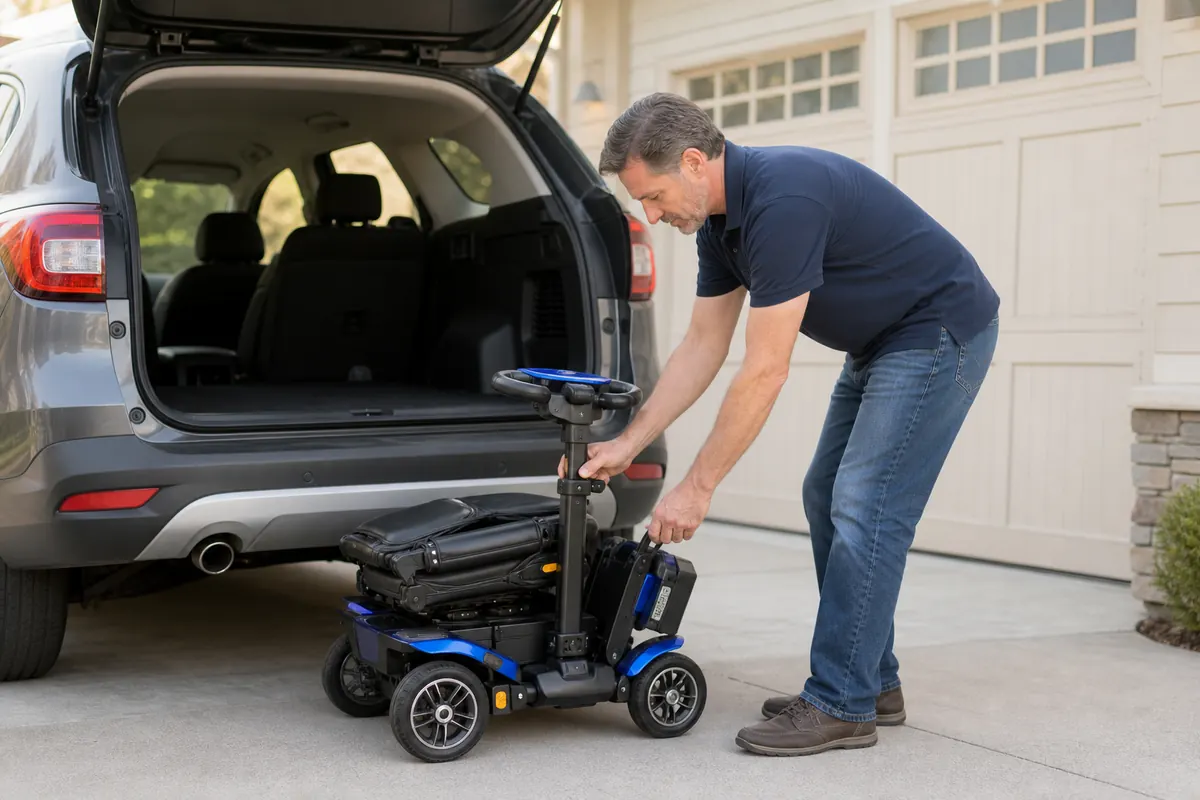
Quick answer: A folding mobility scooter is most useful when compact storage and vehicle transport are priorities and the rider’s routes are mainly smooth and predictable. Its limits can include lifting weight, a smaller seat, small wheels, modest clearance, reduced suspension, and battery documentation requirements for travel.
Folding is a storage mechanism, not a complete statement about portability or suitability. The correct question is whether a specific folded scooter can be safely handled by the people, vehicle, building, and transportation providers involved.
How folding scooters work
Manual folding scooters use hinges, latches, or release levers to collapse the tiller, seat, or frame. Powered folding models use a motor and remote or onboard control. Some products called folding scooters also allow the battery or seat to be removed.
Practice the exact process in person. Verify that every latch produces a clear, secure lock in both the open and folded position. Keep hands, clothing, and cables clear of pinch points and use only the steps in the manufacturer’s manual.
Benefits of a folding design
- A smaller storage footprint in apartments, hotels, and some vehicle cargo areas.
- Fewer separate pieces than a traditional take-apart travel scooter.
- A predictable unit to roll or lift when folded, if the design provides appropriate wheels and handles.
- Potentially simpler short trips on smooth, accessible routes.
These benefits are meaningful only after checking folded dimensions, total weight, balance, and lifting points.
The lifting-weight problem
Some folding scooters are compact but still too heavy for one person. Battery removal may reduce weight, yet the remaining frame can be awkward. Vehicle sill height and trunk depth add strain.
Ask for total weight, battery weight, and weight without removable parts. Then rehearse a lift using the real vehicle and helper. A ramp, hoist, lift, or disassembling model may be a better solution. Do not rely on an advertisement that shows a person lifting a unit without confirming the published weight and your safe ability.
Ride comfort and surface limits
Compact folding scooters often use small wheels, a short wheelbase, simple suspension, and a lightweight seat. Those choices help storage but can transmit vibration and make cracks, thresholds, loose surfaces, and broken pavement more demanding.
Check ground clearance, tire type, approved obstacle height, grade, and water limits in the manual. Test on a representative route with permission. Never treat “travel” styling as an all-terrain rating.
Seat fit and control reach
Verify seat width and depth, back support, armrests, transfer height, foot space, knee clearance, tiller angle, throttle style, and control reach. The rider should not need to lean forward to steer. Add the rider and all carried items when checking capacity.
Some folding seats prioritize low weight rather than long-duration support. A longer test helps reveal pressure, vibration, and posture issues. Do not add unapproved cushions or accessories that interfere with controls or stability.
Manual folding vs. automatic folding
| Feature | Manual folding | Powered folding |
|---|---|---|
| Folding effort | Requires physical release and movement | Motor performs part of the sequence |
| Complexity | Usually simpler | Adds motor, controls, and troubleshooting |
| Use with a depleted battery | Often possible as directed | May require a manual override procedure |
| Weight | Varies | Motorized mechanism may add weight |
Neither is universally better. Select the mechanism the rider or helper can operate reliably, and learn the manual recovery procedure before travel.
Folding vs. disassembling scooters
A folding scooter remains one main unit. A disassembling scooter separates into several pieces. Folding may reduce assembly steps; disassembly may reduce the heaviest individual lift. Compare the heaviest item, total time, connector handling, storage shape, and likelihood of leaving a piece behind.
Our mobility scooter types guide places both options in context.
Car transport checklist
- Measure hatch or door width and height, cargo floor, and sill height.
- Compare folded length, width, and height with mirrors and accessories removed only as allowed.
- Confirm the lifting method and rated equipment.
- Prevent movement in transit using the vehicle and scooter manufacturers’ instructions.
- Protect controls and removable batteries from impact.
- Do not leave a battery or scooter in temperatures outside its stated storage range.
A folding scooter in a cargo area still needs to be managed as heavy equipment. Ask a qualified installer about lifts and securement when needed.
Air travel is a separate decision
A scooter that folds does not automatically qualify as cabin baggage. Airlines consider dimensions, weight, battery chemistry, whether the battery is securely installed or removable, terminal protection, and aircraft limitations. Contact the airline before booking and provide the exact scooter and battery information.
The FAA states that protected installed batteries may remain with a mobility device in certain circumstances, while removable or inadequately protected lithium batteries must be removed, protected from short circuit, and carried in the cabin. Applicable watt-hour limits and spare-battery conditions also matter. Use the current FAA guidance and our plane-travel checklist; the airline makes the operational arrangements.
Battery and charging questions
Get written confirmation of chemistry, voltage, capacity, watt-hours, charger, charging time, removal method, and replacement availability. Watt-hours are typically calculated from rated volts multiplied by amp-hours when the manufacturer does not already state the figure, but use manufacturer documentation for travel whenever possible.
Use only the approved charger and a suitable dry outlet. Inspect cables and connectors. Follow the manual for storage charging; practices differ by chemistry and model.
Best uses for a folding scooter
A folding scooter can be a strong fit for a rider who has adequate seated control, travels mainly on smooth accessible surfaces, values compact storage, has a workable loading method, and can accept a lighter seating system. It can also serve as a secondary travel device when it still meets safety and fit needs.
When another type may be better
- Rough or broken outdoor routes require larger wheels, clearance, or suspension.
- The rider needs extensive seating support or adjustment.
- The folded frame is too heavy or awkward to load.
- Long routine trips require more battery reserve and comfort.
- The building or vehicle can accommodate a mid-size scooter or powered lift.
What to test before buying
- Open and close the scooter three times using the manual.
- Verify every latch and the manual override if powered.
- Measure the folded unit and lift or roll it into the intended vehicle.
- Complete a longer seated trial and representative turn.
- Test starting, stopping, reversing, horn, speed control, and freewheel mode.
- Review battery labels and replacement options.
- Confirm warranty service and return terms.
Frequently asked questions
Can one person lift a folding mobility scooter?
Sometimes, but the answer depends on actual weight, balance, handles, vehicle height, and the person’s safe lifting ability. Test the exact model rather than assuming.
Are folding scooters suitable for daily use?
They can be when fit, range, comfort, surface limits, and service support match daily routes. Compact designs may be less comfortable on long or rough trips.
Do folding scooters have lithium batteries?
Many do, but not all. Confirm the exact chemistry and rating from the label and manufacturer documentation.
Can I gate-check a folding scooter?
Many mobility devices are handled at the aircraft door, but procedures depend on the airline, aircraft, device, and battery. Contact the airline in advance and request return as close to the aircraft door as operationally possible.
Should I choose folding or take-apart?
Compare the heaviest lift, number of steps, storage shape, seated fit, route performance, and service. The better choice is the one the user and helper can manage consistently.
Continue with The Complete Mobility Scooter Buying Guide before making a final purchase.
Hotels, cruises, and public transportation
Before a trip, confirm the folded and open dimensions with the hotel, cruise line, rail operator, bus provider, or transportation service. Ask about accessible entrances, cabin or room storage, charging outlets, prohibited extension cords, tender ports, boarding equipment, securement, and whether the scooter may remain in a corridor. Rules and equipment vary.
Do not assume a scooter can be stored or charged outside the room. Provide the exact battery chemistry and charger information, and keep walkways and emergency routes clear. For a cruise or international itinerary, check every transportation segment rather than relying on one provider’s answer.
Protect the folding mechanism
Inspect latches, hinges, cables, and covers before each trip. Dirt, luggage straps, or loose accessories can interfere with folding. Never force a mechanism that does not move normally. Keep hands away from documented pinch points and verify the open-position lock before sitting.
After transport, check for impact damage and complete a low-speed control test. If a powered folding system stops midway, follow the manual override procedure; do not pull wiring or pry the frame.
Include ownership support in the decision
Ask who services the folding mechanism, electronics, battery, and structural parts. A compact scooter that cannot be repaired locally may create longer downtime than a slightly larger supported model. Compare the maintenance requirements, replacement battery availability, warranty labor, and expected parts supply before ordering.
Last reviewed: July 21, 2026. Specifications and rules change; verify the exact product manual and the current policy of any transportation provider.

Questions and reader comments