
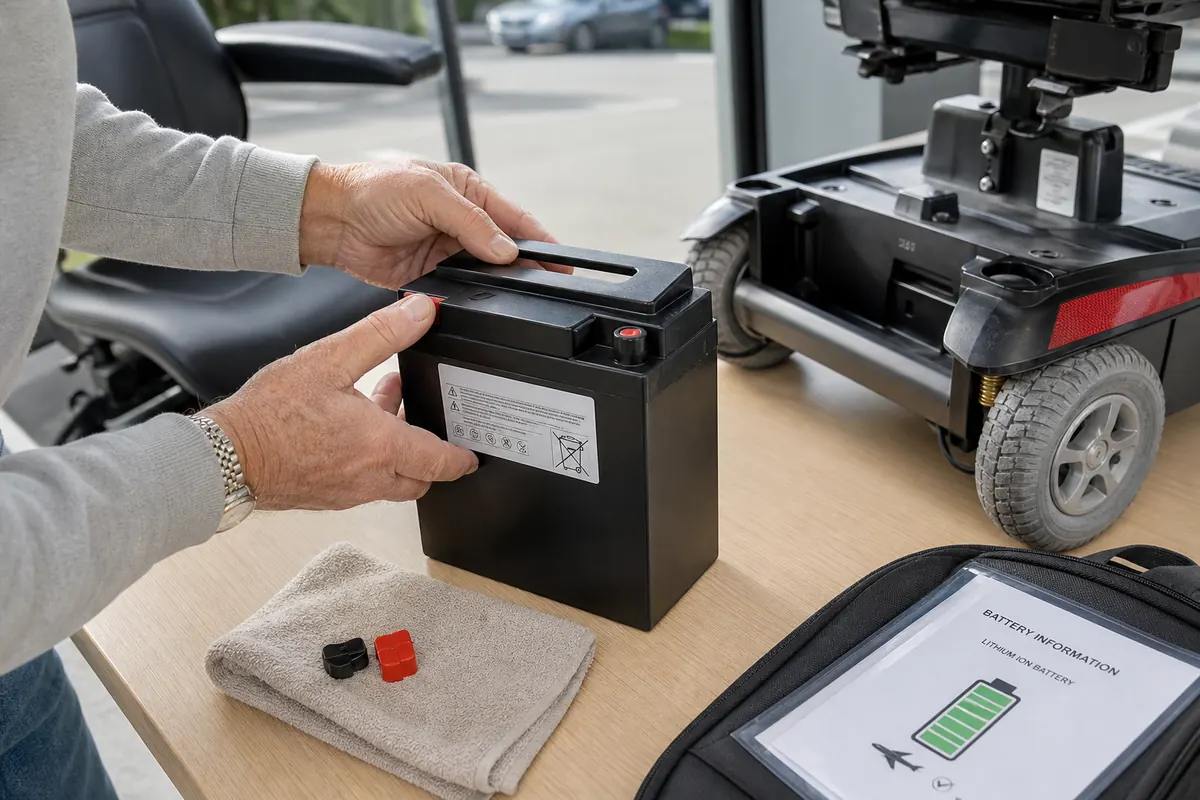
Quick answer: Under current FAA guidance, a lithium-ion battery securely attached to a mobility scooter may remain installed when it is protected against damage and accidental activation. If the scooter is designed for the user to remove the battery, the battery must be removed, protected from short circuit and damage, and carried in the passenger cabin. A removable mobility-device battery may be up to 300 Wh; the spare allowance is one up to 300 Wh or two up to 160 Wh each. Contact the airline before travel.
Mobility scooter battery airline rules are more specific than “lithium batteries cannot fly.” The device design, battery chemistry, watt-hours, installation, terminal protection, condition, airline, aircraft, and route determine what must happen.
Use the FAA source, not a reseller summary
The primary U.S. reference is the FAA’s PackSafe page for wheelchairs and mobility devices. Airline procedures may be more restrictive, and international segments may follow additional national requirements. Recheck both the government source and operating airline before every trip.
Step 1: identify the battery chemistry
Look at the battery label, owner manual, specification sheet, or manufacturer travel letter. Common mobility-device categories include:
- lithium-ion, sometimes abbreviated Li-ion;
- non-spillable wet battery, often sealed lead-acid or AGM/gel when properly marked and qualified;
- spillable wet battery;
- dry-cell or nickel-metal hydride systems in some equipment.
Do not infer chemistry from the charger, connector, battery color, or a marketplace listing. If the label is missing or contradictory, contact the manufacturer or authorized supplier before travel.
Step 2: record watt-hours
Watt-hours describe stored energy for lithium transportation limits. Prefer the number printed on the battery or a manufacturer document. If the label gives rated volts and amp-hours, the mathematical conversion is:
Wh = V × Ah
A 24 V, 12 Ah rating mathematically equals 288 Wh. This example does not certify a particular battery. Airline staff may require a readable label or manufacturer evidence, so a calculation alone may not resolve an undocumented pack.
Step 3: determine whether the battery is designed to be removed
This design question changes the handling of lithium-ion mobility batteries. Some folding and travel scooters use a quick-release pack intended for user removal. Other scooters secure the battery within the device and require tools or service procedures.
Do not remove a securely installed battery merely because it is lithium. Do not leave a user-removable battery installed when the applicable rule and airline require cabin carriage. Follow the manual and airline direction.
Installed lithium-ion batteries
The FAA allows a lithium-ion battery to remain on a wheelchair or mobility aid when it is securely attached and the device and battery are protected from damage and accidental activation. The airline must know how to power the scooter down and handle it. Provide the travel sheet and point out the correct controls, drive/freewheel position, and lifting points.
Protection may involve placing the device upright, disabling the control according to manufacturer instructions, and shielding vulnerable controls during loading. Never improvise by cutting cables or opening the pack.
Removable lithium-ion batteries
When the mobility aid is designed for battery removal, the FAA requires the battery to be removed. The removed battery must be protected from short circuit by insulating exposed terminals, protected from physical damage, and carried in the cabin. The passenger must advise airline staff where it is located.
Use a strong protective pouch or packaging consistent with airline and manufacturer instructions. Keep the battery accessible for inspection without allowing metal objects to contact terminals. Do not place it in checked baggage.
Watt-hour limits for mobility-device batteries
- One removed lithium-ion battery for the mobility device may be rated up to 300 Wh.
- One spare battery may be rated up to 300 Wh.
- Alternatively, two spare batteries may be carried if each is rated no more than 160 Wh.
These conditions do not guarantee acceptance on every flight. The airline considers aircraft stowage, battery protection, route, and operational constraints. Confirm approval and retain the response.
Non-spillable batteries
Non-spillable batteries may remain attached when securely installed and protected from damage, short circuit, and accidental activation under the applicable FAA conditions. The battery should bear appropriate non-spillable identification or otherwise satisfy testing requirements. Airline staff may need to disconnect or remove it if the device cannot be loaded and secured upright or protection is inadequate.
Because markings and handling matter, bring the manual or manufacturer statement. Do not call a battery “sealed” without documentation.
Spillable batteries
Spillable wet batteries require careful upright handling and additional packaging conditions. When a device cannot be loaded, stowed, secured, and unloaded upright, removal and strong leakproof packaging may be required under the hazardous-material rules. This work belongs with trained airline personnel following the current rule, not an improvised passenger procedure.
Tell the airline early if the scooter uses a spillable battery so the appropriate equipment and time can be arranged.
Damaged, defective, or recalled batteries
Do not travel with a battery that is swollen, leaking, excessively hot, physically damaged, producing unusual odor, or subject to an unresolved safety recall. The FAA prohibits damaged or recalled lithium batteries when they are likely to produce dangerous heat, fire, or short circuit. Stop using the device and contact the manufacturer, supplier, or qualified service provider for safe instructions.
Do not mail, discard, puncture, open, or attempt to repair a suspect battery without appropriate guidance.
Terminal and short-circuit protection
A short circuit can occur when conductive material bridges exposed terminals. For a removed battery, use the manufacturer cap, terminal cover, nonconductive tape as permitted, or separate protective packaging. Keep tools, keys, coins, and metal accessories away.
Protection must not conceal required markings or damage the connector. Ask the airline how it wants the pack presented for inspection.
Prevent accidental activation
Power off the scooter and remove the key. Use the manufacturer-approved transport or control-lock procedure if available. Tell staff how the throttle works and which parts are delicate. Do not use a method that disables braking, damages electronics, or prevents correct unloading.
Freewheel mode affects how a scooter moves when unpowered. Provide simple instructions for switching between freewheel and drive; confirm the scooter is returned to drive mode before normal use.
Build a battery document set
- Photograph the full label in focus.
- Save the model’s battery specification and relevant manual pages.
- Record chemistry, voltage, amp-hours, watt-hours, quantity, and removal design.
- Note the approved charger and manufacturer contact.
- Keep the airline’s written acknowledgment with the itinerary.
A laminated copy can travel on the scooter, while the original and digital copy remain with the traveler.
Ask the airline these exact questions
- Do you accept this scooter and battery on each operating aircraft?
- Should the battery remain installed or be removed?
- What terminal protection or battery bag is required?
- Where will a removed battery be stowed in the cabin?
- How should the scooter be disabled and placed in drive/freewheel?
- What documentation should be presented at check-in?
- How are connections and aircraft changes handled?
Common myths
“All lithium scooter batteries are banned.”
False. The FAA provides conditions for installed and removable lithium-ion mobility-device batteries.
“Anything under 300 Wh can go in checked baggage.”
False. A removed lithium mobility-device battery must be carried in the cabin under the FAA conditions.
“If the scooter folds, it goes in the cabin.”
Not necessarily. Device dimensions and aircraft storage differ, and the scooter itself is commonly handled as an assistive device for cargo stowage.
“The charger label proves the battery rating.”
No. Charger output is not the same as battery energy. Use the battery label or manufacturer document.
“Airline approval once applies forever.”
No. Policies, aircraft, routes, and equipment can change. Reconfirm each itinerary.
Day-of-travel battery checklist
- Battery is identified, undamaged, and not subject to an unresolved recall.
- Labels and documents are readable.
- Installed battery is secure; removable battery can be handled as agreed.
- Terminals and controls are protected.
- Keys, removable control components, and documentation are in carry-on baggage.
- Airline staff know the correct power and freewheel procedures.
- Pre-handoff photographs are saved.
Frequently asked questions
Can a 300 Wh scooter battery be carried on?
A removed lithium-ion mobility-device battery may be up to 300 Wh under FAA conditions and must be carried in the cabin. Airline approval and other conditions still apply.
Can I bring a spare?
The FAA states that one spare up to 300 Wh or two spares up to 160 Wh each may be carried for a mobility device, subject to protection and airline notification.
What if the label says only volts and amp-hours?
Calculate volts times amp-hours for a preliminary watt-hour figure, then request manufacturer documentation. Do not rely on a guess at the airport.
Can staff disconnect my battery?
Handling depends on battery type, device design, protection, and loading conditions. Provide instructions and discuss the procedure with the airline in advance.
Do these rules apply worldwide?
No single article covers every jurisdiction. FAA rules apply to relevant U.S. air transportation. Check every operating carrier and national authority on the itinerary.
Use the complete mobility scooter plane-travel guide for booking, airport assistance, handoff, and damage documentation.
A practical battery-handling decision sequence
- Identify chemistry from the battery label and manufacturer document.
- Record watt-hours and the number of installed and spare batteries.
- Determine whether the scooter provides adequate installed protection or is designed for user removal.
- Send the information to every operating airline.
- Follow the agreed terminal, packaging, cabin, and device-disable procedure.
- Reconfirm after an aircraft, airline, or itinerary change.
This sequence does not replace the rule or airline decision. It ensures the information needed for that decision is available before the airport.
International and connecting-flight differences
FAA requirements apply to relevant U.S. air transportation. Other national authorities and airlines may use additional documentation, notice, packaging, or approval procedures. A connection can place the battery under more than one operating carrier’s process. Obtain written answers for every segment.
Do not assume an IATA reference, travel-agent statement, or prior approval automatically settles a current itinerary. The carrier remains responsible for operational acceptance under applicable rules.
Keep battery care and travel preparation connected
An airline document does not make a damaged battery safe. Track performance, inspect the case and connections, use the approved charger, and arrange testing when range changes. See How Long Do Mobility Scooter Batteries Last? and the maintenance checklist.
For the full passenger journey—including booking, gate use, assistance, connections, arrival inspection, and damage reporting—use Can You Take a Mobility Scooter on a Plane?.
Last reviewed: July 21, 2026. Airline, aircraft, and hazardous-material requirements can change. Confirm the current procedure with the operating airline before every trip.

Questions and reader comments