
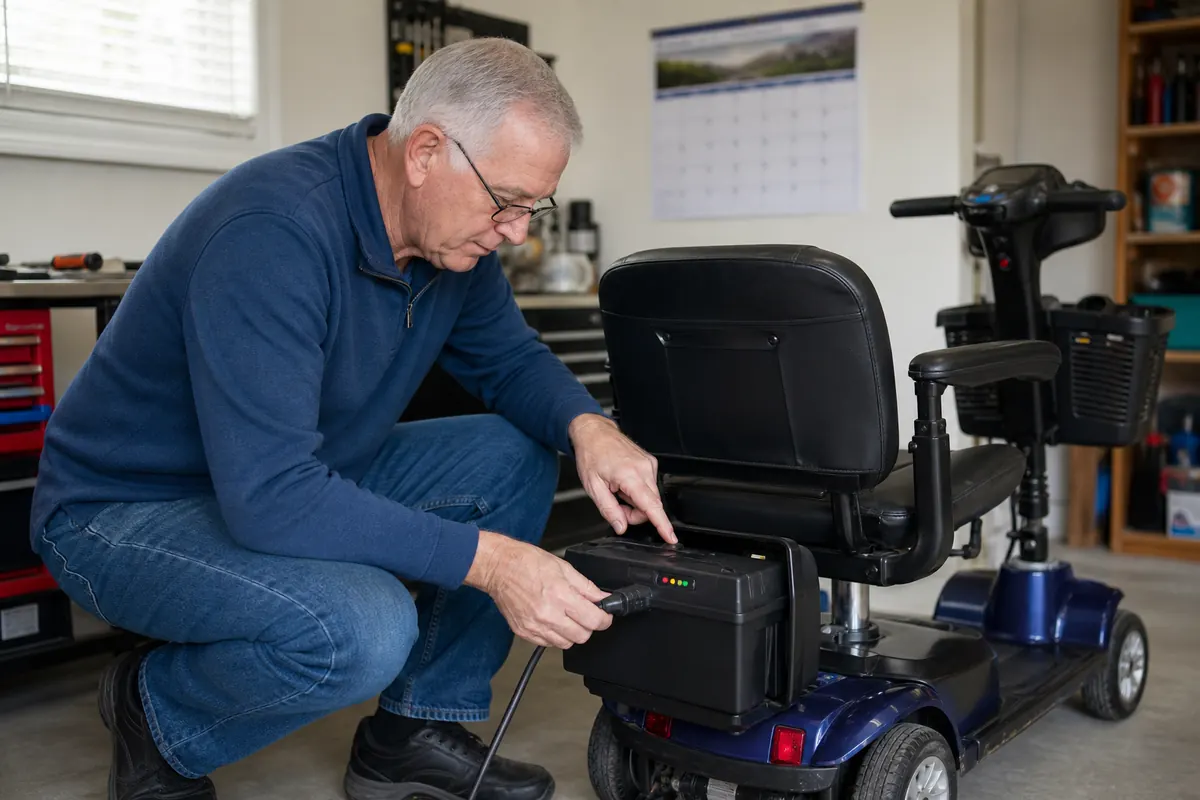
Quick answer: There is no single guaranteed lifespan for a mobility scooter battery. A battery may provide useful service for months or years depending on its chemistry, quality, charging routine, depth of discharge, temperature, scooter load, storage, and condition. The practical replacement point is when tested capacity or dependable trip range no longer meets the rider’s needs—not a date printed in a generic chart.
Battery life has two meanings. Runtime is how far or how long the scooter can travel on one charge. Service life is how long the battery remains useful before replacement. Keeping those questions separate prevents a short trip, an old battery, and a charging fault from being treated as the same problem.
Why battery-life estimates vary
Manufacturers test range under defined conditions. Real trips introduce hills, starts and stops, wind, surface resistance, rider and cargo weight, tire condition, temperature, accessory use, and battery age. Two riders using identical scooters can therefore see different runtime.
Service life also varies because every discharge and recharge is part of a battery’s operating history. Frequent deep discharges, long periods in a depleted state, unsuitable charging, excessive heat, freezing conditions, vibration, corrosion, or an incorrect replacement pack can shorten useful life. A well-maintained battery can still wear out normally.
Common mobility scooter battery types
| Battery type | Common characteristics | Care priority |
|---|---|---|
| AGM sealed lead-acid | Widely used, relatively heavy, generally maintenance-free internally | Use the approved charger and avoid leaving it discharged |
| Gel sealed lead-acid | Sealed design with charging requirements matched to the battery | Do not substitute an incompatible charger |
| Lithium-ion | Lower weight for comparable stored energy in many designs; may be removable | Follow the exact battery-management, storage, and travel instructions |
These are broad categories, not interchangeable parts. Voltage, capacity, physical size, connector, controller compatibility, charger profile, battery-management electronics, and manufacturer approval all matter. Never replace a battery solely because it appears to fit.
What most affects useful battery life
Charging routine
Follow the scooter and charger manuals. Many scooter manuals tell daily users to recharge after use, but the exact sequence, indicator behavior, and storage routine depend on the product. Use only the charger specified or approved for the scooter and battery. The current Pride battery charger safety manual, for example, directs users to read the charger, battery, and product instructions together.
Do not assume that any charger with the same plug is safe. A connector can match while the voltage, current, polarity, or charging profile does not.
Depth of discharge
Repeatedly running a scooter until it can barely move can be harder on many batteries than routine partial use followed by appropriate charging. It also leaves no reserve for a detour, cold weather, or a hill. Plan trips conservatively and recharge as the manual directs.
Temperature
Heat can accelerate battery aging, while cold can temporarily reduce available performance. Storage and charging temperature limits vary. Keep the scooter and battery within the manufacturer’s stated range and avoid an unconditioned vehicle, shed, or garage when temperatures exceed those limits.
Load and terrain
Higher total load, steep routes, soft ground, low tire pressure, and frequent acceleration demand more energy. Calculate the complete operating load, including the rider, clothing, bags, oxygen equipment, and accessories. Use the mobility scooter buying guide to match capacity and terrain before relying on a range estimate.
Storage
A scooter stored for weeks or months still needs the manual’s battery routine. Some chargers or batteries are designed for a particular maintenance approach; others must be disconnected or charged on a schedule. Do not invent a universal storage cycle. Record the manufacturer’s instruction and set a reminder.
Battery age and balance
A scooter that uses a matched pair of lead-acid batteries generally needs both batteries evaluated together. Replacing only one may create an imbalanced set. Many manufacturers instruct owners to replace the pair at the same time with batteries of the same type and rating. Confirm the rule for the exact scooter.
Signs that a battery needs attention
- Useful range has fallen consistently on comparable routes.
- The battery gauge drops quickly under a normal load.
- The scooter slows sooner than usual on an approved incline.
- Charging takes much longer or ends much sooner than the normal documented pattern.
- The charger reports a fault that remains after following the manual.
- Connections show looseness or corrosion.
- The case is swollen, cracked, leaking, unusually hot, or has an unusual odor.
A visible defect, leakage, swelling, abnormal heat, or burning odor is not a cue for another test ride. Stop using and charging the equipment, move away from immediate hazards if this can be done safely, and contact the manufacturer, supplier, or qualified service provider. Do not open or puncture a battery case.
Rule out other causes of lost range
A declining trip range does not prove battery failure. Check the items that the owner manual assigns to the user:
- Confirm that the charger completed its normal cycle and that the outlet works.
- Inspect charger and battery connectors without opening electrical housings.
- Check pneumatic tire pressure against the scooter label or manual.
- Confirm the freewheel lever is in the correct drive position.
- Compare the route, load, temperature, and surface with earlier trips.
- Note any new noise, drag, brake behavior, or steering problem.
If the cause is not obvious or the scooter behaves abnormally, arrange qualified service. Our mobility scooter maintenance checklist separates owner checks from technician work.
How a technician evaluates batteries
A service provider may inspect connections, charger operation, open-circuit voltage, voltage under load, error codes, and measured capacity using procedures appropriate to the system. A simple dashboard gauge or unloaded voltage reading cannot always show how the battery performs during a real load.
Ask for the test result, not only a verbal statement that the battery is “good.” Useful documentation identifies the battery model, date, test method, measured result, and whether the charger or scooter contributed to the complaint.
When replacement makes sense
Consider replacement when a qualified test shows inadequate capacity, the battery cannot complete the rider’s necessary trips with a conservative reserve, it has a confirmed fault, or the manufacturer directs replacement because of damage or recall. Do not wait for a vulnerable rider to become stranded on a critical trip.
Order the exact approved battery or matched set. Verify chemistry, voltage, capacity, dimensions, terminal arrangement, connector, charger compatibility, and any battery-management requirements. Ask how the old battery will be recycled under local rules.
Battery practices that support dependable service
- Read the scooter and charger manuals before the first charge.
- Use the approved charger in a dry, suitable location.
- Keep charging cords out of walkways and away from damage.
- Recharge on the schedule stated for the exact battery and use pattern.
- Keep tires at the specified pressure when pneumatic tires are fitted.
- Avoid loads, slopes, surfaces, and weather outside the scooter’s limits.
- Record installation dates, service, unusual range changes, and error codes.
- Follow the documented storage procedure during periods of non-use.
Planning trips as the battery ages
Use recent real-world performance on a familiar route, not the original advertised range. Maintain a reserve, consider weather and hills, and have a communication and backup-mobility plan. When dependable range begins to approach the length of an essential trip, schedule testing before the situation becomes urgent.
Air travel and battery age
Airline acceptance depends on battery type, design, condition, protection, documentation, and current rules—not simply age. Damaged, defective, or recalled batteries can be prohibited. Before flying, review the mobility scooter battery airline rules and contact the operating airline.
Use a documented battery plan
For longer storage periods, follow the model-specific routine in How to Store a Mobility Scooter and Protect Its Battery. If lower range may be caused by tires rather than battery capacity, review mobility scooter tire pressure, wear, and replacement basics before assuming that a replacement battery is needed.
Frequently asked questions
How many years should a mobility scooter battery last?
No fixed number applies to every battery. Chemistry, cycling, temperature, load, charging, storage, quality, and scooter condition determine useful service. Evaluate documented performance and test results.
Should I charge after every trip?
Follow the exact scooter and charger manuals. Many manufacturers recommend charging after daily use, but the correct routine depends on the product.
Can I use a higher-capacity replacement?
Only when the scooter manufacturer or qualified supplier confirms compatibility. Physical fit alone does not establish safe electrical, charger, controller, weight, or travel compatibility.
Why does the gauge show full but the scooter has little range?
A gauge may reflect voltage rather than tested capacity. An aging battery can reach charging voltage yet drop under load. Tires, brakes, connections, charger operation, route, and temperature can also contribute.
Can I replace one battery in a two-battery set?
Many systems require a matched pair and recommend replacing both together. Follow the exact manufacturer instruction and have the set evaluated.
What battery technology is best?
There is no universal winner. Weight, cost, charger compatibility, service, travel, temperature, capacity, and the scooter’s approved design all matter. See Mobility Scooter Battery Technology Trends.
Last reviewed: July 21, 2026. This article provides general education. Follow the current scooter, battery, and charger manuals and use a qualified service provider for diagnosis or electrical work.

Questions and reader comments