
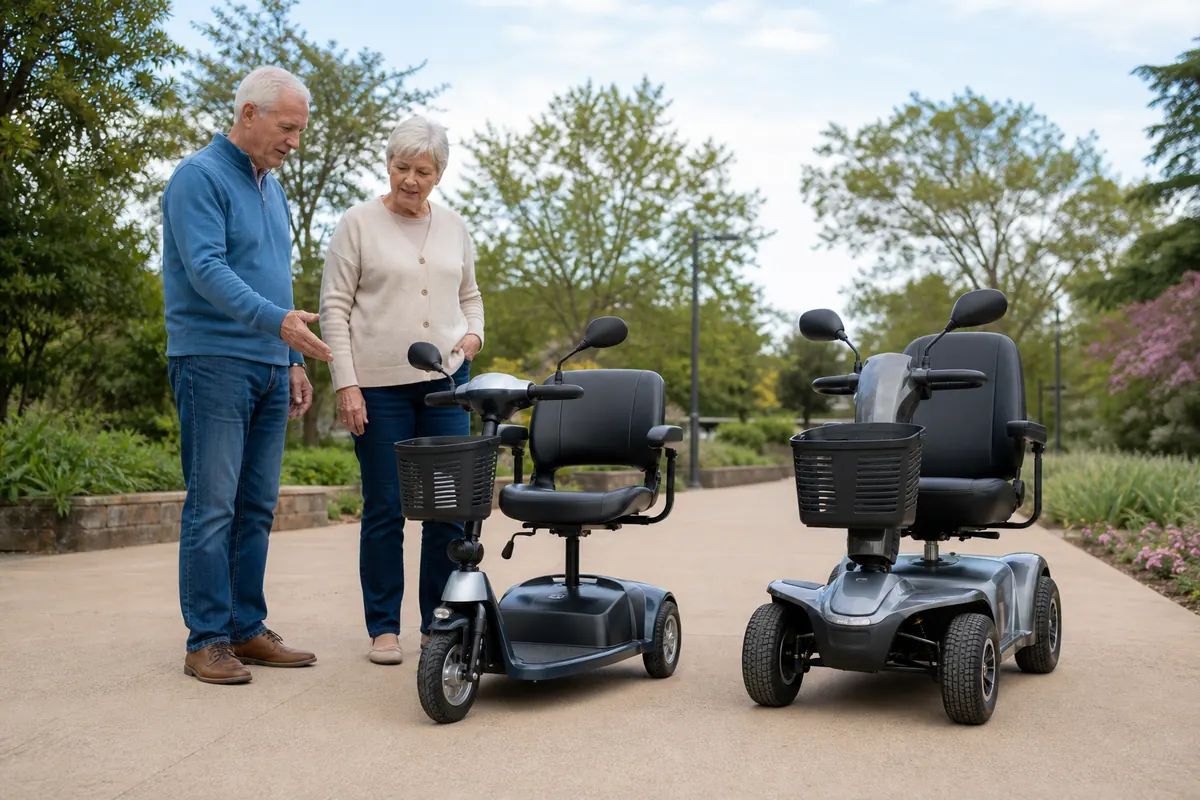
Quick answer: A three-wheel mobility scooter often offers a tighter turning circle and more open leg space, while a four-wheel scooter often offers a broad footprint and familiar outdoor tracking. Neither layout is automatically best or safe in every situation. Fit, speed, center of gravity, surface, slope, tires, load, and rider behavior matter as much as wheel count.
The correct 3-wheel vs. 4-wheel mobility scooter choice begins with the route and rider. Compare exact measurements and complete a supervised test rather than choosing from the number of wheels alone.
Key differences at a glance
| Question | 3-wheel scooter | 4-wheel scooter |
|---|---|---|
| Turning | Often tighter | Often wider |
| Foot and knee space | Often more open around the tiller | Front wheel structure may use more space |
| Outdoor feel | Depends heavily on model and route | Broad front footprint may feel familiar |
| Indoor access | Can suit tight aisles and turns | Requires careful turn measurement |
| Transport | Determined by size and construction | Determined by size and construction |
| Stability | Depends on complete design, load, speed, surface, grade, tires, and operation | |
Turning space
Three-wheel scooters commonly pivot in a smaller area because of the single front wheel assembly. That can help in an apartment, elevator, store, or restaurant. Published turning radius is only a starting point: a real turn also needs approach room, knee clearance, basket clearance, and space for the scooter’s rear to swing.
Four-wheel scooters can require a multi-point turn in the same space. Measure the narrowest route and tape the scooter’s dimensions on the floor. Test the model at low speed in an area similar to normal use.
Stability: avoid simple claims
It is reasonable to notice that two front contact points create a different footprint from one. It is not accurate to say every four-wheel scooter is stable on every surface or every three-wheel scooter is unsafe. Stability changes with wheelbase, track width, center of gravity, seat position, load, tires, suspension, speed, steering input, slope, and obstacles.
Many incidents begin when a rider turns too quickly, travels diagonally across a slope, hits a curb or hole, carries an unapproved load, or uses a surface outside the manual. Slow before turns, approach approved inclines straight, keep feet and cargo in their intended positions, and never test the tipping point.
Legroom and control reach
The open front of many three-wheel models can help a tall rider or someone who needs more knee space. It can also simplify a particular transfer. Four-wheel models may have bodywork or wheel arches that affect the feet and knees.
Fit cannot be predicted from layout. Sit on the exact scooter and check seat width and depth, tiller adjustment, throttle reach, armrests, foot platform, transfer height, and the ability to look behind before reversing.
Indoor use
A compact three-wheel model can be practical where tight turns dominate. However, overall length, width, minimum speed, control response, and rear overhang also matter. A short four-wheel scooter may fit better than a long three-wheel scooter.
Measure doors with the door open, elevator openings, hallway corners, kitchen islands, bedside approaches, tables, thresholds, and the storage location. Avoid routing the charging cable across walkways.
Outdoor use
Outdoor routes introduce cracks, curb ramps, cross slopes, drainage grates, wet leaves, gravel, and traffic exposure. Choose a model approved for the intended surfaces with suitable tires, clearance, lighting, and battery reserve. Wheel count does not turn a compact travel scooter into an off-road vehicle.
Plan a pedestrian route and avoid roads that are not safe or permitted. Local rules differ. The U.S. Department of Justice mobility-device guidance explains access principles in ADA-covered facilities, while transportation and traffic rules may impose additional requirements.
Ramps and slopes
Use only grades, surfaces, and procedures allowed by the specific manual. A ramp can include a turn, edge, threshold, wet patch, or cross slope that makes the real situation more demanding than a maximum-grade number. The rider’s load, battery state, tire condition, and speed also affect performance.
Do not travel sideways across a slope, turn sharply on a grade, or descend faster than the manual allows. If the normal route exceeds the product’s limits, change the route or choose another solution.
Ride comfort
Comfort is driven more by tires, suspension, wheelbase, seat, posture, and surface than by wheel count alone. Small solid tires can feel harsh even on a four-wheel model. A well-fitted three-wheel mid-size scooter may be more comfortable than an ill-fitted four-wheel travel model.
Complete a longer trial. Check vibration through the seat and tiller, pressure, posture, arm position, control effort, and the rider’s ability to maintain a stable position during stops and turns.
Transport and storage
Three-wheel does not necessarily mean lighter. Compare total weight, heaviest disassembled piece, folded dimensions, battery removal, and loading points. Measure the vehicle opening and cargo space. If a carrier or lift is needed, verify vehicle, hitch, lift, and scooter ratings.
In storage, allow room to transfer, position the tiller, connect the charger, and avoid fire or trip hazards. Follow the manufacturer’s temperature and charging instructions.
Capacity and cargo
Use the complete operating load: rider, clothing, medical equipment, bags, groceries, and accessories. Keep within the stated capacity with a sensible margin. Do not hang heavy bags from the tiller or seat unless an approved accessory and load limit are provided; moving weight can affect steering and balance.
Which layout is better for a tall rider?
Three-wheel designs often provide more open knee space, but seat-to-tiller distance and deck length vary. A tall rider should test both layouts while wearing normal footwear and carrying usual equipment. Do not assume a high-capacity scooter automatically provides long legroom.
Which is better for a first-time rider?
Choose by safe fit, route, control response, and training, not experience level alone. A first-time rider may value a low, predictable minimum speed, clear controls, mirrors, a horn, suitable lighting, and a structured practice session. Training should include turns, stops, reversing, ramps, obstacles, transfers, parking, and freewheel mode.
A route-based decision
Choose a three-wheel model to investigate when:
- the tightest turn is the main constraint;
- the rider benefits from open knee or foot space;
- the intended route is smooth and within the exact model’s limits;
- a test confirms stable fit and confident low-speed control.
Choose a four-wheel model to investigate when:
- the rider prefers the tracking and footprint of the exact model;
- there is adequate turning and storage space;
- outdoor routes are important and the model is designed for them;
- transport and access measurements still work.
Test-drive checklist
- Adjust the seat, armrests, and tiller for the rider.
- Check foot position and knee clearance through a full turn.
- Start at the lowest speed and practice stopping.
- Complete left and right turns in the measured space.
- Reverse and check mirror or shoulder-view ability.
- Cross only representative obstacles approved for the model.
- Repeat the vehicle loading or storage sequence.
- Review the manual, battery, service, and warranty.
Frequently asked questions
Is a 4-wheel mobility scooter safer than a 3-wheel scooter?
Not in every situation. A four-wheel footprint is different, but safe use depends on the whole design, rider, load, route, speed, surface, tires, and instructions.
Can a 3-wheel scooter be used outdoors?
Yes when the exact model is approved for the intended outdoor route and the rider operates within its limits. Avoid assuming all three-wheel travel scooters suit rough surfaces.
Which turns tighter?
Three-wheel models often do, but compare published turning radius and a real test. Overall length and rear swing can change practical maneuverability.
Does wheel count affect range?
It is not a useful predictor by itself. Battery capacity, motor, controller, load, tires, route, speed, temperature, and testing conditions matter more.
What if both layouts fit?
Compare comfort, low-speed control, service, transport, route performance, battery support, and the rider’s confidence after a longer test.
Next, review the types of mobility scooters and the full buying guide.
Compare exact models, not wheel counts
Make a two-column sheet with overall width and length, turning radius, wheelbase, seat and tiller adjustment, tire type, clearance, complete capacity, battery, heaviest transport piece, and approved terrain. A compact four-wheel scooter may turn more tightly than a large three-wheel model, while a well-fitted three-wheel scooter may feel more controllable than a poorly fitted four-wheel model.
Ask the rider to repeat the same route and maneuvers at the same low speed. Include a stop before each turn and verify that feet, knees, and cargo remain in their intended positions. Record confidence, effort, and any need for assistance.
Maintain the stability the design provides
Correct tire pressure, secure seating, approved accessories, sound steering, and a conservative load all support predictable handling. A worn tire, loose seat, heavy rear bag, or raised unapproved cushion can change behavior on either layout. Use the maintenance checklist and stop riding when controls, steering, tires, or structure change.
Last reviewed: July 21, 2026. This comparison is educational. Evaluate the exact device, user, environment, and current manufacturer instructions.


Questions and reader comments