
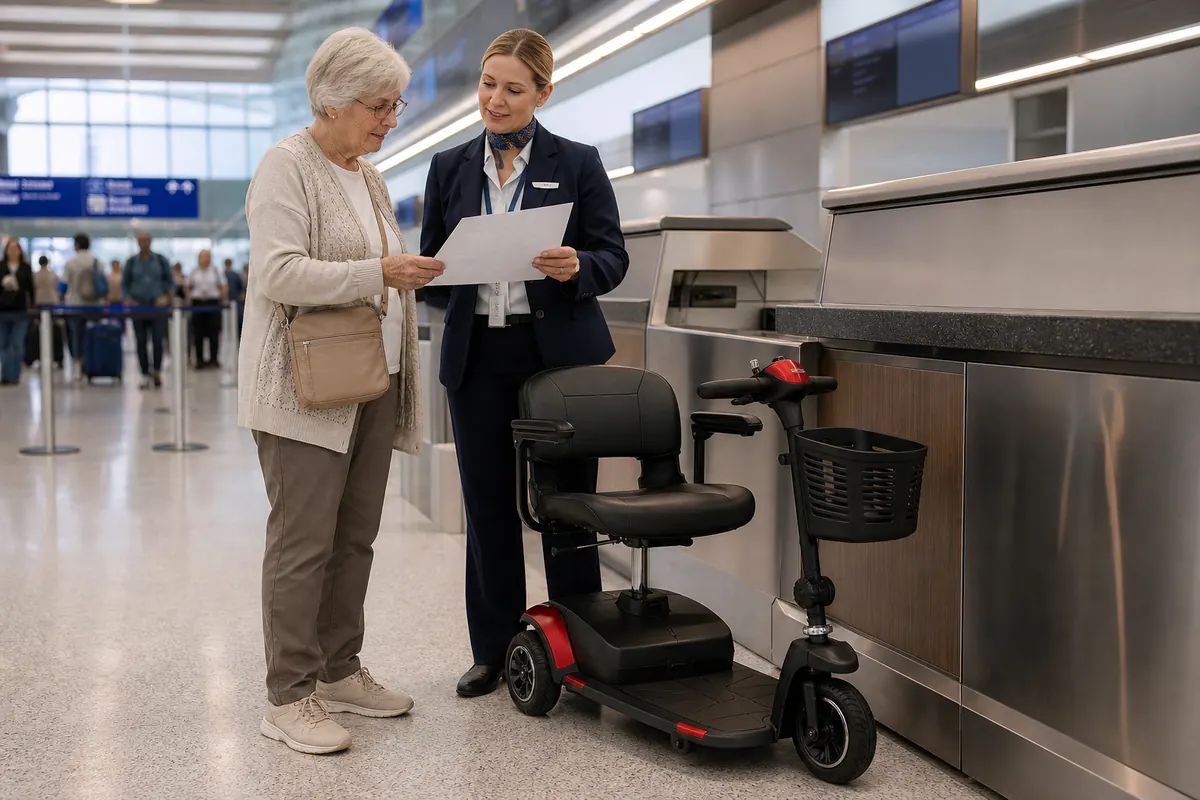
Quick answer: Mobility scooter road and sidewalk rules are not uniform across the United States. Federal disability law affects access to covered public places and services, while state traffic codes, local ordinances, property policies, and transit rules may address where and how a device can be operated. Check the exact device, jurisdiction, and route before riding.
This article is a research method, not legal advice or a statement of one nationwide rule. Definitions and policies change, and the word “scooter” can refer to a disability mobility device, a standing e-scooter, a moped, or another vehicle. Searching the wrong term can produce a confident but irrelevant answer.
Why one rule cannot answer every route
A trip can cross several legal and operational settings: an apartment property, city sidewalk, county road, state highway crossing, park trail, transit station, private shopping center, and destination building. Different authorities may control each segment. The rider’s mobility scooter may also be classified differently from a recreational motorized scooter under a specific code.
Separate four questions:
- How does the applicable law define this exact device and its use?
- Is the space a pedestrian area, roadway, bicycle facility, trail, or private property?
- Which state, county, city, agency, or business controls it?
- What current operational rules apply, including signs or temporary closures?
Understand the federal access layer
The U.S. Department of Justice’s ADA mobility-devices overview explains that wheelchairs include manual or power-driven devices designed primarily for people with disabilities to get around. Its detailed mobility-device guidance says covered state and local governments, businesses, and nonprofits serving the public generally must allow wheelchairs and scooters used by people with mobility disabilities in areas open to the public, subject to the applicable ADA framework.
That access protection should not be rewritten as a blanket traffic rule. It does not by itself say that every mobility scooter may use every traffic lane, bicycle lane, limited-access road, or trail. Roadway placement, pedestrian duties, equipment definitions, and local authority can come from other law. If access and traffic rules appear to conflict, seek an answer from the responsible agency or qualified legal resource.
Identify the device precisely
Record the make, model, number of wheels, seat and steering design, top speed, width, length, weight, and the manufacturer’s intended use. Also note that it is being used as a mobility device by a person with a mobility disability when that fact is relevant to the rule. Do not post personal medical details in a public request.
Read the definitions section of the current code. Terms such as “wheelchair,” “motorized wheelchair,” “electric personal assistive mobility device,” “motorized scooter,” “pedestrian,” and “vehicle” may have distinct meanings. A search result about a two-wheeled stand-up scooter may have nothing to do with a three- or four-wheeled seated mobility scooter.
Use an official-source research sequence
1. Check the state code and state agency
Begin with the official legislature or code publisher, then check the state motor-vehicle or transportation agency for a plain-language summary. Search both the device term and related definitions. Record the section number, effective date, and any cross-references or local-authority clauses.
Official examples show why wording matters. California’s Vehicle Code section 415 addresses when a self-propelled wheelchair, motorized tricycle, or quadricycle is excluded from “motor vehicle.” Virginia’s sidewalk statute separately names wheelchair conveyances, electric personal assistive mobility devices, and motorized scooters. These are illustrations of different terminology, not rules to apply outside those states.
2. Check county and city ordinances
State law may authorize local regulation, and cities can publish rules for sidewalks, business districts, trails, parks, crossings, or speed. Use the municipality’s official code and transportation, public works, parks, or disability-access office. The USAGov local-government directory can help locate official contacts.
3. Ask about the exact segment
A useful question names the street or facility, block limits, travel direction, device model, and proposed location of travel. Ask which current code section or written policy supports the answer. If the response is verbal, note the department, representative, date, and callback number, then request written confirmation when the trip depends on it.
4. Verify facilities and transit separately
A park, campus, shopping center, event, or private path may have a mobility-device policy. Public transit also has its own framework. The Federal Transit Administration’s wheelchair and bus-and-rail guidance discusses when an electric scooter meets the transit definition of a wheelchair. Still contact the actual operator about stops, lifts, ramps, securement areas, and service changes.
Accessibility standards do not establish operating permission
The U.S. Access Board’s Public Right-of-Way Accessibility Guidelines address the design of pedestrian facilities such as sidewalks, crossings, curb ramps, signals, and transit stops, with adoption and scope depending on the enforcing agency. They are valuable for understanding accessible infrastructure. They are not a shortcut for deciding the traffic classification or legal operating location of a scooter.
Plan the route after checking the rule
Legal permission does not make every route physically suitable. Review curb ramps, cross-slope, surface breaks, driveway visibility, signal timing, narrow points, construction closures, lighting, drainage grates, and places to turn. Use only surfaces, slopes, weather, and obstacles allowed by the scooter manual.
Do not enter a roadway simply because a sidewalk is blocked unless current law permits it and the route can be used safely. A detour, assistance, transit option, or different destination may be appropriate. Follow traffic-control devices and any lawful pedestrian duties that apply. Operate at a controlled speed around people and allow space for stopping, recognizing that local rules may state specific duties.
What to do when information conflicts
Prefer the current official code and the agency with jurisdiction over summaries, blogs, retailer pages, or old forum answers. Check whether a state preempts local rules or expressly permits local regulation. Confirm that the code page is current and that a bill has actually taken effect.
For a recurring access problem, contact the responsible public works or accessibility office with the location, direction of travel, photographs taken safely, and a concise description of the barrier. For individualized legal interpretation or enforcement questions, use a qualified attorney or disability-rights organization in that jurisdiction.
Practical rules-check checklist
- Identify the scooter and its intended mobility use without relying on the word “scooter.”
- Map every jurisdiction and property owner along the route.
- Read official state definitions, operating sections, and local-authority provisions.
- Check current city or county codes, agency policies, and posted controls.
- Confirm public transit, park, campus, or venue rules separately.
- Save section numbers, effective dates, links, and written agency answers.
- Inspect the route for surface, crossing, visibility, slope, and construction problems.
- Recheck before travel and whenever the route, device, or jurisdiction changes.
Frequently asked questions
Are mobility scooters legally pedestrians?
Sometimes a code assigns a mobility-device user pedestrian rights or duties, but language varies. Read the definitions and operating provisions for the relevant state and locality.
Can a mobility scooter use a bicycle lane?
Do not assume it can. Bicycle-facility rules and mobility-device classifications differ. Ask the road authority about the exact lane and code section.
Does the ADA allow scooters on every sidewalk?
The ADA provides important access protections in covered pedestrian areas, but it does not replace every state and local traffic rule or resolve every physical and safety condition. Check both layers.
Do mobility scooters need registration, insurance, a license, lights, or a helmet?
Requirements depend on the jurisdiction, device definition, operating location, and sometimes the user’s circumstances. Verify each item through the official state and local sources; do not borrow rules for mopeds or recreational e-scooters.
What if a business says scooters are prohibited?
Ask for the written mobility-device policy and the basis for the decision. Review the DOJ mobility-device guidance, and seek help from an appropriate ADA resource or qualified legal adviser if the issue remains unresolved.
For travel beyond the local route, see the Mobility Scooter Rental Guide for Travel and Preparing a Mobility Scooter for a Cruise.
Last reviewed: July 22, 2026. Laws, ordinances, signs, and operator policies change. This is general research guidance, not legal advice; verify the current rule with the authority that controls the route.

Questions and reader comments