
Quick answer: A travel mobility scooter rental works best when the exact model, dimensions, capacity, battery, delivery point, support hours, and return process are confirmed in writing. Reserve against a route and transportation plan—not only a scooter category—and keep a backup plan for late delivery, breakdown, or an itinerary change.
Renting can avoid transporting a personal scooter and can place equipment at a hotel, cruise terminal, or destination. It also means using an unfamiliar device under a time-limited contract. Rental availability, operator acceptance, insurance, and local rules vary, so no provider or model is suitable for every trip.
Decide where the rental should begin and end
Draw the entire journey: home, airport or station, transfer vehicle, hotel, venue or ship, daily routes, and return departure. A rental delivered to a hotel does not solve mobility between the airport and hotel. A scooter waiting in a cruise stateroom may not be available in the terminal. Ask for exact handoff and return locations, time windows, identification requirements, and the name of the party allowed to receive it.
Confirm what happens if a flight is delayed, the hotel changes, a ship boards at another terminal, or the traveler arrives outside business hours. Obtain an after-hours number and written redelivery, cancellation, and missed-handoff terms.
Translate the trip into scooter requirements
Fit and capacity
Request the exact model before accepting a quote. Verify rated weight capacity using the total operating load, including the rider, clothing, bags, and accessories. Compare usable seat width and depth, tiller reach, armrest arrangement, foot space, transfer approach, and control layout. This is equipment-fit planning, not medical advice; a clinician or qualified mobility professional can address individualized functional needs when appropriate.
Dimensions and turning space
Record operating width, length, height, turning radius, ground clearance, and folded or disassembled dimensions. Compare them with hotel doors, elevators, bathroom approach, cruise-cabin storage, vehicle lifts, and venue routes. “Travel scooter” or “compact” is not a measurement.
Route and range
Tell the provider about permitted indoor floors, pavement, curb ramps, hills, thresholds, grass or gravel, expected daily distance, and charging opportunities. Ask for the manufacturer’s surface and slope limits. Advertised range depends on test conditions; total load, hills, temperature, tire pressure, starts and stops, and battery condition can reduce it. Plan a conservative reserve.
Confirm the supplied equipment
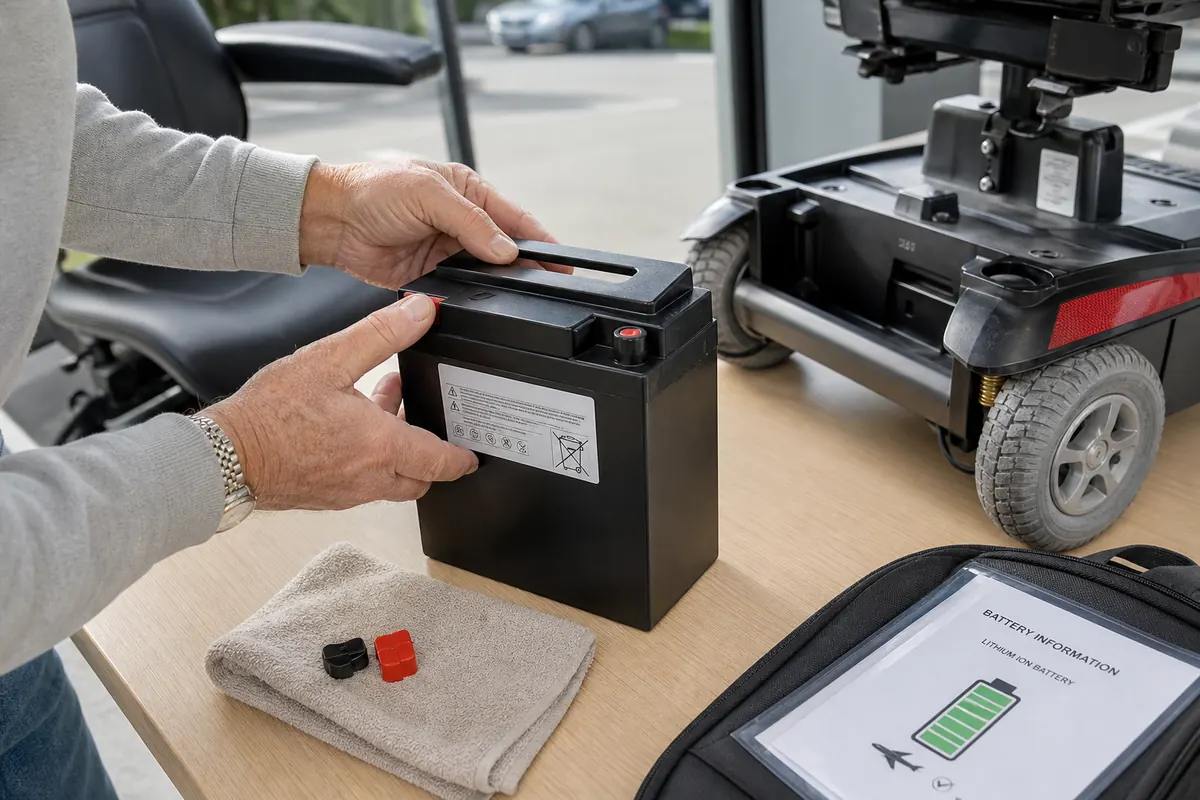
The written reservation should identify the scooter model or explain the substitution standard, battery type, approved charger, key count, basket or accessory, delivery fee, tax, deposit, and total price. Ask whether the battery and charger are original or approved for the scooter and whether a current owner manual will be supplied.
If transport requires folding or disassembly, obtain the heaviest-piece weight and documented procedure. Compare options with Folding vs. Disassembly Mobility Scooters. Do not remove a battery, seat, or drive section unless the manufacturer describes it as a user procedure.
Read the support and damage terms
Before paying, ask:
- Who provides help if the scooter stops away from the delivery address?
- What hours and geographic area does support cover?
- What response is offered, and is a replacement subject to availability?
- Who pays for pickup, a puncture, lost key, water exposure, cosmetic damage, or theft?
- Does an optional damage waiver exclude common events or accessories?
- What documentation is needed for a claim, refund, or deposit release?
Do not assume a credit-card benefit, travel policy, homeowner policy, or venue insurance covers rented mobility equipment. Ask the relevant insurer for the applicable terms. Keep the signed contract, condition report, receipts, and provider messages.
Verify every transport operator
Air travel
If the rental will travel on an aircraft, the operating airline—not the rental company alone—must confirm handling. Send the exact model, dimensions, weight, battery chemistry, watt-hours when applicable, and removal or activation-control instructions. Review the FAA’s current PackSafe guidance for wheelchairs and mobility devices and the DOT Airline Passengers with Disabilities Bill of Rights. Carrier procedures and aircraft capacity can vary, and battery rules can change.
Rail and transit
Ask each operator about platform access, lifts or ramps, onboard location, securement, and advance requests. For example, Amtrak publishes an official wheeled mobility device service page and directs passengers to contact it for current trip-specific information. Local bus and rail equipment can differ by route, so verify the actual service rather than applying another operator’s dimensions.
Cruises
Confirm that the rental provider is permitted to deliver at the terminal or onboard and that the exact scooter fits the stateroom. Cruise lines set their own forms, battery, storage, and boarding processes. Norwegian’s official mobility support page, for example, describes its current rental and storage arrangements; it is not a rule for other lines. Use Preparing a Mobility Scooter for a Cruise to check ports and tenders.
Check destination rules and access
In the United States, DOJ’s mobility-device overview explains federal access principles for covered government facilities and businesses. It does not replace state and local traffic rules. Outside the United States, U.S. statutes should not be assumed to apply. Contact the destination, venue, transportation operator, and local authority with the device description.
Review Mobility Scooter Road and Sidewalk Rules: How to Check Local Requirements before planning a public route. Also ask the hotel or rental property about clear doors, elevator outages, safe charging locations, and whether the scooter can remain indoors overnight.
Inspect the scooter at handoff
Match the model and accessories to the contract. Photograph all sides before use and record scratches, cracks, tire damage, missing parts, battery-gauge behavior, and charger condition. Ask the representative to demonstrate the controls, brake or freewheel mode, seat and tiller adjustments, horn, lights if fitted, charging sequence, fold or disassembly locks, and any error display.
Take a short familiarization drive only in a permitted, low-risk area. Confirm steering, stopping, turning, and control response before beginning the route. If the scooter behaves abnormally or does not match the reservation, stop and contact the provider rather than attempting a repair not assigned to the renter.
Charge and store it correctly
Use the approved charger in a location allowed by the manual, rental property, and transport operator. Keep cords out of walkways and protect equipment from weather and impacts. Do not charge in an evacuation route, unattended vehicle, or improvised location merely because an outlet is available. Follow the documented schedule rather than guessing from the dashboard gauge.
Practical rental checklist
- Map the complete trip and identify every gap before and after the rental period.
- Reserve an exact model with capacity, fit, dimensions, terrain, and range confirmed.
- Get delivery, return, substitution, cancellation, deposit, and support terms in writing.
- Verify the scooter with every airline, rail operator, cruise line, venue, and transfer provider.
- Confirm local road or sidewalk rules and accessible storage and charging.
- Inspect, photograph, and test the scooter at handoff; report issues immediately.
- Carry the manual, provider number, reservation, charger, and written operator approvals.
- Plan backup mobility and transport for delay, breakdown, weather, or route closure.
Frequently asked questions
How early should I reserve?
As soon as the itinerary and required specifications are stable. Accessible staterooms, suitable models, and approved delivery windows can be limited. Reconfirm near departure.
Is the cheapest rental a good comparison point?
Compare the complete cost and service: exact model, fees, deposit, support, delivery reliability, cancellation, accessories, damage terms, and route suitability. A lower base price may omit essential support.
Can a provider substitute another scooter?
Only accept a substitution that meets every confirmed requirement and operator limit. Put minimum capacity, maximum dimensions, battery needs, and essential features in the reservation.
Can I fly with a destination rental?
Possibly, but the rental contract must allow it and every operating airline must evaluate the exact device and battery. A provider’s general statement does not replace airline confirmation.
What if the rental fails?
Move to a safe location if possible, stop using a device that behaves abnormally, and contact the provider. Use the agreed backup plan; do not open electrical housings or improvise a repair.
Last reviewed: July 22, 2026. Rental contracts, laws, operator policies, and equipment availability change. Verify the exact device and current terms with every provider involved in the trip.

Questions and reader comments