
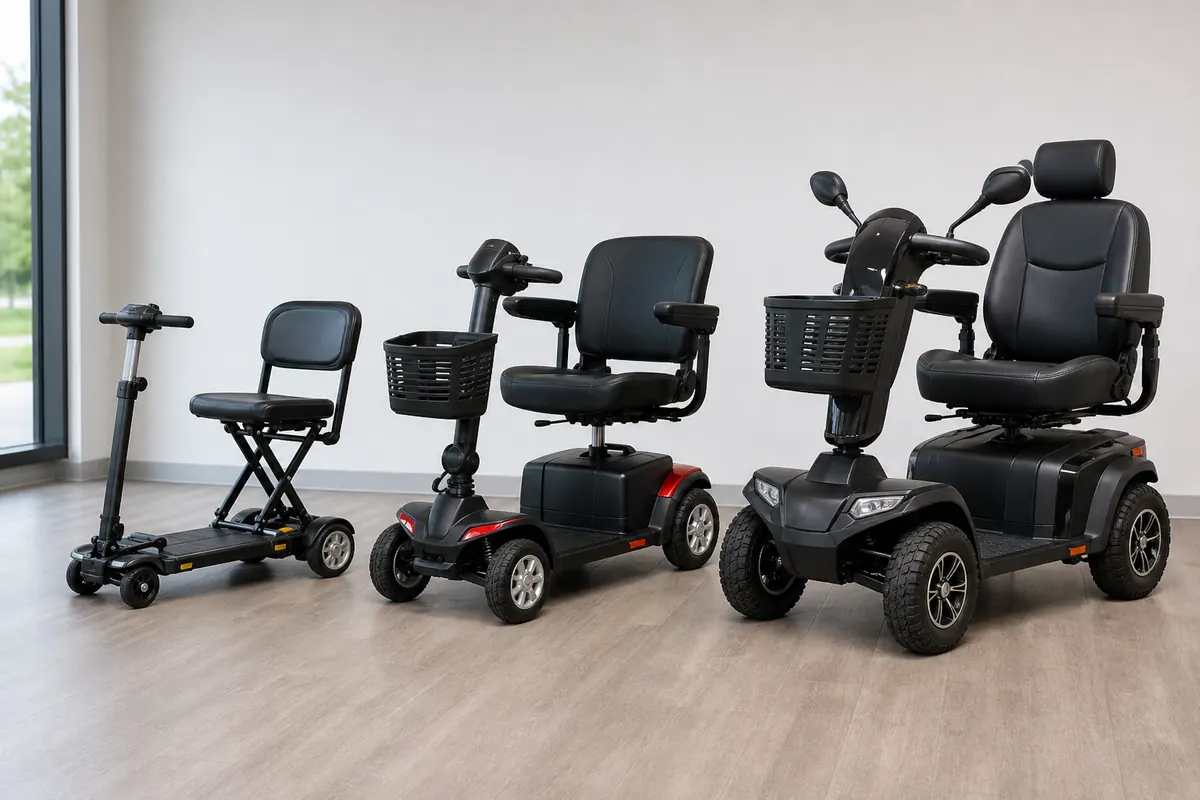
Quick answer: Heavy-duty mobility scooters usually offer higher published capacity, larger seating options, and a more substantial chassis than compact models. Those benefits come with tradeoffs: a wider turning path, greater transport weight, larger storage needs, and possible access problems. “Heavy-duty” does not automatically mean all-terrain, weatherproof, or suitable for every slope.
The right model is the one whose exact specifications match the rider, route, home, storage, and transportation plan. Treat category labels as a starting point, then verify every limit in the current manual.
What “heavy-duty” actually tells you
There is no single set of dimensions or features shared by every scooter marketed as heavy-duty. Manufacturers may use the term for capacity, frame size, motor configuration, tire size, suspension, seat options, or an outdoor-oriented design. Two products with the same label can have different intended surfaces and restrictions.
Record the full model number and configuration. Compare the official capacity, width, length, turning information, ground clearance, maximum permitted slope, battery and charger, seat dimensions, scooter weight, component weights, and transport instructions. Read footnotes and test conditions rather than copying a retailer’s summary.
Capacity and fit are separate decisions
A higher capacity rating can provide an appropriate option for a larger rider or more carried equipment, but the rating’s definition must be checked. Determine whether it covers only the user or the total payload, including clothing, mobility aids, approved accessories, and cargo. Do not invent a percentage margin or exceed the stated maximum.
Then check usable seat width and depth, armrest space, back support, footboard room, knee clearance, control reach, and transfer method. A broad seat is not automatically supportive or correctly positioned. When seating or transfer needs require individualized evaluation, consult a qualified mobility professional; this guide does not give medical advice.
For a step-by-step capacity calculation, use the mobility scooter weight-capacity guide.
Size and maneuvering tradeoffs
A larger footprint may improve room for the rider and equipment, but it can limit use in older homes, small elevators, narrow store aisles, tight restrooms, and crowded venues. Measure door clear opening, hallway corners, elevator door and cabin, ramp width, storage, and the space needed to approach and mount the scooter.
Turning-circle or turning-radius terminology can vary, so compare like with like and confirm how the manufacturer defines the figure. A paper measurement also cannot show every real maneuver. Test the exact scooter at low speed in a representative clear space when possible.
Terrain: read the allowed-use details
Some heavy-duty scooters are designed for a broader range of firm outdoor surfaces than travel scooters. Features such as larger tires, greater clearance, or suspension may help on permitted uneven surfaces. They do not cancel the manual’s limits.
Firm pavement and paths
Inspect the route for broken concrete, cross-slopes, curb ramps, drainage grates, narrow sections, and construction. Ground clearance alone does not prove obstacle capability. Use only transitions the manufacturer allows and approach them as instructed.
Grass, gravel, and loose surfaces
A retailer may show a scooter on a lawn or trail, but product imagery is not an operating specification. Wet grass, deep gravel, sand, mud, and leaf cover can behave very differently from a dry firm path. Confirm the exact surface in the manual or with the manufacturer and avoid conditions outside the documented use.
Slopes and side slopes
Use the model’s stated slope limits and instructions. Surface grip, direction, turns, load, speed, and abrupt transitions all matter. Never assume a high-capacity scooter can climb a steeper ramp. A ramp also has its own slope, width, edge protection, landing, and load requirements.
Review indoor versus outdoor mobility scooters for a route-based comparison.
Range and performance claims
Range, speed, and climbing figures are tied to conditions disclosed by the manufacturer. Rider and cargo load, battery option and condition, temperature, tire condition, stops, surface, slope, and driving pattern can change real results. A larger battery label does not make every trip predictable.
Compare test conditions and ask which configuration produced the published figure. Begin with shorter known routes, observe actual behavior, and maintain a conservative reserve. Do not deliberately run the battery down far from safe charging simply to reproduce a brochure number.
Transport can be the deciding constraint
Many heavy-duty scooters are not designed for routine manual lifting or simple trunk disassembly. Obtain the weight and dimensions of the exact transported configuration, including battery, seat, and approved accessories as required. Verify any removable components and approved lifting points in the manual.
A vehicle lift, carrier, ramp, trailer, or accessible van must be compatible with both scooter and vehicle. Check rated load, platform dimensions, vehicle limits, installation, securement, visibility, ground clearance, and local requirements. Use qualified installation where required; a carrier that can hold the published weight may still be incompatible with a particular vehicle.
For public transportation, confirm the operator’s current size, weight, securement, and booking rules. For cost planning, include equipment, installation, maintenance, storage, and alternate transportation in the mobility scooter total-cost checklist.
Home storage and charging
Choose a dry, secure location permitted by the manufacturer, with enough room to approach, park, connect the approved charger, and maintain required ventilation and clearances. Keep exits and shared corridors clear. Do not run unsuitable extension cords or create a trip hazard to reach the scooter.
If electrical or building changes are needed, use qualified professionals and follow local rules. Measure the scooter with the seat, tiller, mirrors, and accessories in their stored positions. Confirm floor and elevator requirements with the responsible building authority when relevant.
Comfort and everyday usability
Evaluate more than cushioning. Check posture, visibility, control effort, throttle style, steering reach, tiller adjustment, seat swivel, armrest movement, foot placement, mirror coverage, and access to the charging port. Try normal clothing and the equipment carried on a typical trip.
Large scooters can be harder to position at tables, counters, or accessible parking areas. Plan where the scooter will wait without blocking others. Consider whether the rider needs a second compact mobility option for environments the heavy-duty model cannot enter.
Who may benefit—and who may not
A heavy-duty scooter may suit a rider who needs its verified capacity, seating space, allowed outdoor capability, or longer-distance configuration and has adequate access and transport. It may be a poor fit when indoor turning space is limited, frequent manual loading is required, storage is small, or the intended route exceeds the model’s permitted surfaces.
If portability is the priority, compare travel mobility scooters. Neither category is inherently better; they solve different combinations of constraints.
Practical shopping checklist
- Save the exact model’s current manual and specification sheet.
- Calculate a realistic rider, clothing, equipment, and cargo load.
- Verify seat, footboard, control, and transfer fit.
- Measure doors, halls, elevator, turning space, and storage.
- Map slopes, cross-slopes, curbs, and surface changes on real routes.
- Confirm permitted terrain and weather conditions in writing.
- Compare range claims and their disclosed test conditions.
- Verify scooter, battery, and component weights.
- Match the vehicle, ramp, lift, carrier, and securement limits.
- Identify local service and approved replacement parts.
- Price delivery, setup, accessories, transport, service, and batteries.
- Test the exact configuration in a controlled setting when possible.
Frequently asked questions
Are heavy-duty mobility scooters all-terrain?
No. “Heavy-duty” is not permission for every surface. Follow the exact manual’s surface, slope, obstacle, and weather instructions.
Can a heavy-duty scooter be used indoors?
Sometimes, if its dimensions, turning needs, and operation fit the building. Measure the actual route, including doors, corners, elevators, restrooms, and storage.
Does a higher weight capacity guarantee better stability?
No. Capacity and stability are not interchangeable ratings. Follow the model’s loading, turning, slope, tire, and operating instructions and do not compare stability from capacity alone.
Can I transport one on a hitch carrier?
Only when the scooter, carrier, hitch, vehicle, installation, securement, and local requirements are compatible. Verify actual configured weights and dimensions with the relevant manufacturers or qualified installer.
Will a heavy-duty scooter always have more range?
No. Compare exact battery configurations and the conditions behind published figures. Real range varies with the trip, load, battery condition, temperature, tires, and driving pattern.
Last reviewed: July 22, 2026. This article is general shopping information. The current manufacturer instructions for the exact scooter, battery, accessories, and transport equipment control.

Questions and reader comments