
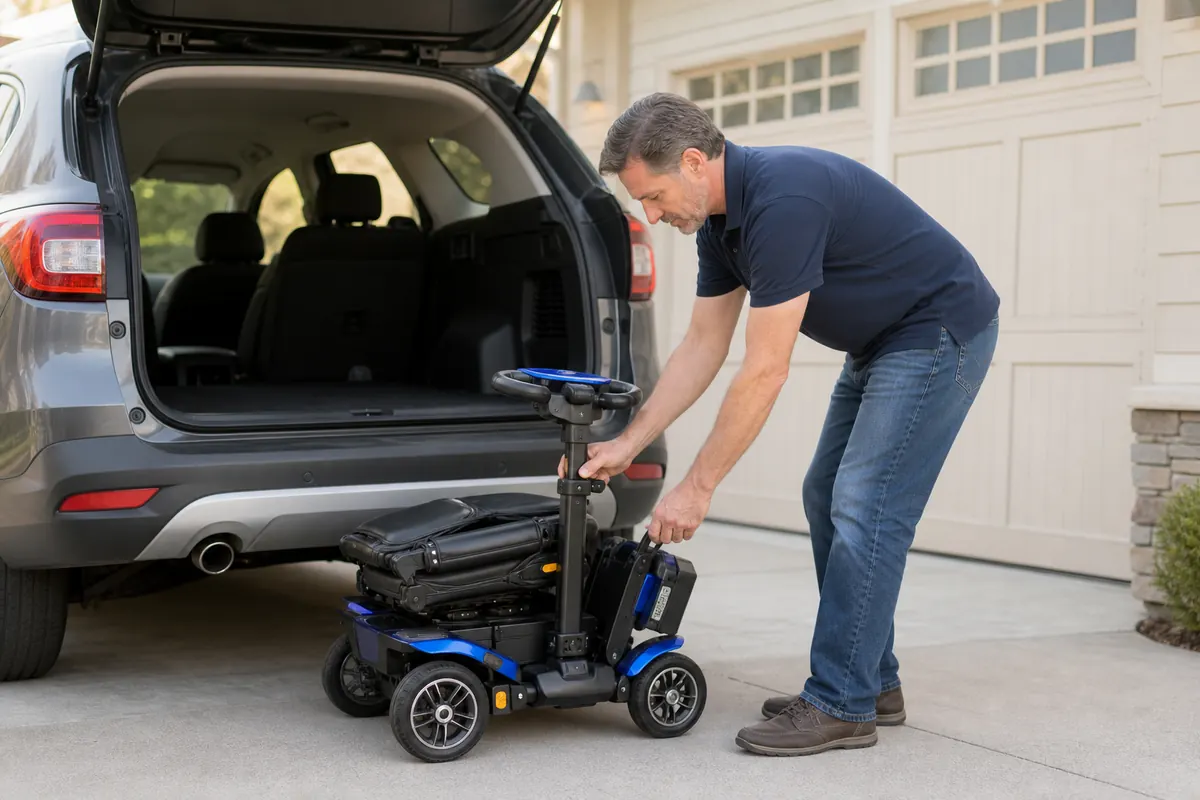
Quick answer: Choose a mobility scooter by mapping the places it must work, not by choosing an “indoor” or “outdoor” label. Indoor priorities usually include compact dimensions, predictable low-speed control, and tight maneuvering. Outdoor priorities often include route-appropriate tires, clearance, lighting, comfort, and documented surface and slope capability.
Many riders need both. The best compromise fits the rider and is explicitly suitable for the most demanding regular route—not a model chosen from one headline specification.
Start with a door-to-destination route map
Trace a normal trip from the storage and charging spot to the destination. Note mounting space, doors, hall corners, elevators, ramps, curb cuts, cross-slopes, paving changes, gates, store aisles, restrooms, weather exposure, and where the scooter can park. Measure narrow points rather than estimating them from memory.
Repeat the map for important occasional trips. A scooter that handles the outdoor segment but cannot enter the destination is not a complete solution.
What matters most indoors
Overall dimensions
Compare the scooter’s widest and longest operating configuration, including seat, armrests, basket, mirrors, and approved accessories. Measure the clear opening of doors, not the nominal door size. Check elevator door timing and interior turning room with the building operator when needed.
Turning and approach space
Published turning measurements can use different methods. Use them for shortlisting, then test the exact model at low speed in a representative space. A scooter may pass through a doorway yet lack room to approach or turn afterward.
Low-speed control
The rider should be able to start, steer, slow, reverse, and stop predictably in a clear controlled area. Check throttle type, tiller reach, speed-control access, and visibility around the front basket. The scooter should not require an awkward posture to maneuver slowly.
Flooring, thresholds, and shared spaces
Identify carpet transitions, elevator gaps, mats, thresholds, ramps, and polished or wet-prone floors. Use only obstacle heights and surfaces permitted by the manual. Plan considerate parking and passing so exits, counters, aisles, and other mobility-device users are not blocked.
What matters most outdoors
Surface suitability
List the actual surfaces: smooth sidewalk, cracked pavement, pavers, firm packed path, grass, gravel, or something else. Do not assume a photograph proves approval. Confirm the manufacturer’s surface instructions for the exact model, and account for how rain, leaves, sand, mud, or ice can change a familiar route.
Ground clearance and transitions
Ground-clearance figures help compare models but do not, by themselves, establish safe curb or obstacle performance. The lowest point and the shape of the transition matter. Use accessible curb ramps where available and follow the manual’s approach guidance and limits.
Tires, wheels, and ride comfort
Tire size and type, wheelbase, seat, and suspension can affect how a scooter feels on uneven ground. Pneumatic tires require pressure and condition checks; solid tires avoid inflation but still wear or damage. Test a permitted representative surface when possible instead of predicting comfort from specifications alone.
Visibility and communication
Check the exact lighting, reflectors, horn, mirrors, and indicator equipment and learn their operation. Equipment does not make every road or low-visibility condition appropriate. Choose accessible routes that follow local rules, avoid relying on drivers seeing the scooter, and carry a charged communication device appropriate to the trip.
Slopes, cross-slopes, and ramps
A route can feel level while sloping sideways for drainage. Map both uphill sections and cross-slopes, including driveway crossings and ramp landings. Compare them with the exact manual and avoid turning sharply or operating in a way the manufacturer prohibits.
A ramp is a separate system with its own rise, length, width, edge, landing, surface, and load requirements. A scooter’s slope capability does not certify a ramp, and a ramp’s capacity does not prove the scooter is allowed to use its angle. Use qualified guidance for permanent access work.
Weather and environmental exposure
Do not assume a scooter is waterproof because it is marketed for outdoor use. Check the manual for rain, moisture, temperature, storage, and charging restrictions. Plan shelter and a return option when conditions may change. Never cover controls or the rider in a way that interferes with steering, vision, ventilation, or operation.
After unexpected exposure, follow the manufacturer’s shutdown, drying, inspection, storage, and charging instructions. Do not charge or use equipment showing water ingress, damage, unusual heat, odor, or control problems.
Range planning for mixed routes
Advertised range reflects particular test conditions and is not a guaranteed distance. Load, hills, temperature, tire condition, stops, speed, surface, battery condition, and accessories can affect a trip. Start with shorter routes, record behavior, and maintain a conservative reserve rather than planning to arrive with an empty indication.
Confirm the approved charging setup at home. Public charging should be used only when the location permits it and the scooter’s instructions can be followed; never assume an outlet is available or appropriate.
Three wheels versus four wheels
Wheel count alone does not decide indoor or outdoor suitability. Some three-wheel scooters publish tighter turning figures, while some four-wheel designs are marketed for broader outdoor use, but geometry, dimensions, speed, surface, and manufacturer instructions matter. Compare exact models and avoid broad claims that one layout is always more stable.
For either design, slow down before turns, avoid abrupt maneuvers, and follow all slope and obstacle directions in the manual.
Travel, mid-size, and heavy-duty compromises
A compact travel model may work well in buildings and cars but offer less seating space or capability on uneven permitted surfaces. A mid-size scooter may balance fit and route needs yet still be difficult in a small elevator. A heavy-duty model may provide needed capacity or outdoor-oriented features while requiring more turning, storage, and transport space.
Compare travel mobility scooters and heavy-duty mobility scooters for the category tradeoffs. The label should follow the route analysis, not replace it.
When two mobility solutions make sense
One scooter cannot always satisfy conflicting constraints. A rider may use a compact scooter for indoor or vehicle trips and a larger model for permitted neighborhood routes. Another may use an accessible transportation service rather than owning transport equipment. Compare storage, charging, maintenance, training, and total cost before choosing two devices.
Do not use one scooter outside its instructions while waiting to buy another. If the regular route cannot be matched safely, consider changing the route, arranging transportation, or seeking individualized help from a qualified mobility professional.
Practical indoor/outdoor decision checklist
- Map every regular route from storage to destination.
- Measure doors, corners, elevators, ramps, gates, and storage.
- List each surface, threshold, slope, cross-slope, and curb transition.
- Calculate the rider and carried load using the manual’s definition.
- Check seat, footboard, control reach, visibility, and transfer space.
- Compare documented dimensions and turning information.
- Verify permitted surfaces, slopes, obstacles, and weather conditions.
- Review tires, lighting, horn, mirrors, and maintenance needs.
- Estimate real trip needs from disclosed range conditions.
- Confirm storage, approved charging, service, and transportation.
- Test the exact scooter at low speed on representative permitted surfaces.
- Write down which route requirement rules each model in or out.
For the complete selection sequence, see How to Choose a Mobility Scooter. If loading equipment into a vehicle is part of the plan, also check how much mobility scooters weigh.
Frequently asked questions
Can an outdoor mobility scooter be used inside?
Possibly, if the actual dimensions, turning needs, controls, flooring instructions, and building rules work for the space. Measure and test rather than assuming the category determines access.
Can an indoor scooter go outside?
Only on surfaces and in conditions permitted for the exact model. A short distance outside is still outdoor use; check the manual and the complete route.
Do I need suspension for outdoor use?
There is no universal requirement. Surface, tires, seat, wheelbase, speed, and individual comfort all contribute. Compare exact models on a permitted representative surface.
Which is better for doorways: three wheels or four?
Use actual width, length, tiller shape, and documented turning information. Wheel count alone cannot show whether a scooter can approach, pass through, and turn after a particular door.
What if my home fits a compact scooter but my route needs a larger one?
Do not force a single-device compromise that fails either setting. Explore access changes, storage, accessible transport, route changes, or two suitable mobility options, and compare total cost.
Last reviewed: July 22, 2026. This guide is general shopping information. Follow the current manual and official specifications for the exact scooter and use qualified help for individualized mobility or access needs.

Questions and reader comments