
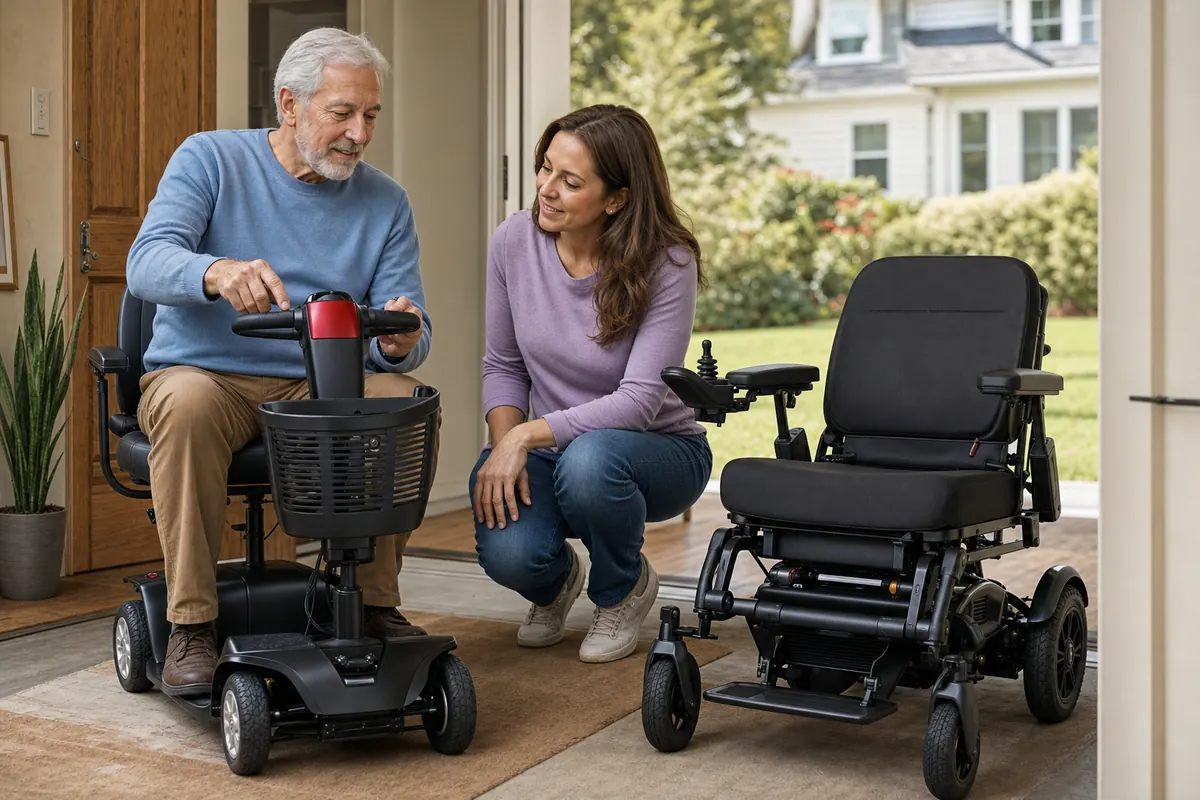
Quick answer: A mobility scooter is generally operated with a tiller by a rider who can transfer and maintain a stable seated position. A power wheelchair is generally controlled by a joystick or other input and can offer more specialized seating and indoor maneuverability. The right choice depends on individual function, seating, environment, transportation, and professional assessment—not on which device looks more convenient.
This mobility scooter vs. power wheelchair comparison explains the practical differences without attempting to prescribe a medical device. If mobility, posture, pressure, breathing, vision, cognition, or control ability is affected by a health condition, seek an individualized assessment.
Core functional difference
A scooter places the steering column in front of the rider. The user turns the tiller and operates a finger or thumb lever. Most scooters require a transfer onto a swivel or fixed seat and enough trunk and arm control to steer.
A power wheelchair places the drive wheels and seating in a chair-based platform. A joystick is common, but alternative controls may be available through specialized assessment. Power wheelchairs can support complex seating, positioning, and powered functions that are uncommon on scooters.
Comparison at a glance
| Factor | Mobility scooter | Power wheelchair |
|---|---|---|
| Typical control | Tiller and throttle lever | Joystick or specialized input |
| Transfer | Usually expected | May serve as the primary seat for longer periods |
| Turning | Front-steered arc | Some drive configurations turn near their own footprint |
| Seating | Basic to comfort-oriented | Basic to highly customized |
| Transport | Compact models may fold or disassemble | Many require an accessible vehicle or rated lift |
| Assessment | Retail purchase common; professional input may still be important | Clinical and supplier assessment often important for configuration |
Control ability
A scooter rider normally reaches forward, turns the tiller, and holds or modulates a lever. Limited grip, arm movement, reaction time, trunk stability, vision, or cognition may change whether that control is appropriate. Some scooters offer configurable lever styles, but modifications must be approved and professionally set up.
A power wheelchair joystick can require less gross arm movement and may be positioned for a specific side. Alternative controls are a specialist area. A qualified rehabilitation team can evaluate access, sensitivity, programming, and safe use.
Transfers and daily seating
A scooter seat often swivels to help transfer. That still requires enough space, stable equipment, and an appropriate transfer method. The rider must keep feet within the intended deck and remain supported during acceleration, braking, and turns.
A power wheelchair may reduce transfers when it functions as the person’s primary mobility seat. It can also integrate positioning, tilt, recline, elevating leg supports, or pressure-management components when clinically appropriate. These features require assessment, setup, and maintenance.
Indoor maneuverability
Compact scooters can work indoors, but the tiller and front steering create a turning arc. Knee clearance and rear swing matter. Some power wheelchairs, especially certain mid-wheel designs, can turn in a compact footprint, though footrests and anti-tip components still affect clearance.
Measure doors, hallways, elevators, bedroom approaches, bathrooms, tables, thresholds, and charging space. A device that turns tightly may still be too wide or long for a particular doorway or transfer.
Outdoor travel
Both categories include products intended for different surfaces. Outdoor suitability depends on the exact tires, clearance, suspension, drive system, grade limits, battery reserve, visibility features, and manual. Do not compare a compact indoor power chair with a full-size outdoor scooter as if the category name alone decides performance.
Plan safe pedestrian routes and follow local rules. Neither device should be treated as a road vehicle unless a jurisdiction explicitly provides for that use.
Seating and posture
Scooter seating ranges from lightweight travel seats to larger captain’s chairs. It is usually designed for comfort rather than complex postural support. Adding unapproved cushions can change stability, control reach, and transfer height.
Power wheelchair seating can be configured around posture, skin protection, tone, deformity, respiration, and function when assessed by professionals. A diagnosis alone does not specify a configuration; body measurements and goals matter.
Transport and vehicles
Some scooters fold or separate for a car, but lifting still requires a safe method. Larger scooters and many power wheelchairs require ramps, lifts, accessible vehicles, and securement. Occupied transport introduces vehicle and restraint standards that are beyond a simple cargo tie-down.
Measure device size and weight, vehicle opening, floor height, lift capacity, and securement locations. Work with qualified vehicle and equipment professionals. For air travel, provide the airline with device and battery information early.
Battery and range
Both devices may use sealed lead-acid or lithium-ion systems. Published range depends on testing conditions. Rider and cargo load, surface, hills, temperature, tire pressure, speed, battery age, and powered seating functions can change real use.
Use the approved charger and replacement batteries. If travel is planned, retain a battery specification sheet and follow the FAA mobility-device battery guidance plus the airline’s instructions.
Maintenance and repair
Every powered device needs a pre-use check and manual-based maintenance. Scooters commonly require attention to tires, freewheel mode, throttle return, steering, seat locks, lights, cables, charger, and battery performance. Power wheelchairs add drive-wheel, caster, joystick, seating actuator, and programming considerations depending on configuration.
Identify a qualified service provider before a breakdown. Keep the serial number, manual, charger details, repair contact, and emergency mobility plan available.
Cost, funding, and documentation
Retail prices vary widely, and configured power wheelchairs can involve specialized components and services. Do not assume insurance will cover a device purchased first. In the United States, Medicare power mobility coverage depends on eligibility, a face-to-face evaluation and documentation process, medical necessity in the home, and an enrolled supplier, among other requirements. Review the CMS documentation fact sheet and ask the plan and supplier for current rules.
When a scooter may fit better
- The rider transfers safely and can maintain seated balance.
- Tiller reach and control are comfortable and reliable.
- Trips are occasional or community-focused rather than all-day seating.
- A folding or disassembling transport solution genuinely works.
- The route and surfaces match a specific scooter.
When a power wheelchair assessment may be important
- The person cannot use a tiller safely or consistently.
- Customized seating or pressure management is needed.
- The device will be the person’s main seat for long periods.
- Very tight indoor maneuvering is central.
- Alternative controls or powered positioning may be needed.
These points are prompts for assessment, not a diagnosis or prescription.
Questions for an evaluation
- What daily activities should the device make possible?
- Can the person transfer and use the proposed control safely?
- What seating and posture support is required?
- What are the narrowest home and community dimensions?
- Which surfaces, slopes, and distances are routine?
- How will the device be charged, stored, transported, and repaired?
- What backup mobility plan is available?
- What documentation does the insurer require before ordering?
Access rights and facility safety rules
The ADA generally recognizes wheelchairs and manually powered mobility aids, and it addresses other power-driven mobility devices under defined conditions. Covered entities may ask limited questions and apply legitimate safety requirements. Review the Department of Justice guidance for mobility devices; individual transportation programs and jurisdictions can have additional rules.
Frequently asked questions
Is a power wheelchair more stable than a scooter?
It depends on the exact design, configuration, load, surface, speed, and operation. Do not make a safety decision from the category name alone.
Can a scooter have a joystick?
Most scooters use a tiller. Specialized controls and modifications require manufacturer approval and professional assessment. A power wheelchair may be the more appropriate platform when joystick or alternative control is needed.
Which is easier to transport?
Some travel scooters separate into smaller pieces. Many power wheelchairs and full-size scooters need a rated lift or accessible vehicle. Compare actual dimensions, weight, and lifting method.
Can Medicare pay for either device?
Potentially, when current coverage and medical-necessity rules are satisfied. Coverage is not guaranteed and community convenience alone is not the federal test. Start with the treating practitioner, plan, and enrolled supplier.
Who should help choose?
Depending on need: a physician, occupational or physical therapist, assistive technology professional, rehabilitation supplier, and trained dealer may contribute. The rider’s goals and environment remain central.
For scooter-specific selection, use our step-by-step choosing guide.
Compare the daily task, not only the device
Write down where mobility begins and ends for each activity. A scooter may work for a shopping center but still require walking from a bedroom to a garage and transferring into a vehicle. A power wheelchair may support indoor mobility and seating but require an accessible vehicle. Include transfers, doors, bathroom access, desk or table approach, charging, transportation, and assistance.
Test the controls while completing representative tasks, not only driving in a straight line. Check whether the rider can approach a surface, reach needed objects without destabilizing posture, reverse safely, and position for a transfer.
Plan maintenance and backup mobility
Both devices can be unavailable during service. Identify who will diagnose the equipment, whether home service is offered, how long common parts take, and what backup mobility is safe for the user. Keep manuals, serial numbers, charger details, programming information where appropriate, and service history together.
Review the mobility scooter maintenance checklist for scooter ownership. For battery-dependent travel, also read battery runtime and replacement guidance.
Reassess when needs change
A device chosen correctly today may no longer fit after a change in transfer ability, posture, strength, control, skin tolerance, home layout, vehicle, or daily activities. Arrange reassessment before using improvised cushions, control extensions, or structural modifications. The goal is safe participation, not preserving one device category at all costs.
Last reviewed: July 21, 2026. This comparison is educational. Evaluate the exact device, user, environment, and current manufacturer instructions.

Questions and reader comments