
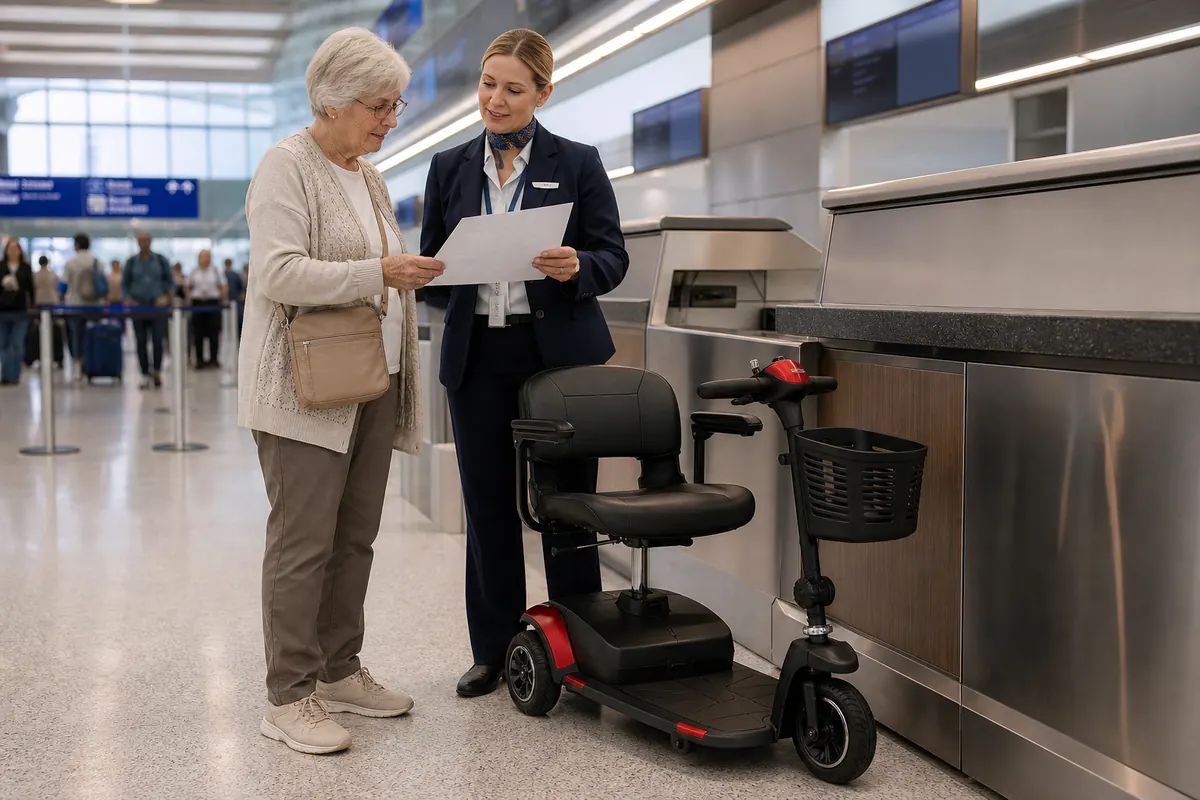
Quick answer: Yes, a U.S. airline can transport a mobility scooter as an assistive device when the scooter and battery meet applicable safety requirements. Contact the operating airline early, provide the scooter’s size, weight, battery chemistry, watt-hour rating, and handling instructions, and arrive with time for inspection and safe preparation. A folding scooter is not automatically carry-on baggage.
Air travel with a mobility scooter becomes much easier when the device is treated as a documented mobility aid rather than an ordinary suitcase. The traveler, airline, and airport team need enough information to protect the battery, controls, frame, and the traveler’s mobility at both ends of the trip.
Know the U.S. passenger protections
The Air Carrier Access Act prohibits disability discrimination by airlines in covered air travel. The U.S. Department of Transportation’s Airline Passengers with Disabilities Bill of Rights summarizes rights that include assistance at airports and the transport of assistive devices, subject to legitimate safety and aircraft constraints.
Airline staff may need device information to plan loading, battery handling, and aircraft compatibility. A request for technical facts is not the same as requiring a traveler to prove a disability. Ask for the airline’s accessibility or special-assistance team when booking.
Create a mobility scooter travel sheet
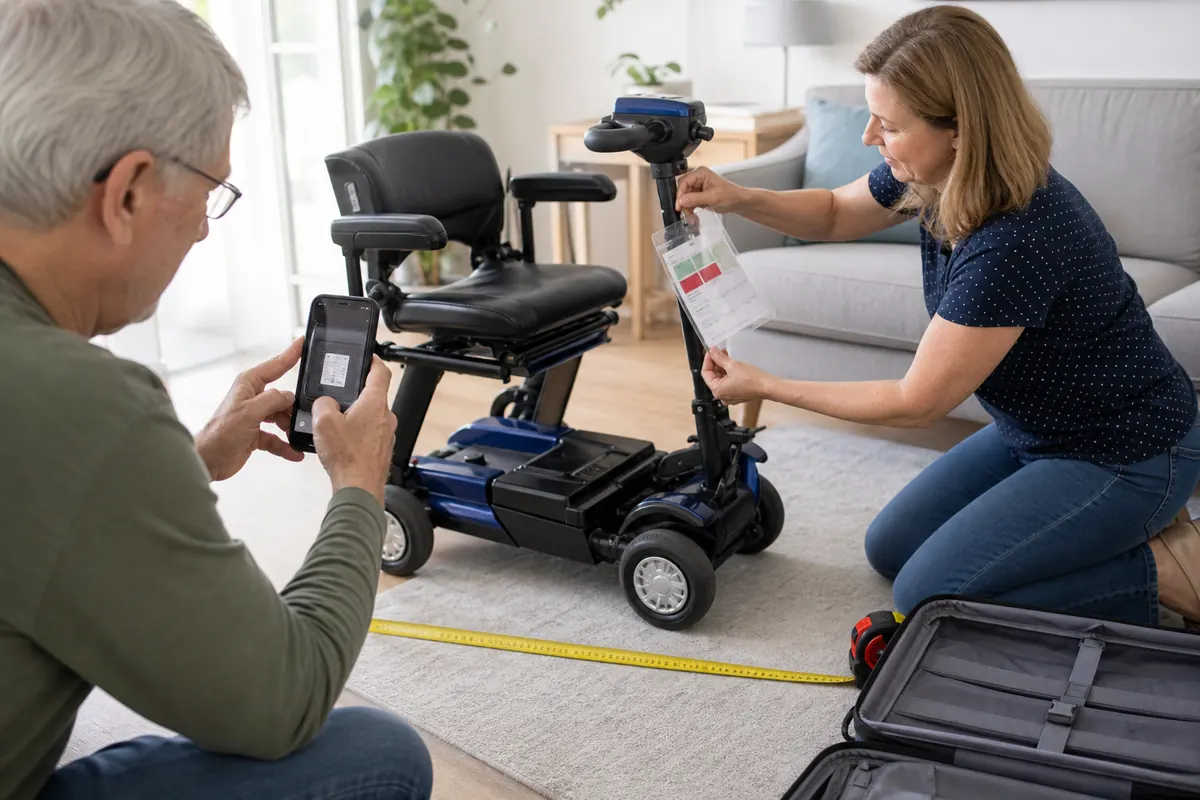
Prepare a one-page document and keep a copy on the scooter and in carry-on baggage. Include:
- manufacturer, exact model, serial number, and a clear photograph;
- upright and folded dimensions;
- total weight and, if relevant, weight with the battery removed;
- battery chemistry, voltage, amp-hours, stated watt-hours, and number of batteries;
- whether the battery is designed to be removed;
- the correct steps to power off, lock, fold, place in freewheel, and return to drive mode;
- lifting points and areas that must not be used for lifting;
- manufacturer manual or travel-document link;
- traveler contact and itinerary.
Use the manufacturer’s own terminology. Do not guess battery chemistry from color, shape, or the charger.
Identify the battery before booking
Mobility scooters may use lithium-ion, non-spillable sealed lead-acid, spillable lead-acid, or another approved battery system. Each category has different packaging and handling conditions. The FAA PackSafe mobility-device page is the primary U.S. reference.
For lithium-ion batteries, the FAA explains that a protected battery may remain installed in the device. When a device is specifically designed for the user to remove the battery, the battery must be removed, protected from short circuit and damage, and carried in the cabin. A removable lithium-ion mobility-device battery may be up to 300 watt-hours; the stated spare-battery allowance is one battery up to 300 Wh or two batteries up to 160 Wh each. The airline should be contacted and may have more restrictive operational conditions.
Calculate watt-hours carefully
Use the watt-hour value printed on the battery or in the manufacturer’s document. When only rated voltage and amp-hours are provided, the mathematical relationship is:
Watt-hours (Wh) = volts (V) × amp-hours (Ah)
For example, a label that legitimately states 24 V and 10 Ah corresponds to 240 Wh. Do not use a charger output rating or an informal online listing as proof. Ask the manufacturer or authorized supplier for a written specification when the label is missing or unclear.
Contact the operating airline
If an itinerary has multiple carriers, contact each operating airline. Provide the travel sheet and ask:
- Where should the scooter be presented and how early should the traveler arrive?
- Can the scooter be used to the aircraft door?
- Does the aircraft cargo door or compartment impose a dimensional limit?
- Will the battery remain installed or be removed under the applicable rule?
- How should controls, loose parts, and the freewheel lever be prepared?
- Can the device be returned at the aircraft door or another agreed location?
- What is the process for a connection or aircraft change?
Write down the date, channel, and confirmation number. Reconfirm after a schedule or aircraft change.
Do not remove a battery just because it is lithium
Removal depends on device design and protection. Unnecessary removal can expose connectors, create handling risk, or conflict with manufacturer instructions. Conversely, a battery designed to be removed may need to travel in the passenger cabin under the FAA conditions. Follow the current FAA rule, airline instructions, and device manual together.
Prepare the scooter without improvisation
- Charge according to the manual; do not travel with a damaged, hot, leaking, swollen, or recalled battery.
- Remove loose accessories such as a basket, cushion, mirror, key, or phone holder when the manual and airline procedure allow, and carry them securely.
- Power the device off and prevent accidental activation using the manufacturer-approved method.
- Protect the throttle and tiller without taping over safety labels or using a method that damages controls.
- Place the scooter in drive or freewheel only as the airline and manual require for the handling stage.
- Photograph every side at the airport before handoff.
Do not disconnect wiring, open a battery case, or create terminal covers unless the instructions specifically call for it.
At the airport
Check in with the airline’s assistance team and present the travel sheet. Explain how to power the scooter, release or engage the drive system, and identify safe lifting points. Keep the key, removable controls, and approved removable battery with you when instructed.
Request the mobility assistance needed between handoff and the seat. The traveler should not be left without an agreed mobility solution. For U.S. travel, the DOT’s assistive-device stowage guide gives further context.
Gate delivery and aircraft-door return
Many travelers use a scooter to the gate or aircraft door, then transfer to an aisle chair or walking assistance as needed. The exact handoff and return point depends on the airport, aircraft, safety, and operations. Request the preferred arrangement early and repeat it during boarding.
Attach the travel sheet so it remains readable but does not interfere with moving parts. A bright, durable identifier can help staff distinguish the device, but avoid loose straps that can catch.
Connections and codeshare flights
A connection adds transfer and reloading. Confirm whether the scooter will be returned during the connection or transferred directly. Build enough connection time for assistance. For a codeshare, the airline that sold the ticket may not operate the aircraft; verify requirements with the operating carrier.
International trips
FAA and DOT rules govern relevant U.S. travel, but the departure country, connection point, destination, and foreign airline may apply other requirements. A device accepted on one flight may face different documentation or aircraft limitations on another. Obtain written responses from every operating carrier and check current national dangerous-goods and accessibility rules.
Arrival inspection
- Inspect the frame, tiller, seat, wheels, tires, controls, basket mounts, and battery area before leaving the airport.
- Confirm the scooter is in the correct drive mode and powers on normally.
- Compare with pre-flight photographs.
- Report missing parts, delay, or damage immediately to the airline and obtain a written file or claim number.
- Do not operate a scooter that has visible structural, control, battery, or braking damage.
The DOT disability rights page explains complaint channels when an issue is not resolved at the airport.
What not to put in checked baggage
Do not place a removed lithium mobility-device battery in checked baggage when the FAA requires it in the cabin. Keep spare lithium batteries in carry-on baggage under the applicable conditions, with terminals protected and each battery protected from damage. The airline must be informed.
Travel checklist
One to four weeks before departure
- Confirm model, dimensions, weight, and battery documents.
- Contact every operating airline and request assistance.
- Review connections, return point, and backup mobility plan.
- Arrange suitable ground transport at the destination.
Before leaving home
- Inspect the scooter and battery; charge as directed.
- Pack the manual, travel sheet, photographs, tools allowed by security, and approved accessories.
- Label removable pieces and keep critical items in carry-on baggage.
At handoff
- Demonstrate power, drive/freewheel, folding, and lifting points.
- Photograph condition and retain claim tags.
- Confirm where the device will be returned.
For route, station, securement, and accessible-transportation planning beyond the airport, see Accessible Transportation Trends That Matter to Mobility Scooter Users.
Frequently asked questions
Does a mobility scooter count toward the baggage allowance?
In covered U.S. air travel, assistive devices generally receive special treatment rather than being treated as ordinary baggage. Confirm the booking and operating airline procedure.
Can my scooter stay assembled?
That depends on aircraft dimensions, loading, battery protection, and the scooter. Airlines should avoid unnecessary disassembly, but operational limits may require preparation. Supply clear instructions.
Can I bring the scooter battery into the cabin?
A removable lithium mobility-device battery may be required in the cabin under FAA conditions. Non-lithium batteries have different rules. Identify the chemistry and contact the airline.
Is a 300 Wh lithium battery always accepted?
No. The 300 Wh figure is one federal condition for a removable mobility-device battery; device design, protection, airline approval, aircraft, routing, and other requirements still apply.
What if the scooter is damaged?
Report it before leaving the airport, obtain written documentation, preserve photographs and receipts, and ask the airline about repair, replacement mobility, and complaint procedures. Do not operate unsafe equipment.
For battery-specific preparation, continue with Mobility Scooter Lithium Battery Airline Rules. For device selection, see our folding scooter guide.
Coordinate with a travel companion
If another person is traveling with the rider, decide who carries the battery documents, detachable accessories, medication, and contact information. The companion should understand power, freewheel, folding, and safe lifting points without taking control away from the rider. Airline staff still need the travel sheet even when a companion can explain the scooter.
Discuss transfer assistance directly with the airline. A family member should not be expected to perform an unsafe manual lift. Request the equipment and trained assistance the traveler needs.
Prepare the destination and return flight
Confirm accessible ground transportation, lodging entrance, room dimensions, charging location, and a local repair contact. Carry the approved charger and any plug adapter permitted by the manufacturer; voltage and frequency compatibility must be confirmed rather than assumed.
Repeat airline confirmation for the return trip, especially when another carrier or airport is involved. Inspect the scooter before departure and retain photographs from each handoff.
Build a resilient travel plan
Keep essential documents and small approved removable items in carry-on baggage. Allow time for assistance and connections. Record the airline’s disability-service and complaint-resolution contacts. If a scooter is delayed or damaged, ask about a suitable loaner and immediate mobility support under applicable rules.
Battery preparation remains a separate safety step. Review Mobility Scooter Lithium Battery Airline Rules and the current operating-airline instructions for every itinerary.
Last reviewed: July 21, 2026. Airline, aircraft, and hazardous-material requirements can change. Confirm the current procedure with the operating airline before every trip.

Questions and reader comments