
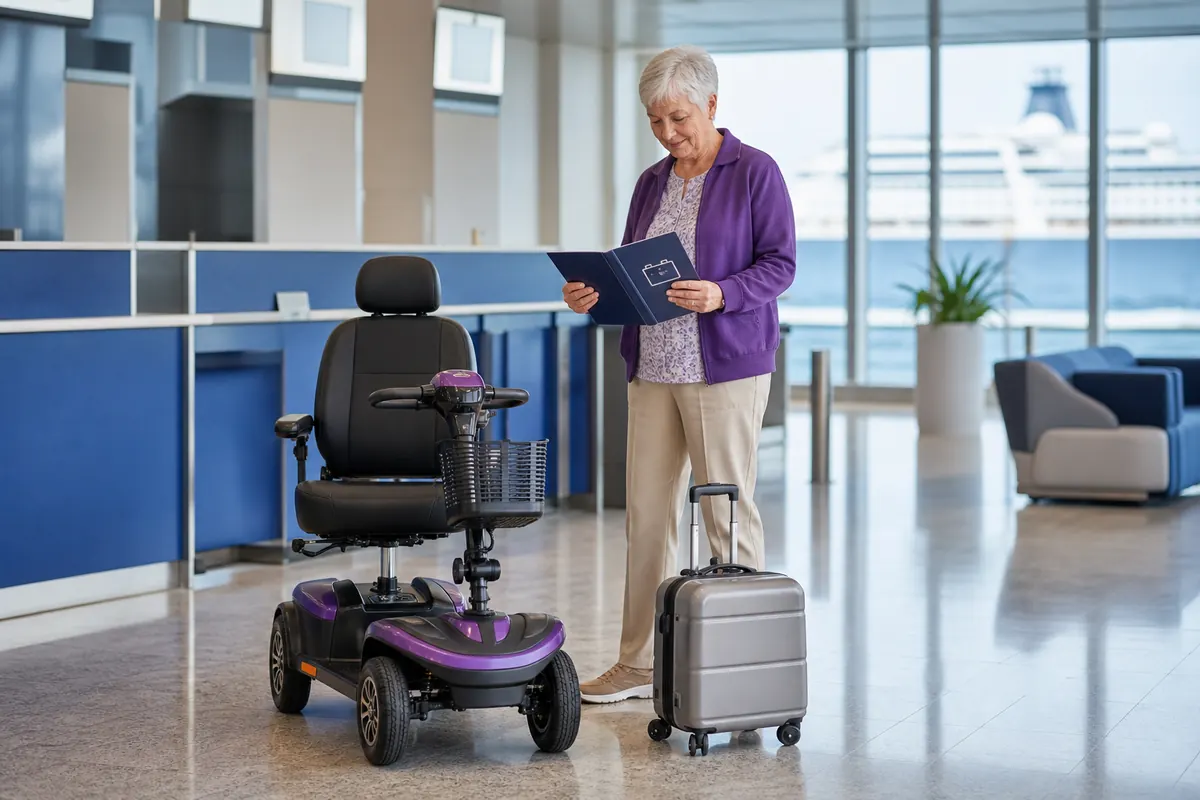
Quick answer: Prepare for a cruise by confirming the exact ship and stateroom can accommodate the scooter, sending its dimensions and battery details to the cruise line, arranging storage and charging, and checking every port transfer and shore excursion. Cruise-line, ship, port, and itinerary policies differ and can change, so a prior sailing is not proof of current acceptance.
A scooter that works well at home can meet narrow doors, crowded elevators, steep gangways, tender boats, or inaccessible transportation during a cruise. Resolve those questions before final payment when possible. Keep the cruise line’s written answers with the booking documents and reconfirm after any ship or itinerary change.
Start with the operator, ship, and sailing
In the United States, the Department of Transportation’s guidance on 49 CFR Part 39 explains policy and service responsibilities for covered passenger-vessel operators. It says operators are expected to provide useful information about cabin features, routes between ship facilities, boarding assistance, and known accessibility of excursions they sell. That is a reason to ask specific questions, not a guarantee that every ship or port has the same physical access.
The U.S. Access Board describes its Passenger Vessels Accessibility Guidelines as proposed and not yet finalized. Do not treat a diagram or dimension from a general building standard as a promise about a particular vessel. The cruise line’s accessibility team should confirm the actual ship, stateroom category, embarkation port, and sailing date.
Build a scooter information sheet
Use manufacturer documents and labels to record:
- Make, model, and serial number.
- Operating width, length, and height, plus folded dimensions if applicable.
- Total weight and the weight of the heaviest approved removable piece.
- Turning radius and any space needed to swivel the seat or transfer.
- Battery chemistry, voltage, capacity, watt-hours when shown, and whether it is removable.
- Charger input requirements and the manufacturer’s charging instructions.
- Freewheel, brake, key, and accidental-activation procedures.
Add clear photos of the scooter, battery label, charging port, and approved lifting points. Do not guess missing battery information; ask the manufacturer or supplier for documentation.
Confirm the stateroom before booking
Ask for the clear door opening, thresholds, turning area, usable floor space with the beds in the booked configuration, bathroom access, and a route that keeps the scooter clear of the exit. An “accessible” label can represent different features among ships and cabin classes. Confirm the features the traveler actually needs.
Operator policies illustrate why ship-specific verification matters. Carnival’s current mobility-device and stateroom information lists different doorway and storage conditions for its cabin types. Norwegian’s mobility support page publishes its own stateroom, battery, charger, and storage conditions. Royal Caribbean asks travelers using its Guest Special Needs process to provide scooter dimensions, weight, and battery type. These examples are not interchangeable rules; check the latest page and obtain an answer for the booked sailing.
Plan storage and charging
Major cruise lines commonly require scooters to be stored in the stateroom rather than in corridors, stairways, elevator lobbies, or other evacuation routes. Follow the policy for the actual line. Confirm that the parked scooter will not block the room exit and that the charger can be used in the assigned location.
Use only the manufacturer-approved charger and follow both scooter and ship instructions. Ask about outlet voltage, plug type, extension-cord or power-strip restrictions, and whether the battery may be removed for charging. Do not improvise an adapter or charge a damaged, swollen, leaking, unusually hot, or recalled battery. Report an abnormal battery or charger to the appropriate operator contact and stop using it as directed.
Map embarkation and disembarkation
Accessibility assistance can begin at different points depending on the terminal and operator. Ask where curbside or terminal assistance starts, who handles luggage, whether a ramp or lift will be used, and whether the rider remains on the scooter during boarding. Record the check-in time requested for mobility-device users.
Keep the scooter key and removable accessories with the traveler unless staff give a documented reason for another procedure. Before handoff, take date-stamped photos from several sides and note existing marks. Attach a handling card that identifies the brake or freewheel control, approved lifting points, and how to prevent activation without exposing personal medical information.
Do not assume every port is accessible
Gangways and tender boats
Gangway angle and boarding conditions can change with tide, weather, pier, and vessel position. A tender port uses a smaller boat between ship and shore; scooter acceptance can depend on the equipment, transfer method, sea conditions, and operator policy. Ask about each port by name and understand that the final safe-operating decision may be made on the day.
Shore transportation and excursions
An excursion marked “accessible” still needs a detailed check. Ask whether the traveler stays seated on the scooter, the lift’s size and combined-weight capacity, securement method, vehicle doorway, route surfaces, restroom access, and whether steps or transfers are required. Get the answer from the cruise line or excursion operator in writing. Rules and vehicle availability can differ outside the United States.
Prepare the scooter itself
Complete only the owner-level inspection described in the manual. Check tires, user-visible fasteners, steering, controls, horn, lights if fitted, battery status, seat lock, and any fold or disassembly latches. Address faults before departure. Our mobility scooter maintenance checklist separates routine checks from technician work.
Pack the approved charger, manual, accessibility-team correspondence, a compact cleaning cloth, permitted spare parts recommended by the manufacturer, and emergency contact details. Label removable parts. Do not pack loose tools or battery accessories without checking every transport provider’s rules.
Coordinate the journey to the port
Airlines, rail operators, buses, hotels, and cruise lines make separate decisions under different rules. A cruise line’s acceptance does not approve a scooter for a flight. For U.S. air travel, review the FAA’s current PackSafe mobility-device guidance and contact every operating airline with battery details. See our airline battery guide for a preparation sequence.
Practical cruise checklist
- Confirm the exact ship, sailing, stateroom number or category, and accessibility features.
- Send scooter dimensions, weight, battery chemistry, and charger information.
- Complete the cruise line’s accessibility or mobility-device form by its deadline.
- Verify in-room storage, charging location, outlet rules, and a clear exit route.
- Ask about embarkation, every port, tender transfer, and each booked excursion.
- Inspect the scooter, photograph its condition, and label controls and lifting points.
- Arrange accessible transport between home, hotel, terminal, and return pickup.
- Reconfirm after schedule, ship, cabin, airline, or equipment changes.
Frequently asked questions
Can a scooter be left in a cruise-ship hallway?
Do not assume so. Major lines commonly require in-stateroom storage to keep evacuation routes clear. Follow the current policy for the specific operator and ship.
Do I automatically need an accessible stateroom?
Not in every case, but a standard room may lack the door width, turning space, bathroom access, or storage area needed. Confirm measurements and required features before booking.
Can I take the scooter ashore at every port?
No universal answer exists. Gangways, tenders, tides, weather, port infrastructure, and local transportation can change access. Check each port and prepare an alternative onboard plan.
Will the ship provide a scooter?
Do not rely on onboard inventory. Some lines identify outside rental arrangements or have limited wheelchairs for specific uses, but availability and delivery conditions vary. Reserve a confirmed device if rental is needed.
What if the cruise line changes the ship?
Contact the accessibility team immediately and repeat the cabin, route, scooter, charging, and port checks. Approval for the original vessel does not establish compatibility with the replacement.
Travelers considering delivery at the port can use the Mobility Scooter Rental Guide for Travel.
Last reviewed: July 22, 2026. Policies, vessels, ports, weather, and excursion equipment can change. Verify the current requirements with the cruise line and every operating travel provider.

Questions and reader comments