
Quick answer: Store a mobility scooter powered off in a dry, secure place that stays within the temperature and humidity limits in its manual. Protect the controls and charging equipment from moisture, keep the scooter out of an exit path, and use the exact long-term battery routine specified for its battery and charger. There is no safe universal schedule for every lead-acid and lithium-ion system.
Good storage is more than parking. A scooter can develop a depleted battery, tire flat spots, corrosion, pest damage, or a forgotten fault while it sits. A written plan makes the next ride more predictable without turning the owner into a battery technician.
Start with the exact product documents
Find the scooter owner’s manual, battery instructions, and charger manual. Record the model and serial number, battery chemistry, approved charger part number, and the manufacturer’s service contact. If the battery is removable, confirm whether the manual permits off-scooter charging and how its terminals or connector must be protected.
Do not transfer a routine from another scooter. Even models from the same brand can use different battery chemistries, charging profiles, temperature limits, and shutdown behavior. Pride’s current travel-scooter manual, for example, gives storage guidance for that product family, while its separate lithium-ion FAQ gives model-specific charging and storage advice. Those documents illustrate why the manual controls; they do not create one rule for every scooter.
Choose a storage location deliberately
Keep it dry and within its stated temperature range
An indoor, weather-protected location is usually easier to manage than an exposed porch, vehicle, or shed. Avoid direct sun, rain, dew, standing water, roof leaks, sprinklers, and condensation. A closed vehicle or unconditioned outbuilding can move beyond the product’s limits even when the outdoor temperature seems moderate.
Use the temperatures in the exact manual rather than a generic online range. If a battery has been exposed to temperatures outside its charging limits, do not guess when it is ready to charge. Move it only as the manufacturer directs and ask the provider when the instructions are unclear. Never charge a battery the manufacturer identifies as frozen or damaged.
Protect access and household safety
Park on a level surface with the power off, key removed, seat facing the recommended direction, and freewheel lever in the position specified for storage. Keep the scooter, charger, and cords out of doors, hallways, stairs, and other escape routes. Make room to reach the charging port without stretching a cord across a walking path.
Choose a place where children, pets, falling objects, lawn equipment, and vehicle doors cannot strike the controls or wiring. Do not drape an improvised plastic cover over a damp scooter or over a charger in use. If the manufacturer offers a storage cover, follow its instructions and make sure the scooter is dry before covering it.
Plan battery care for the length of storage
For a few days
Complete the normal after-use routine in the manual. Many scooters are intended to be recharged after routine use, but the correct connection sequence and finish indication vary. Inspect the charger, cable, plug, and charge port before use, then store the charger where it remains dry and cannot be crushed.
For weeks or months
Long-term storage requires an explicit plan. The manual may call for periodic charging, battery disconnection, a storage or shutdown mode, or removal of a battery pack. Never leave the scooter with a depleted battery, connect a generic trickle charger, or disconnect terminals unless the manufacturer documents that procedure for the owner.
Set calendar reminders that quote the manual rather than relying on memory. Log the date, indicator result, and anything unusual. If the manufacturer says to remove a pack, store it in the orientation and environment specified, protect its connector from metal objects, and keep the approved charger with it. Do not open a sealed case or attempt to balance, rebuild, or revive cells.
Reduce tire and structure problems
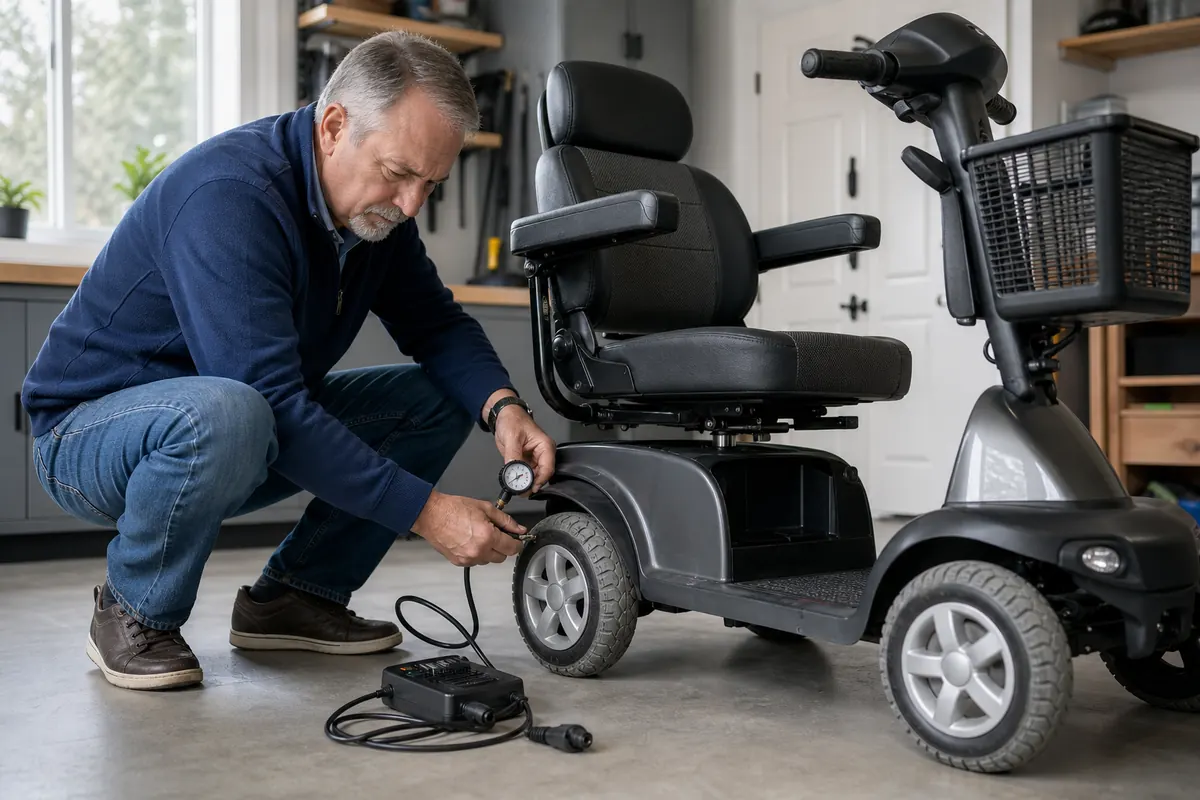
Before storage, inspect each tire for damage and excessive wear. Inflate pneumatic tires only to the pressure specified for the exact tire or scooter; solid tires still need checks for separation and flat spots. Some manufacturer manuals suggest unloading the tires during prolonged storage to reduce flat spotting, but lifting and support points are model-specific. Do not improvise with an unstable jack or blocks.
Remove loose items from the basket, secure approved accessories, and clean surface dirt using the manual’s method. Do not pressure-wash the scooter or spray liquid into controls, the motor, connectors, or the charging port. Dry any permitted damp cleaning before storage.
Check the scooter while it is stored
At the interval in the manual, look for water, corrosion, damaged insulation, pest nesting, tire changes, battery-case distortion, odor, or unusual heat. Do not operate or charge a scooter with a swollen, cracked, leaking, unusually hot, smoking, or burned battery or connector. Move away from an immediate hazard if it is safe to do so and contact the manufacturer, fire service, or qualified provider as appropriate.
A falling dashboard gauge during storage does not diagnose the cause. It may reflect normal standby demand, battery aging, temperature, a connection problem, or another fault. Have unexplained loss evaluated rather than repeatedly extending charge time.
Return the scooter to service carefully
- Inspect the scooter, battery area, charger, tires, seat, tiller, and visible wiring before connecting power.
- Restore any disconnected or shutdown system exactly as the manual directs.
- Complete the documented charge cycle and note the normal completion indicator.
- Confirm the freewheel lever is in drive and all adjustable parts are locked.
- Test steering, throttle return, stopping, horn, and lights at the lowest practical speed in a clear, level area.
- Use a short familiar route before depending on the scooter for an essential or long trip.
Stop if the scooter shows a persistent fault, new noise, unpredictable control response, weak range, tire problem, or charging abnormality. The mobility scooter maintenance checklist separates owner checks from technician work.
Practical storage checklist
- Manual, battery instructions, and charger instructions are available.
- Model, serial number, chemistry, and approved charger are recorded.
- Scooter is clean, dry, powered off, and parked level.
- Storage area stays within the documented environmental limits.
- Exits and walking routes remain clear.
- Tires and visible wiring have been inspected.
- Long-term charging, shutdown, or disconnection steps match the manual.
- Calendar reminders and a simple storage log are set.
- Restart inspection and low-speed test are planned.
Frequently asked questions
Should I leave a mobility scooter plugged in during storage?
Only if the exact scooter and charger instructions explicitly call for it. Products differ. Do not assume that an automatic-looking charger can remain connected indefinitely.
Can I store a scooter in a garage?
Possibly, if the garage stays dry, secure, ventilated as required, and within all scooter, battery, and charger temperature limits. Check seasonal extremes, flooding, condensation, and vehicle impact risk.
Should I remove the battery?
Remove it only when the manual assigns that step to the user. Some packs are designed for removal; other systems require provider service or a documented disconnect procedure.
How often should a stored scooter be charged?
Use the interval for the exact battery and scooter. Manufacturer examples range by chemistry and model, so a generic weekly or monthly rule can be wrong.
Will storage damage solid tires?
Solid tires do not lose air, but prolonged loading can contribute to flat spots on some products. Follow the manual’s storage support guidance and have persistent vibration or deformation inspected.
What if the scooter will not start after storage?
Check only the owner steps in the manual, such as key position, drive mode, approved charging, and accessible connectors. Record any code or indicator and contact qualified service if the problem remains.
Sources and further reading
- Pride Mobility Travel Scooter Series owner’s manual (January 2026)
- Pride Mobility lithium-ion battery FAQ
- How Long Do Mobility Scooter Batteries Last?
- Mobility Scooter Charging Safety: A Practical Home Checklist
Last reviewed: July 22, 2026. This article provides general ownership information. The current scooter, battery, and charger instructions control, and electrical or structural work belongs with a qualified service provider.

Questions and reader comments