
Editorial disclosure: This is an independent, specification-based review. MobilityScooterLab did not receive the product, did not conduct a hands-on test, and does not present manufacturer range claims as guaranteed real-world results. Specifications and documentation were checked against official manufacturer sources on July 23, 2026.
Quick verdict
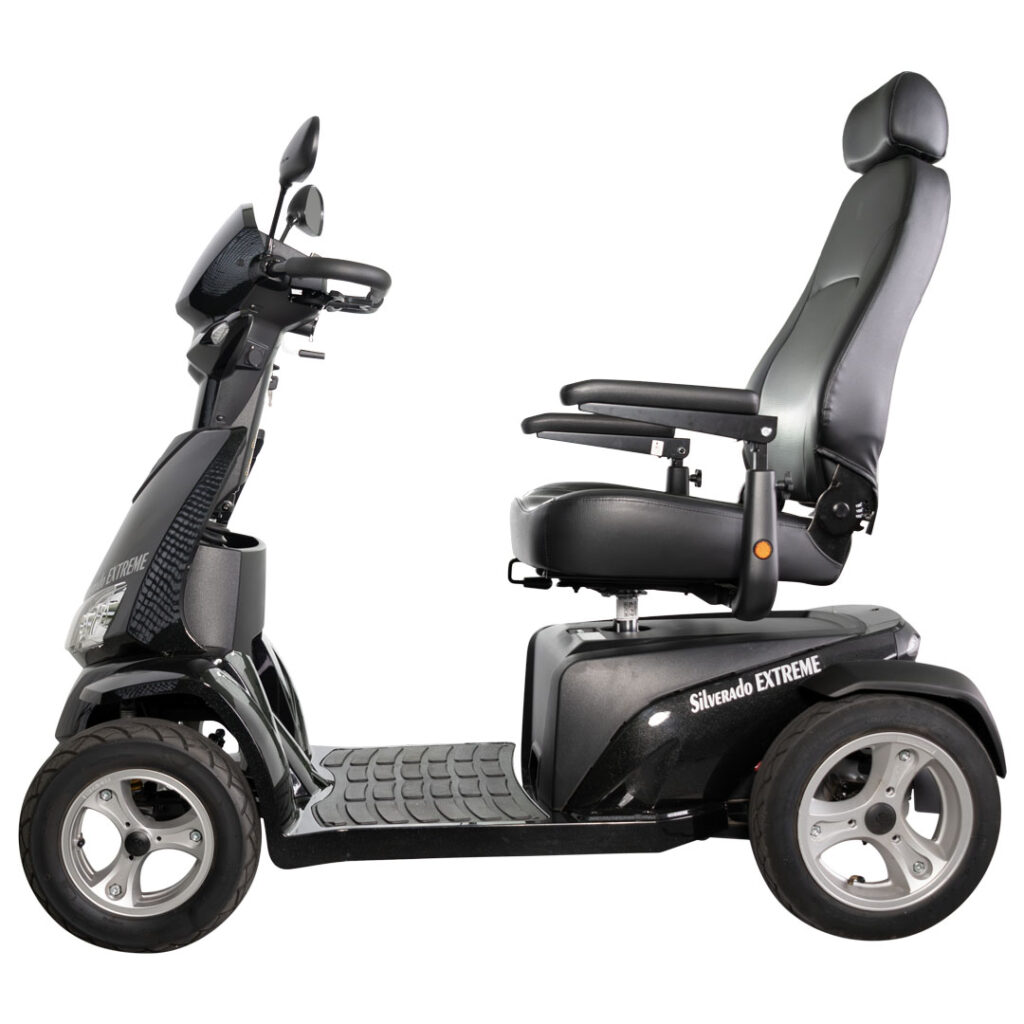
The Silverado Extreme is designed for long outdoor routes, not portability. Its headline specifications—up to 55 miles, 9.5 mph, 450-pound capacity, full suspension, and large pneumatic tires—come with a 387-pound total weight and a 185-pound heaviest section.
Best for: Long planned outdoor routes where full suspension, large batteries, lighting, and high capacity matter more than transport weight.
Think twice if: Routine trunk loading, confined indoor routes, or ownership without a suitable charging and storage area.
Official specifications at a glance
| Model | S941L |
|---|---|
| Weight capacity | 450 lb |
| Maximum speed | 9.5 mph |
| Manufacturer-stated range | Up to 55 miles |
| Turning radius | 82.7 in |
| Ground clearance | 5.1 in |
| Size | 61 in long × 29 in wide |
| Total weight | 387 lb |
| Heaviest piece | 185 lb |
| Battery | Two 12 V, 100 Ah Group 27 batteries |
Range, speed, climbing, and braking performance vary with payload, battery condition, temperature, tire condition, terrain, stops, and configuration. Verify the serial-specific label and current manual before ordering.
What the specifications mean in daily use
The 55-mile number should be treated as a best-case manufacturer estimate, not a trip-planning guarantee. A prudent route plan includes reserve capacity and a turnaround point well before the battery display approaches empty. The scooter’s mass and turning circle make pre-purchase site planning essential: door width, ramp rating, lift capacity, floor loading, and charging ventilation should all be checked.
Do not choose from capacity or range alone. Start with the user’s seated fit, transfer method, control reach, combined rider-and-cargo weight, doorway width, turning space, storage location, and the heaviest item that must actually be lifted. Our mobility scooter selection guide explains that process, while the weight-capacity guide explains why a published maximum is not a comfort target.
Pros
- Large battery bank and 55-mile manufacturer claim target long routes.
- Full suspension and 14-/16-inch pneumatic tires are appropriate for outdoor comfort.
- LED lighting, LCD dashboard, and speed reduction while turning add useful controls.
- A 450-pound rating supports a wider range of users.
Cons
- At 387 pounds, normal vehicle transport requires specialized equipment.
- The 82.7-inch turning radius is unsuitable for tight indoor navigation.
- Pneumatic tires and large batteries increase maintenance responsibilities.
- Real range can be substantially lower with hills, cold, payload, tire pressure, battery age, and stops.
Certification and documentation check
Merits publishes a current model specification sheet and product flyer. We did not find a model-specific UL certification statement in the cited manufacturer documents, so this article does not claim one. A range or braking specification is not the same as third-party product certification; buyers needing a particular regulatory document should request it by exact model and serial configuration.
Words such as “approved,” “compliant,” “registered,” “cleared,” and “tested to” are not interchangeable. A billing code is not a safety certificate, an FDA device classification is not a personal medical recommendation, and no manufacturer statement guarantees airline acceptance. For flights, review our mobility scooter airline planning guide and lithium battery documentation guide, then contact the operating carrier.
Who should shortlist it?
Long planned outdoor routes where full suspension, large batteries, lighting, and high capacity matter more than transport weight. Before buying, arrange a seated trial when possible. Confirm that the user can steer, brake, transfer, and maintain posture without strain, and that a helper can safely manage every transport component.
Who should choose something else?
Routine trunk loading, confined indoor routes, or ownership without a suitable charging and storage area. Compare at least one alternative from the same size class and one from the next class up or down. That makes the portability, comfort, and route tradeoffs easier to see than comparing headline prices alone.
Ownership checklist before purchase
- Measure doors, elevators, vehicle openings, ramps, storage space, and turning areas.
- Confirm the exact battery chemistry, capacity, charger, replacement cost, and local service path.
- Check the heaviest transport component against the actual lifter, lift, ramp, or vehicle rating.
- Read the current owner’s manual, warranty exclusions, tire instructions, and charging schedule.
- Plan trips with a substantial range reserve instead of using the published maximum as a target.
After purchase, use a repeatable inspection routine. Our mobility scooter maintenance checklist covers tires, fasteners, controls, brakes, battery care, and service triggers.
Final assessment
The Silverado Extreme is designed for long outdoor routes, not portability. Its headline specifications—up to 55 miles, 9.5 mph, 450-pound capacity, full suspension, and large pneumatic tires—come with a 387-pound total weight and a 185-pound heaviest section. The right decision depends on fit and route evidence, not brand recognition. Treat this review as a research starting point, then verify the current configuration with the manufacturer or an authorized provider.
Official sources
Product image used for editorial identification and attributed to the manufacturer. MobilityScooterLab is not the manufacturer and has not independently laboratory-tested the product.

Questions and reader comments