
Editorial disclosure: This is an independent, specification-based review. MobilityScooterLab did not receive the product, did not conduct a hands-on test, and does not present manufacturer range claims as guaranteed real-world results. Specifications and documentation were checked against official manufacturer sources on July 23, 2026.
Quick verdict
The Dasher 4’s strongest argument is not speed or range—it is the 26-pound heaviest section after three-part disassembly. That can materially change car loading for some households, while the eight- or ten-mile stated range remains best suited to shorter outings.
Best for: Users who prioritize low individual lift weight and straightforward disassembly for short trips.
Think twice if: Long-range days, rough routes, or anyone who needs suspension and generous ground clearance.
Evidence snapshot
What we verified
Weight capacity, speed, manufacturer-stated range, dimensions, battery details, transport weight, and documentation claims were checked against the official sources cited in this review.
What we did not test
MobilityScooterLab did not receive this scooter and did not conduct a hands-on, laboratory, braking, durability, incline, or real-world range test. A manufacturer maximum is not a guaranteed trip result.
How to use this review
Use the specifications to build a shortlist, then confirm the current manual, exact battery and charger, serial-label ratings, fit, route, vehicle loading method, and local service support for the unit you may buy.
Recheck before purchase
Product configurations and documentation can change. Ask the manufacturer or supplying dealer for the current model-specific manual and written specification sheet. For air travel, obtain the carrier’s current instructions for the exact battery and itinerary.
Evidence review date: July 24, 2026.
Official specifications at a glance
| Weight capacity | 300 lb for units purchased after January 1, 2024 |
|---|---|
| Maximum speed | 4 mph |
| Manufacturer-stated range | Up to 8 or 10 miles, battery dependent |
| Ground clearance | 2 in |
| Size | 44 in long × 22 in wide |
| Unit weight | 94 or 98 lb, battery option dependent |
| Heaviest piece | 26 lb |
| Battery | Two 12 V 12 Ah or 14 Ah batteries |
| Maximum safe climbing angle | 6 degrees / 10 percent |
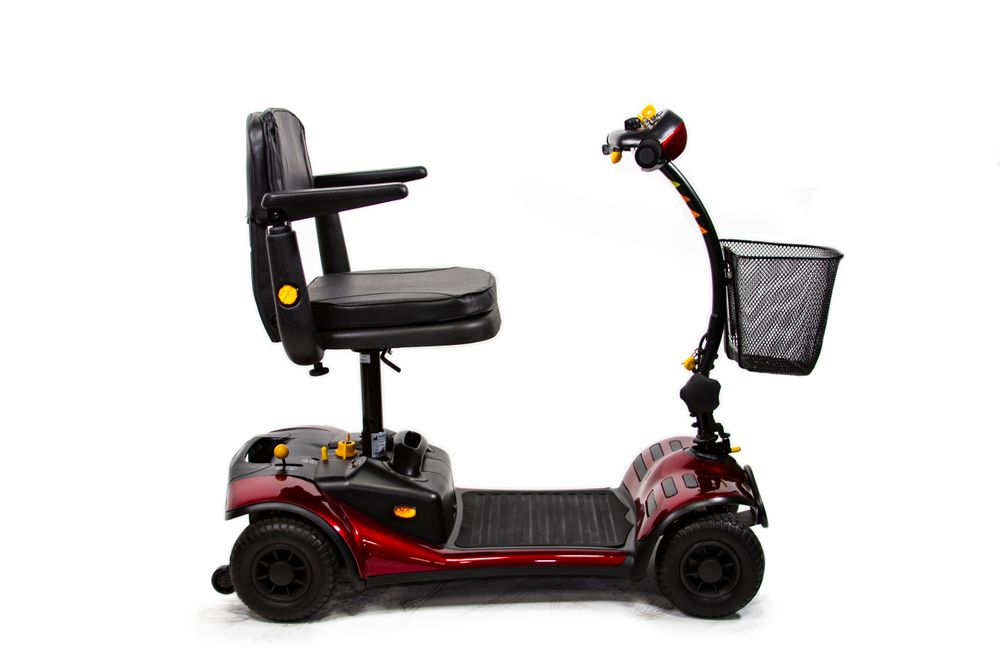
| Tires | Solid 8-inch wheels |
Range, speed, climbing, and braking performance vary with payload, battery condition, temperature, tire condition, terrain, stops, and configuration. Verify the serial-specific label and current manual before ordering.
What the specifications mean in daily use
Lift planning is where the Dasher 4 separates itself. A low heaviest-piece figure may be more meaningful than a lower assembled weight if a caregiver loads the scooter section by section. The compromise is trip radius. Owners should avoid planning an eight-mile outbound trip on an eight-mile stated maximum and should keep battery age, temperature, hills, and payload in the reserve calculation.
Do not choose from capacity or range alone. Start with the user’s seated fit, transfer method, control reach, combined rider-and-cargo weight, doorway width, turning space, storage location, and the heaviest item that must actually be lifted. Our mobility scooter selection guide explains that process, while the weight-capacity guide explains why a published maximum is not a comfort target.
Pros
- A 26-pound heaviest piece is unusually transport-friendly.
- The current 300-pound rating improves on older-unit limits.
- Swivel seating and an adjustable curved tiller support easier transfers and knee room.
- Solid tires avoid punctures.
Cons
- Maximum stated range is modest even with the larger battery option.
- Two-inch clearance calls for smooth surfaces and careful threshold approach.
- The sales sheet lists only limited suspension.
- Older units may have a different capacity, so used buyers must confirm the exact date and label.
Certification and documentation check
The official 2025 sales sheet lists HCPCS K0800. That code relates to reimbursement classification and is not a safety certification. Shoprider’s official page and sales sheet are the primary documents used here; buyers of used units should rely on the serial label and matching manual because the capacity changed for units purchased after January 1, 2024.
Words such as “approved,” “compliant,” “registered,” “cleared,” and “tested to” are not interchangeable. A billing code is not a safety certificate, an FDA device classification is not a personal medical recommendation, and no manufacturer statement guarantees airline acceptance. For flights, review our mobility scooter airline planning guide and lithium battery documentation guide, then contact the operating carrier.
Who should shortlist it?
Users who prioritize low individual lift weight and straightforward disassembly for short trips. Before buying, arrange a seated trial when possible. Confirm that the user can steer, brake, transfer, and maintain posture without strain, and that a helper can safely manage every transport component.
Who should choose something else?
Long-range days, rough routes, or anyone who needs suspension and generous ground clearance. Compare at least one alternative from the same size class and one from the next class up or down. That makes the portability, comfort, and route tradeoffs easier to see than comparing headline prices alone.
Ownership checklist before purchase
- Measure doors, elevators, vehicle openings, ramps, storage space, and turning areas.
- Confirm the exact battery chemistry, capacity, charger, replacement cost, and local service path.
- Check the heaviest transport component against the actual lifter, lift, ramp, or vehicle rating.
- Read the current owner’s manual, warranty exclusions, tire instructions, and charging schedule.
- Plan trips with a substantial range reserve instead of using the published maximum as a target.
After purchase, use a repeatable inspection routine. Our mobility scooter maintenance checklist covers tires, fasteners, controls, brakes, battery care, and service triggers.
Final assessment
The Dasher 4’s strongest argument is not speed or range—it is the 26-pound heaviest section after three-part disassembly. That can materially change car loading for some households, while the eight- or ten-mile stated range remains best suited to shorter outings. The right decision depends on fit and route evidence, not brand recognition. Treat this review as a research starting point, then verify the current configuration with the manufacturer or an authorized provider.
Official sources
Product image used for editorial identification and attributed to the manufacturer. MobilityScooterLab is not the manufacturer and has not independently laboratory-tested the product.

Questions and reader comments