
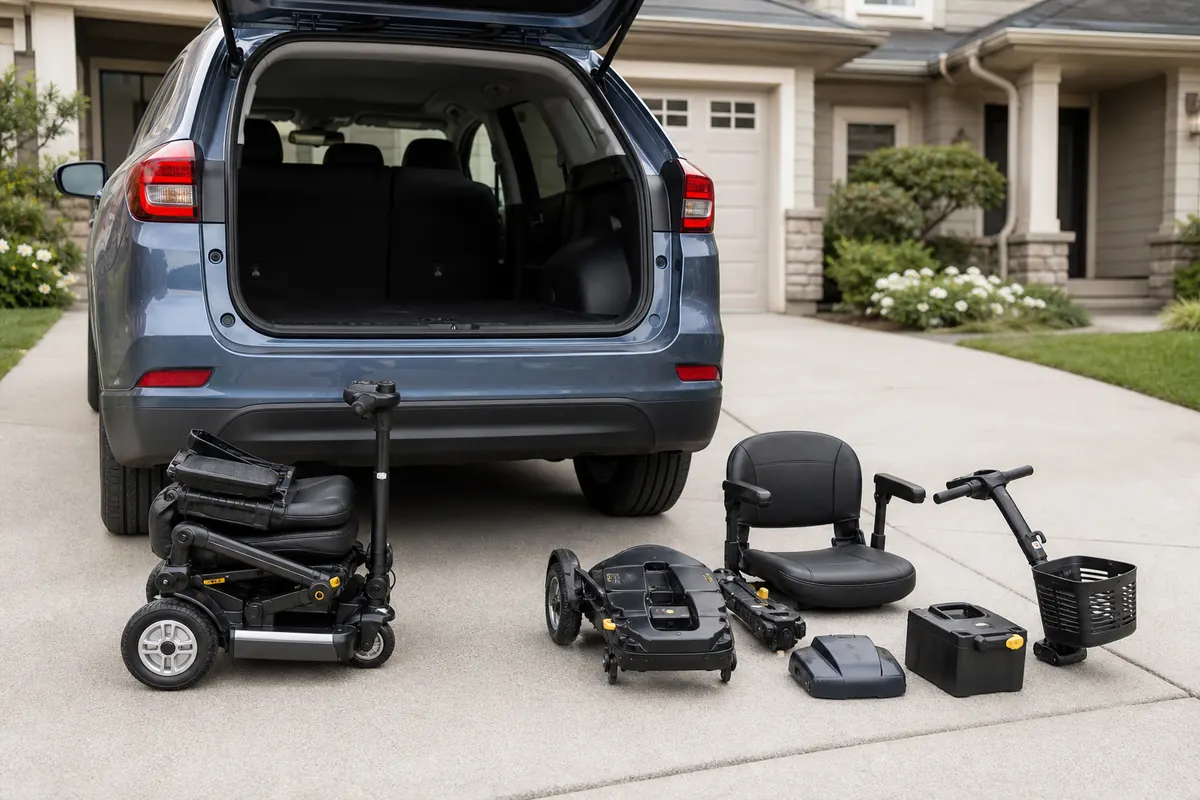
Quick answer: A folding mobility scooter usually stays in one main piece and changes shape for storage, while a disassembly scooter separates into several liftable sections. Neither design is automatically more portable. The better choice depends on the heaviest piece, the largest stored dimension, the number of handling steps, and the person or equipment available to load it.
Shopping labels can blur the distinction. Some folding scooters also have a removable battery or seat, and some disassembly models fold at the tiller before their sections separate. Compare the actual procedure in the owner manual rather than relying on a product name. This guide focuses on transport and everyday use, not on a claim that one mechanism is universally better.
Folding and disassembly at a glance
| Decision factor | Folding scooter | Disassembly scooter |
|---|---|---|
| Stored form | Usually one main folded unit | Several separate components |
| Loading pattern | Fewer steps, but the main lift may be heavy | More steps, with weight divided among pieces |
| Loose parts | Fewer pieces to track | Seat, battery box, basket, or drive section may need separate storage |
| Setup | Unfold, lock, and confirm controls | Reconnect sections in the correct order and check each latch |
| Best question | Can the folded unit be moved safely? | Can every part be identified, lifted, and reassembled reliably? |
The table describes common patterns, not a standard. Always verify the exact model’s weights, dimensions, battery procedure, and locking sequence.
What “folding” means in practice
A manual-fold model may use a release, hinge, or telescoping assembly. A powered-fold model adds a motorized mechanism but may still require the user to position the tiller, remove a key, or secure the folded frame. The scooter is normally transported as one substantial object, even if a battery or armrests come off.
Folding can reduce setup steps and keep parts together. Its main limitation is concentrated weight. A scooter described as compact can still be too heavy or awkward for one person to lift into a trunk. Record both total transport weight and the weight after every manufacturer-approved removable item has been taken off.
What “disassembly” means in practice
A disassembly scooter may separate into a front section, rear drive unit, seat, battery box, and basket. This can make the heaviest lift lower than the weight of a comparable one-piece folder. It also creates several transfers between the scooter, ground, and vehicle.
Look beyond the advertised number of pieces. A heavy rear drive section may have an off-center handle, while a light seat may be bulky. Ask the seller for the heaviest component weight and each component’s dimensions. Use the owner manual to confirm whether tools are needed and whether cables or connectors are exposed during normal disassembly.
Compare the complete loading task
Vehicle opening and cargo shape
Measure the narrowest width and lowest height along the entire loading path, not just the empty trunk floor. Include the hatch opening, bumper lip, wheel wells, rear-seat angle, and space needed to close the door. A folded rectangle may fit where a long chassis does not; separate components may fit around other luggage more easily.
Lift height and handling
The same weight feels different when it must cross a high bumper or be rotated inside a small cargo area. Do a dry fit only with permission and safe assistance. If manual lifting is not dependable, investigate a compatible ramp, hoist, exterior carrier, or a different scooter and vehicle combination. Confirm vehicle payload, hitch rating, carrier rating, and securement instructions before purchasing transport equipment.
Setup reliability
A fast mechanism is useful only when it locks consistently. For a folder, check the fold latch, tiller adjustment, seat position, and accidental-activation protection. For a disassembly model, check every mechanical coupling, electrical connector, battery latch, and seat lock in the order stated by the manufacturer. Never ride if a section does not seat fully.
Daily-use differences after transport
Transport style does not determine ride quality. Wheel size, wheelbase, ground clearance, turning radius, suspension, tire design, seat support, speed, range, and rated capacity vary within both groups. A folder may suit a smooth indoor trip, while a disassembly scooter may be configured for similar use—or the reverse. Compare the route first using our portable versus full-size mobility scooter guide.
Also consider where parts will wait during a trip. Disassembled pieces need clean, secure storage and protection from shifting cargo. A folded unit needs a stable parking position so it cannot unfold or roll. Follow the manual’s transport and tie-down instructions; a parking brake alone is not a general cargo-securement system.
Travel is a separate compatibility check
A folding label does not guarantee airline, cruise, rail, or bus acceptance. Operators may ask for overall dimensions, weight, battery chemistry, watt-hours, instructions for preventing activation, and information about removable batteries. Aircraft and vehicle capacity can also matter. Review current operator requirements for every segment before travel.
For flights, start with our mobility scooter lithium battery airline rules. For ship storage and boarding questions, use Preparing a Mobility Scooter for a Cruise. Policies can change, so obtain confirmation for the actual itinerary.
Practical comparison checklist
- Write down total transport weight, heaviest-piece weight, and every stored dimension.
- Measure the complete vehicle loading path and available cargo floor.
- Count the lifts, bends, rotations, latches, and connectors in one setup cycle.
- Confirm which parts the manufacturer permits the user to remove.
- Check whether the scooter can be secured against movement in the vehicle.
- Compare ride requirements separately: capacity, turning space, surfaces, slopes, and range.
- Practice the documented setup sequence before relying on the scooter away from home.
- Keep the manual and a labeled photo of the assembled scooter with the travel kit.
Frequently asked questions
Is a folding scooter always easier to put in a car?
No. It has fewer main pieces, but its concentrated weight and folded shape may be harder to lift through a particular hatch. Compare the real opening, lift height, and approved transport configuration.
Does disassembly damage electrical connectors?
A scooter designed for routine disassembly should have a documented connection process. Damage can still occur if parts are forced, dropped, contaminated, or connected out of alignment. Inspect user-accessible connectors as the manual directs and arrange service when a latch or connection is abnormal.
Which design has the lower heaviest piece?
There is no category-wide answer. The specification sheet should identify the heaviest component after approved disassembly. Ask what that figure includes and verify it in the current manual.
Can I transport a scooter on its side?
Only if the manufacturer explicitly permits that orientation. Batteries, controls, body panels, and seat mechanisms may be damaged by an improvised position.
Which is better for someone who travels alone?
Choose the system that the traveler can manage for the entire journey, including loading, securing, charging, and setup. A vehicle lift, delivery service, or rental may be more dependable than either manual-handling option.
For a broader review of scooter categories and route fit, continue with Types of Mobility Scooters Explained and The Complete Mobility Scooter Buying Guide.
Last reviewed: July 22, 2026. This article provides general comparison information. Follow the current scooter and transport-equipment manuals, and verify carrier policies for each trip.

Questions and reader comments