
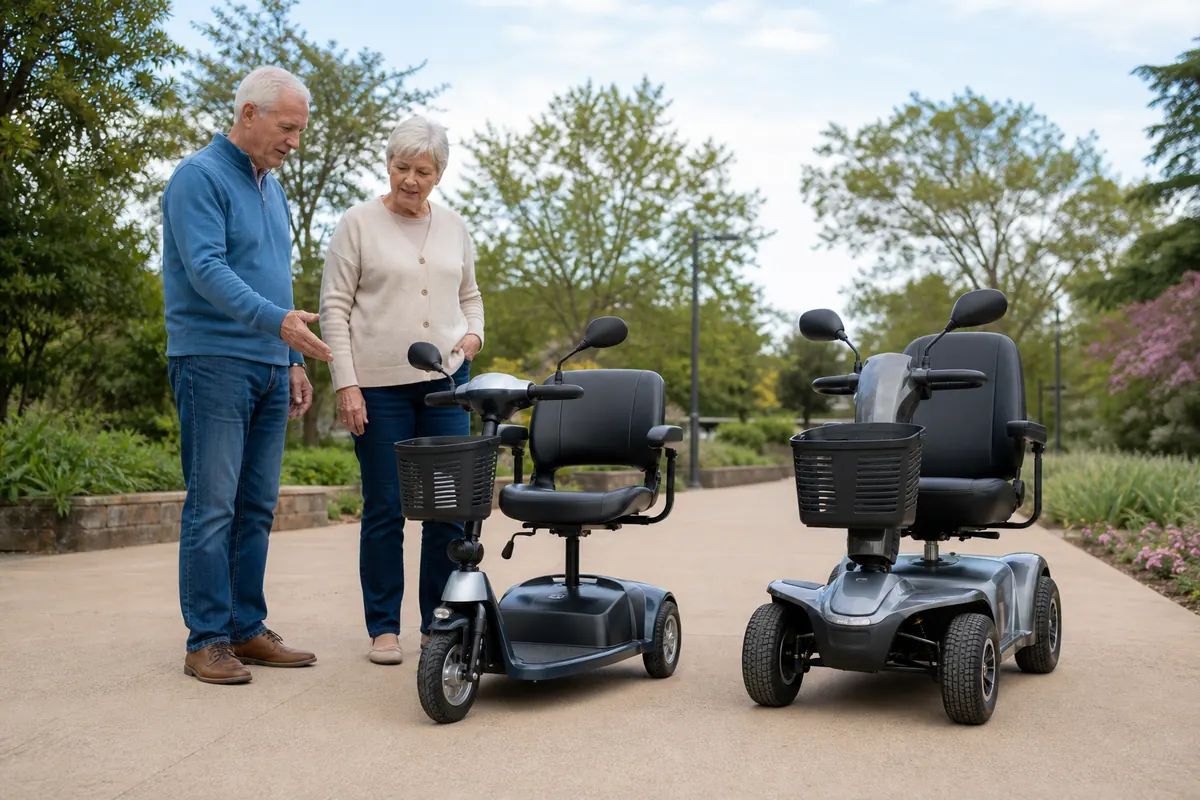
Quick answer: Portable mobility scooters prioritize transport and tighter storage, while full-size scooters generally prioritize sustained outdoor use, space, and higher-capacity components. Those are tendencies, not formal product classes. Choose by matching verified specifications to the rider’s route, transfers, storage, vehicle, and support plan.
“Portable” is a marketing description rather than a single engineering standard. One model may fold; another may separate into five pieces. Likewise, “full-size” can cover many wheelbases, capacities, and configurations. A useful comparison begins with measurements and the owner manual, not the category name.
Portable and full-size scooters compared
| Factor | Portable designs often emphasize | Full-size designs often emphasize |
|---|---|---|
| Transport | Folding or user-removable sections | Vehicle lift, ramp, or accessible vehicle |
| Storage | Smaller footprint | More parking and turning space |
| Route | Smoother, shorter, or indoor-focused trips | Longer outdoor routes within stated limits |
| Components | Compact wheels, batteries, and seating | Larger chassis, batteries, seating, or tires on many models |
| Key constraint | Load, surface, clearance, and real-world range | Size, weight, maneuvering, and transport equipment |
Individual scooters can depart from every pattern in the table. Confirm the exact model’s rated capacity, dimensions, turning radius, ground clearance, slope and surface limits, battery system, and transport procedure.
Start with the route, not the scooter
Map a normal trip from the storage location to the destination. Note doorway clear widths, elevator dimensions, curb ramps, cross-slopes, rough pavement, thresholds, grass or gravel, covered charging areas, and places to turn. Include weather exposure and any segment that requires a bus, train, rideshare, private car, or building lift.
A compact scooter may maneuver well in a shop but have limited clearance on broken pavement. A larger scooter may feel more settled on an approved outdoor surface yet be unable to turn in a home hallway. Neither compromise is minor if it occurs every day.
Transportability is more than total weight
Manual loading
For a folding or disassembly model, record the heaviest component and largest stored shape. Measure the vehicle’s hatch, bumper height, cargo floor, and space remaining for passengers or luggage. The article Folding vs. Disassembly Mobility Scooters explains how to compare the complete handling task.
Lifts, ramps, and carriers
A full-size scooter may require powered loading or an accessible vehicle. Verify the scooter’s actual operating or transport weight, including battery and accessories, against every equipment rating. Also check vehicle payload, hitch tongue rating where relevant, ramp angle limits, securement points, ground clearance, and license-plate or lighting requirements. A carrier that can hold the scooter is not necessarily compatible with the vehicle.
Ride-related tradeoffs
Wheels, tires, and clearance
Larger wheels and greater ground clearance can help with certain outdoor obstacles, but only within the manufacturer’s stated surface limits. Tire construction also changes maintenance and ride characteristics. Use our solid versus pneumatic tire comparison before treating wheel appearance as a durability guarantee.
Seat and controls
Compare usable seat width and depth, back support, armrest adjustment, swivel clearance, tiller reach, control force, foot space, and transfer approach. Do not infer fit from the rider’s height or from a catalog photo. Whenever possible, arrange a supervised demonstration with the exact seat and accessory configuration being considered.
Range and battery reserve
Advertised range comes from defined test conditions. Hills, total load, temperature, tire pressure, starts and stops, surface resistance, battery age, and accessories can reduce trip distance. Plan with a conservative reserve and compare battery specifications in watt-hours when appropriate, while recognizing that efficiency and test methods still differ. See How Long Do Mobility Scooter Batteries Last? for maintenance and range factors.
Capacity needs careful reading
The rated weight capacity is a limit, not a target and not a complete fit test. Count the rider, clothing, bags, mounted accessories, and anything carried in a basket. Ask whether accessory limits are separate and whether performance ratings change near maximum load. Never choose a scooter with a lower rating because a short trip seems harmless.
A higher-capacity full-size model can offer needed structural margin, but it may also require wider doors, larger lifts, and more floor space. The best choice meets every relevant limit at the same time.
Home storage and charging
Plan a dry, ventilated location that follows the battery and charger manuals, keeps cords out of walkways, and allows the scooter to be parked without blocking an exit. Confirm outlet access and the permitted charging temperature. A portable scooter is not automatically safe to charge in a closet or vehicle, and a removable battery does not make every indoor location suitable.
Travel and operator policies
Portable does not mean automatically accepted by an airline, cruise line, bus, or rail operator. The carrier may need exact dimensions, total weight, battery chemistry, watt-hours, and instructions for preventing accidental activation. Space and loading equipment vary by vehicle or vessel. Check the operating carrier for each segment and retain written confirmation.
Use the Mobility Scooter Rental Guide for Travel if transporting either design is impractical. A correctly specified rental at the destination can be more workable than choosing a scooter around one annual trip.
Practical decision checklist
- List the most demanding regular route and all surfaces, slopes, thresholds, and turns.
- Measure home doors, elevator space, storage area, vehicle opening, and loading height.
- Record operating weight, transport weight, heaviest piece, and rated capacity.
- Verify range conditions, battery type, charger requirements, and replacement support.
- Try the controls, seating, transfer approach, and turning space with the planned setup.
- Price necessary ramps, lifts, carriers, delivery, maintenance, and batteries.
- Read the manual’s prohibited surfaces, inclines, weather limits, and securement method.
- Confirm who can provide service near home and at frequent destinations.
Frequently asked questions
Is a portable scooter suitable for everyday use?
It can be when its capacity, fit, surfaces, range, durability, and support match the daily route. “Portable” alone does not establish those qualities.
Is a full-size scooter always more comfortable?
No. Many have larger seating or suspension components, but comfort and control access depend on the exact configuration and rider. A real fit assessment is more useful than the category.
Can a full-size scooter go on public transportation?
Possibly, depending on the device, vehicle, lift or ramp, securement area, and current operator policy. Contact the transit provider with exact dimensions and weight before relying on a route.
Which type is better for rough ground?
Use only a model whose manufacturer permits the specific surface and slope. Tire size, clearance, stability, speed, weather, and obstacle limits matter more than a portable or full-size label.
Should occasional travel determine the purchase?
Usually the regular route deserves priority. Compare the total cost and reliability of rentals, accessible transportation, or loading equipment for occasional trips before accepting daily compromises.
For a complete requirements worksheet, read The Complete Mobility Scooter Buying Guide.
Last reviewed: July 22, 2026. This article offers general comparison information. Verify specifications in the current manufacturer documents and policies with each transport operator.

Questions and reader comments