
Editorial disclosure: This is an independent, specification-based review. MobilityScooterLab did not receive the product, did not conduct a hands-on test, and does not present manufacturer range claims as guaranteed real-world results. Specifications and documentation were checked against official manufacturer sources on July 23, 2026.
Quick verdict
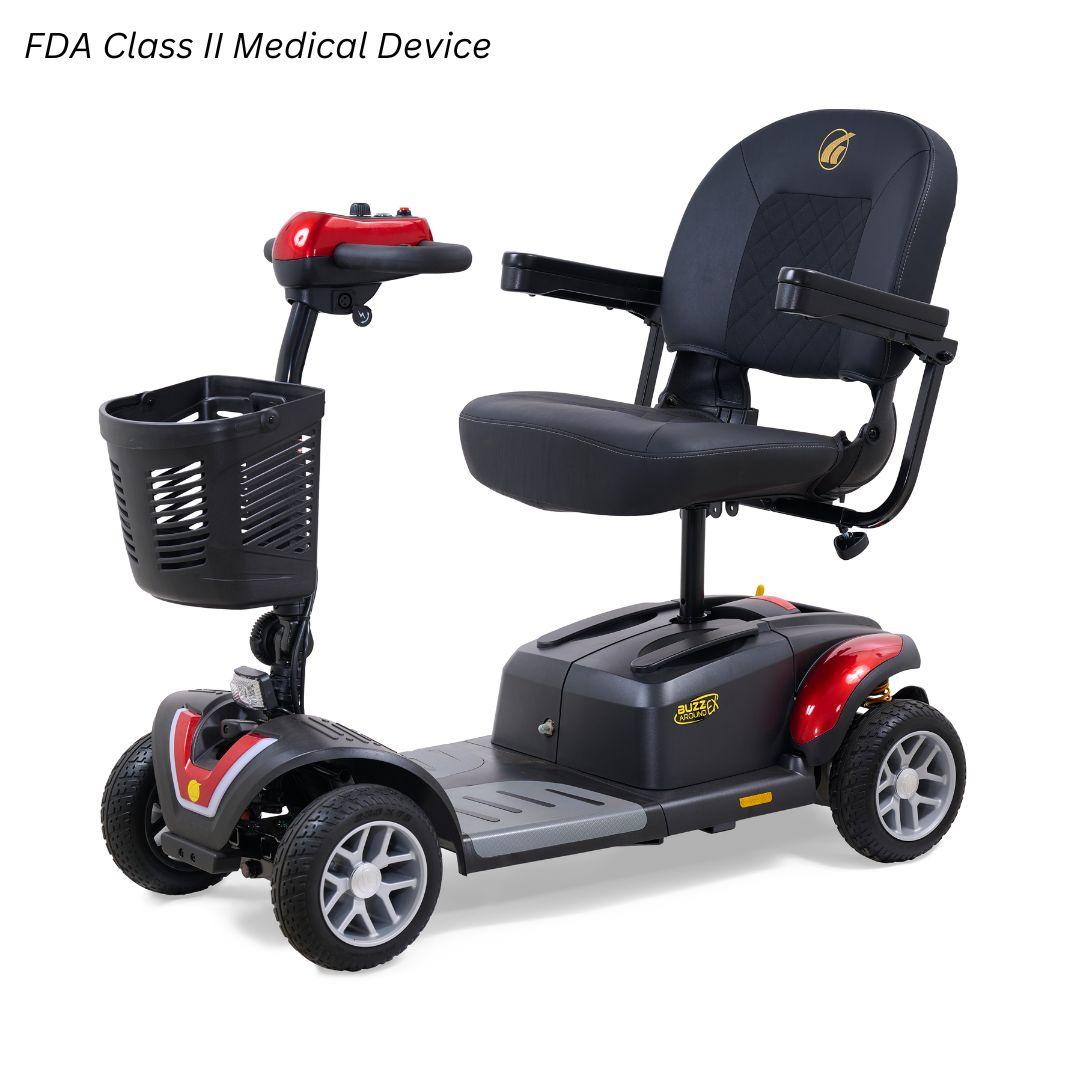
The Buzzaround EX 4-Wheel trades some liftability for an 18-mile manufacturer-rated range, 350-pound capacity, four inches of clearance, and spring suspension. It is a compelling portable-plus model when a 53-pound front section is acceptable.
Best for: Users who want more range and ride comfort than a basic travel scooter while retaining tool-free disassembly.
Think twice if: Solo loaders who cannot safely handle a 53-pound section or shoppers needing a very tight indoor turning circle.
Official specifications at a glance
| Model | GB148 |
|---|---|
| Weight capacity | 350 lb |
| Maximum speed | 5 mph |
| Manufacturer-stated range | Up to 18 miles |
| Turning radius | 54 in |
| Ground clearance | 4 in |
| Size | 44 in long × 22 in wide |
| Assembled weight | 161 lb |
| Heaviest piece | 53 lb front half |
| Battery | Two U1 batteries |
Range, speed, climbing, and braking performance vary with payload, battery condition, temperature, tire condition, terrain, stops, and configuration. Verify the serial-specific label and current manual before ordering.
What the specifications mean in daily use
The EX is best understood as a bridge between a compact travel scooter and a full-size machine. The range, clearance, suspension, and seat support are the reasons to choose it. The penalty is transport mass: disassembly changes the shape of the load, but it does not make the largest section light. Buyers should measure the vehicle opening and perform a realistic lift test before purchase.
Do not choose from capacity or range alone. Start with the user’s seated fit, transfer method, control reach, combined rider-and-cargo weight, doorway width, turning space, storage location, and the heaviest item that must actually be lifted. Our mobility scooter selection guide explains that process, while the weight-capacity guide explains why a published maximum is not a comfort target.
Pros
- Up to 18 miles of stated range is useful for longer planned outings.
- Spring suspension and a high-back seat address comfort better than many travel models.
- Four-inch clearance provides more margin at transitions than low-slung compact scooters.
- A 350-pound capacity broadens fit compared with many folding scooters.
Cons
- At 161 pounds assembled, it is not lightweight despite being disassemblable.
- The 53-pound front section may exceed a user’s or helper’s safe lifting limit.
- A 54-inch turning radius needs more indoor space than tighter travel scooters.
- Two U1 batteries contribute substantial weight.
Certification and documentation check
Golden states that its mobility devices are FDA Class II medical devices. The official page also lists electro-mechanical brakes and warranty terms. Medicare or HCPCS coding is not a safety certification, and the current product page lists this model as not coded.
Words such as “approved,” “compliant,” “registered,” “cleared,” and “tested to” are not interchangeable. A billing code is not a safety certificate, an FDA device classification is not a personal medical recommendation, and no manufacturer statement guarantees airline acceptance. For flights, review our mobility scooter airline planning guide and lithium battery documentation guide, then contact the operating carrier.
Who should shortlist it?
Users who want more range and ride comfort than a basic travel scooter while retaining tool-free disassembly. Before buying, arrange a seated trial when possible. Confirm that the user can steer, brake, transfer, and maintain posture without strain, and that a helper can safely manage every transport component.
Who should choose something else?
Solo loaders who cannot safely handle a 53-pound section or shoppers needing a very tight indoor turning circle. Compare at least one alternative from the same size class and one from the next class up or down. That makes the portability, comfort, and route tradeoffs easier to see than comparing headline prices alone.
Ownership checklist before purchase
- Measure doors, elevators, vehicle openings, ramps, storage space, and turning areas.
- Confirm the exact battery chemistry, capacity, charger, replacement cost, and local service path.
- Check the heaviest transport component against the actual lifter, lift, ramp, or vehicle rating.
- Read the current owner’s manual, warranty exclusions, tire instructions, and charging schedule.
- Plan trips with a substantial range reserve instead of using the published maximum as a target.
After purchase, use a repeatable inspection routine. Our mobility scooter maintenance checklist covers tires, fasteners, controls, brakes, battery care, and service triggers.
Final assessment
The Buzzaround EX 4-Wheel trades some liftability for an 18-mile manufacturer-rated range, 350-pound capacity, four inches of clearance, and spring suspension. It is a compelling portable-plus model when a 53-pound front section is acceptable. The right decision depends on fit and route evidence, not brand recognition. Treat this review as a research starting point, then verify the current configuration with the manufacturer or an authorized provider.
Official sources
Product image used for editorial identification and attributed to the manufacturer. MobilityScooterLab is not the manufacturer and has not independently laboratory-tested the product.

Questions and reader comments