
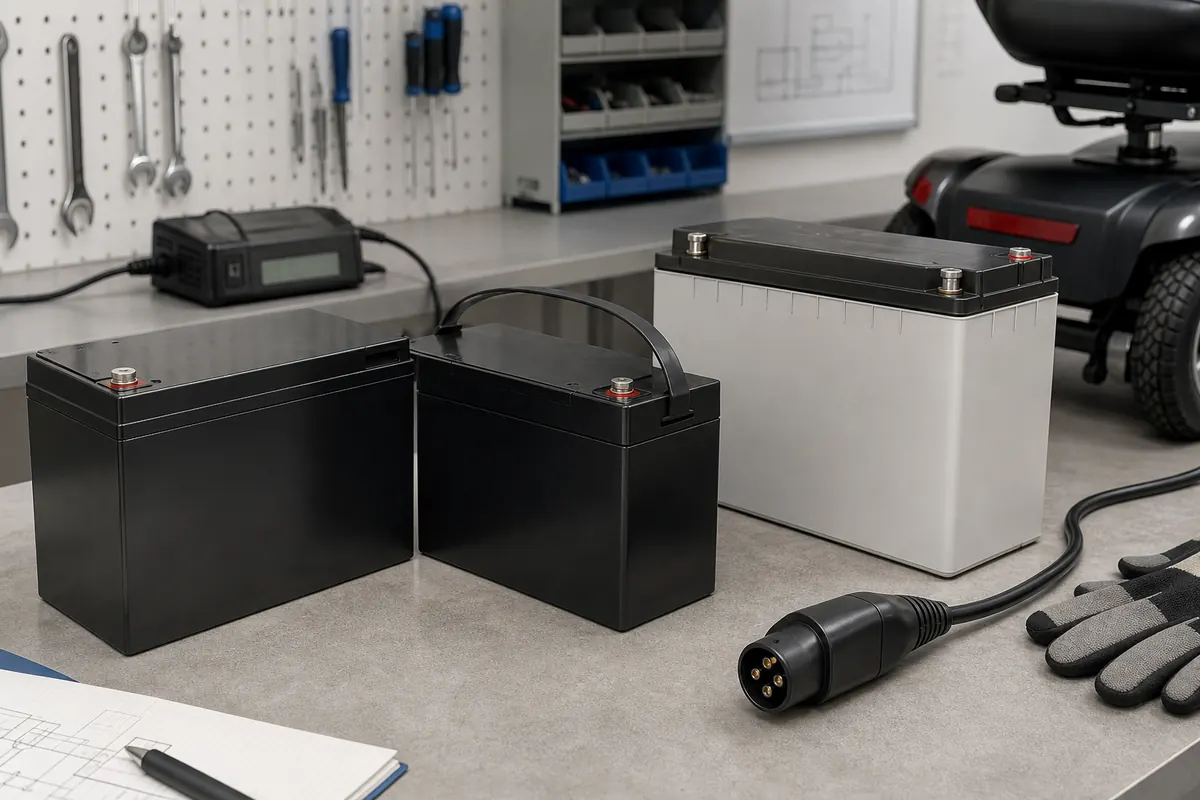
Quick answer: Mobility scooter diagnostics are moving from simple beep codes toward digital displays, configurable controllers, Bluetooth tools, NFC features, and optional remote diagnostics. Availability varies widely. Connected data can make a service call more specific, but it cannot by itself prove that a scooter is safe, measure every battery’s true capacity, or replace a physical inspection.
For an owner, the best technology is not the longest feature list. It is a system that communicates a problem clearly, works when a phone or network is unavailable, protects personal data, receives supported updates, and gives qualified repair providers usable information.
Connectivity exists in several layers
Onboard indicators and fault codes
Many scooters communicate through a flashing battery gauge, beep pattern, or LCD message. These are diagnostics even when no app is involved. A current Pride LCD-console guide says its fault codes are intended to support basic troubleshooting and displays a code and message when listed conditions occur.
The code identifies a detected condition, not always the failed part. Low voltage, for example, could involve state of charge, an aging battery, a connection, charger operation, temperature, or another load-related issue. Record the exact code and use only the owner steps in the manual.
Local wireless and programmable features
Some newer controls use NFC cards, Bluetooth, or a service programming port. Pride’s January 2026 travel-scooter manual documents optional NFC security on certain models and notes that a charger receptacle also serves as a programming port on specified consoles. These features are model-dependent; they are not evidence that every current Pride scooter has an app or remote service.
A local connection may allow an approved tool to read information or configure authorized parameters. Owners should not pair unknown apps, use copied service credentials, or change acceleration, braking, speed, or input settings outside a documented provider procedure.
Remote diagnostics and telematics
Controller supplier Dynamic Controls describes current mobility-scooter platforms with flexible connectivity and support for remote diagnostics through IoT devices. A connected system could transmit status or fault information to a service portal, depending on how a scooter manufacturer implements it.
Connected power wheelchairs show a more developed adjacent example: Permobil’s official Connect materials describe remote service support and user access to battery status and usage information. That power-wheelchair example signals a direction for powered mobility, not a claim that the same functions are available on a particular mobility scooter.
What useful diagnostic data can do
- Preserve an intermittent fault code before it disappears.
- Show when a fault occurred and, on some systems, operating conditions around it.
- Help a provider decide whether to bring a battery tester, controller, cable, or other part.
- Track distance or operating hours for manual-based maintenance reminders.
- Report approximate battery status or charging events.
- Support a clearer conversation between the owner, caregiver, dealer, and technician.
It should reduce guesswork, not automate a parts cannon. Ask the provider to explain which measurement supports the diagnosis and what physical checks remain.
What a dashboard cannot establish
A battery percentage or range estimate is not a laboratory capacity test. Estimates can change with load, temperature, hills, tire pressure, surface, battery age, and driving pattern. A “no faults” screen also does not inspect tire damage, frame cracks, loose seating, water entry, brake behavior, or a damaged charge cord.
Similarly, clearing a code does not prove the underlying condition is corrected. If the fault returns, stopping or control behavior changes, or the scooter has visible damage, keep it out of service and arrange qualified inspection. Use the maintenance checklist alongside digital information.
Questions to ask about a connected scooter
Operation and service
- Can the scooter start, stop, and display essential faults without a phone or internet connection?
- Which data can the owner see, export, and share?
- Can an independent qualified provider obtain codes and approved tools?
- Who may change configuration, and is every change logged?
- What happens if the app, cloud service, or cellular network is retired?
Cost and support
- Is connectivity included, subscription-based, or limited to a trial?
- Which phone operating systems are supported and for how long?
- How are firmware updates delivered, and can a failed update disable use?
- Does ownership transfer require account release from the seller?
- Is there a non-app support channel with accessible communication options?
Data and privacy
- Does the system collect location, trip, fault, battery, account, or device-identifier data?
- Who receives it: manufacturer, dealer, payer, fleet manager, or another vendor?
- What consent choices, retention period, deletion process, and breach contact apply?
- Can location collection be disabled without losing essential scooter functions?
Read the current privacy notice before activation and save a copy. Marketing phrases such as “smart,” “proactive,” or “real time” do not answer these questions.
Basic cybersecurity for owners
NIST explains that IoT products add cybersecurity and privacy risks through interconnection, cloud services, and interaction with the physical world. Its guidance highlights capabilities such as data protection and secure software updates. FDA consumer guidance for connected medical devices similarly recommends unique passwords, manufacturer-approved connections, and supported updates. Whether a particular scooter is regulated as a medical device depends on the product, but those habits are sensible for any connected mobility device.
- Use a unique account password and multi-factor authentication when offered.
- Download apps from the manufacturer-linked official store page.
- Install only manufacturer-approved firmware and follow compatibility instructions.
- Do not share service codes, pairing tokens, or account credentials publicly.
- Remove the old owner’s account and paired phones when buying used.
- Register for safety, recall, and cybersecurity notices.
- Report unexpected movement, settings, logins, or pairing prompts immediately.
A practical diagnostic workflow
- Move away from traffic or another immediate hazard if this can be done safely.
- Note the exact code, message, light pattern, time, and operating condition.
- Photograph the display without posting the serial number or account details publicly.
- Follow only the manual’s owner-level checks, such as drive mode or charger disconnection.
- Do not repeatedly clear a fault or cycle power to force operation.
- Send the record to a qualified provider and ask what additional test is required.
- Keep the diagnosis, parts, software version, and configuration changes in the service file.
Practical connectivity checklist
- Essential operation does not depend on an unexplained app or subscription.
- Owner and technician can retrieve documented fault information.
- Update policy, support period, and end-of-service plan are written.
- Privacy notice explains data, recipients, retention, and deletion.
- Accounts use unique credentials and old pairings are removed.
- Range and battery displays are treated as estimates, not guarantees.
- Remote data is combined with physical inspection.
- Configuration and repair records can be exported or printed.
For a buyer-focused view of documentation, parts access, transportability, and service support, see Mobility Scooter Industry Trends: Documentation, Repair, and Transportability.
Frequently asked questions
Do mobility scooters have OBD ports like cars?
There is no universal scooter equivalent that owners can assume. Interfaces, fault codes, tools, and access permissions vary by controller and manufacturer.
Can an app diagnose a bad battery?
It may show status, voltage-related faults, or trends, but a qualified capacity or load evaluation may still be needed. See the battery-life guide.
Can a technician repair the scooter remotely?
Some systems support remote information or configuration, but physical defects and safety checks still require hands-on service. Confirm exactly what “remote service” means.
Should I install every update immediately?
Follow the manufacturer’s instructions, compatibility notes, and urgency guidance. Use adequate charge and do not interrupt a documented update process.
Can connectivity keep a scooter from being stolen?
NFC, locks, or location features may add layers, but none guarantees recovery. Use the physical security and storage guidance for the exact scooter.
How does right to repair affect diagnostics?
Covered laws may improve access to codes, software, tools, or documentation. Scope is state- and product-specific; read the mobility scooter right-to-repair guide.
Sources and further reading
- Dynamic Controls: mobility scooter control systems and remote diagnostics
- Pride Mobility Travel Scooter Series owner’s manual (January 2026)
- Permobil +Connect official overview (power-wheelchair example)
- NIST Cybersecurity for IoT FAQ
- FDA consumer guidance on connected medical-device cybersecurity
Last reviewed: July 22, 2026. Feature availability and software support change by model and region. Verify current manufacturer documentation before purchase, pairing, configuration, or repair.
Questions and reader comments