

Quick answer: Buy a used mobility scooter only after confirming its identity, ownership, specifications, fit, battery and charger compatibility, service history, physical condition, control behavior, and available parts support. Test it in a controlled area, obtain a written bill of sale, and budget for professional inspection and likely wear items.
A clean appearance and a full battery gauge do not prove condition. The goal is not to diagnose electronics yourself; it is to collect enough evidence to decide whether a qualified inspection and the total cost make sense.
Decide what you need before shopping
Write down the rider’s realistic load, seating and control needs, doorway and elevator measurements, intended surfaces, expected trip length, storage location, charging access, and transportation method. A bargain model that does not fit the home or vehicle can cost more to correct than choosing a suitable scooter initially.
Use the complete mobility scooter buying guide to create a shortlist.
Verify identity and lawful ownership
Ask for the full manufacturer, model name, model number, serial number, approximate purchase date, and original receipt if available. Compare identifiers on the frame with the manual and any invoice. Avoid a scooter with an altered, removed, or unreadable identification label unless ownership and support can be resolved before purchase.
Ask the seller to state in writing that they own the scooter and may sell it. Record both parties, date, amount, serial number, included equipment, disclosed defects, and whether the sale is as-is. Follow local private-sale requirements.
Find the exact manual and specifications
Download the correct manual from the manufacturer or another reliable source. Confirm weight capacity, overall dimensions, turning information, ground clearance, approved battery and charger, tire type, slope and surface restrictions, transport procedure, and warnings. Similar product names may refer to different generations.
Check whether qualified service and essential parts remain available locally, including approved batteries, charger, tires, keys, seat parts, and model-specific connectors.
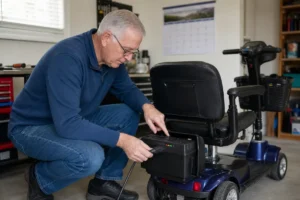
Review the scooter before powering it on
Frame, seat, and tiller
Look for cracks, bends, corrosion, impact marks, missing hardware, mismatched paint, loose covers, and signs of improvised repair. Check that the seat is the correct type, locks as designed, swivels properly, and has secure armrests. Verify that the tiller adjustment holds without excess movement.
Tires, wheels, and anti-tip parts
Inspect tread, sidewalls, flat spots, cuts, separation, uneven wear, wheel damage, and missing components. Pneumatic tires should use the model’s specified pressure; repeated pressure loss needs investigation. Check visible anti-tip components against the manual. Do not accept their removal as a performance upgrade.
Wiring and controls
Look for exposed conductors, taped repairs, crushed cables, loose connectors, water staining, heat discoloration, nonstandard switches, or drilled panels. Do not open sealed controllers, batteries, motors, or chargers during a buyer inspection. Visible modification is a reason to request qualified evaluation, not to continue experimenting.
Evaluate batteries and charger carefully
Record battery chemistry, brand, model, capacity, date code if visible, installation date if documented, and whether the scooter requires a matched set. Confirm that the charger label and connector match the scooter’s official requirements. Damaged plugs, frayed cables, swelling, leakage, unusual odor, or heat are stop signs.
A dashboard gauge after charging does not measure usable capacity. Ask for charging records, typical recent route, storage history, and any battery invoices, but treat undocumented claims as unknown. Arrange model-appropriate battery and charging-system testing through a qualified provider when battery value affects the price.
Assume neither that old batteries are automatically unusable nor that recently labeled batteries are healthy. Price a complete approved replacement set as a contingency. Read the mobility scooter battery-life guide for the factors that affect service.
Conduct a controlled functional check
With the seller’s permission, follow the manual in a dry, level, uncluttered area away from traffic. Start at the lowest practical speed. Confirm that the freewheel lever is in drive mode, the seat and tiller are locked, and the path is clear.
- Power on and observe warning indicators or error codes.
- Check that the throttle returns when released.
- Move forward and reverse slowly.
- Verify predictable stopping as described by the manual.
- Turn both directions and listen for new grinding, clicking, or rubbing.
- Test the horn, lights, indicators, and speed control if equipped.
- Watch for intermittent power, pulling, vibration, odor, or unusual heat.
Do not test an unfamiliar scooter on slopes, curbs, wet ground, or public traffic. Stop for uncommanded movement, unpredictable stopping, binding steering, wheel wobble, or an electrical warning.
Ask for maintenance and incident history
Request service invoices and ask about collisions, water exposure, long storage, transport damage, recurring errors, tires, batteries, controller work, and charger replacement.
Identify who performed repairs and whether replacement parts matched manufacturer requirements. Homemade wiring, speed changes, structural welding, or mixed batteries require specialist review. If the scooter was recalled, follow the manufacturer’s current remedy process and confirm completion through appropriate documentation.
Check fit, access, and transport
The rider should be able to sit stably, reach the controls, place their feet as intended, and use the seat and armrests according to the manual. For individualized positioning or transfer support, involve a qualified mobility professional.
Measure the scooter rather than trusting the listing. Confirm overall width and length, turning space, storage clearance, and the heaviest disassembled component if applicable. Check the actual configured scooter weight against every ramp, lift, carrier, hoist, and vehicle limit.
Calculate the true used price
Add the sale price, inspection, pickup or freight, cleaning, approved batteries, tires, missing charger or keys, repairs, accessories, home access, and vehicle equipment. Include the cost of downtime and the possibility that an inspected scooter is not worth repairing. Compare that total with a current new or professionally refurbished alternative that includes known warranty and return terms.
The mobility scooter total-cost checklist provides a side-by-side worksheet.
Private seller, dealer, or refurbished unit
A private sale may have no return right or warranty. A dealer or refurbisher may include inspection, delivery, coverage, or service, but get each benefit in writing. “Refurbished” has no single universal meaning; ask what was inspected or replaced and read the warranty and return policy.
Practical used-scooter checklist
- Requirements and measurements written before shopping
- Full model and serial number verified
- Seller’s ownership and bill of sale documented
- Correct manual and official specifications saved
- Capacity, fit, route, and transport compatibility checked
- Frame, seat, tiller, tires, wheels, and wiring inspected
- Approved battery set and charger identified
- Service, storage, damage, and modification history requested
- Controlled low-speed function check completed
- Qualified inspection arranged when condition is uncertain
- Parts and local service availability confirmed
- Total cost and contingency compared with alternatives
- Included items, defects, terms, and payment recorded
Walk-away signs
- The seller will not provide or allow inspection of the serial number.
- Ownership is unclear or the payment request is inconsistent.
- The scooter moves without a command or does not stop predictably.
- There is battery swelling, leakage, smoke, burning odor, or damaged charging equipment.
- The frame is cracked, badly bent, or repaired without documentation.
- Critical specifications cannot be matched to the exact model.
- The seller discourages a reasonable inspection or creates artificial urgency.
Frequently asked questions
How old is too old for a used mobility scooter?
Age alone is not a complete condition measure. Identity, support, service history, storage, batteries, parts availability, physical inspection, and functional behavior matter. An older unsupported model may create more risk even when it looks clean.
Can I test battery range during one viewing?
A brief ride cannot establish full usable capacity. Record available evidence and use qualified testing appropriate to the battery and scooter when the result affects the purchase.
Should I replace the batteries immediately?
Not automatically. Identify and inspect the approved system, review records, and obtain testing when needed. Budgeting for replacement is prudent when condition is undocumented.
Is a used scooter sold without its original charger a good deal?
Only after the exact approved charger is identified, available, and included in the total cost. Do not test or charge the scooter with a connector that merely appears to fit.
What paperwork should I keep?
Keep the bill of sale, serial number, seller details, listing, payment record, manual, service records, inspection result, battery information, keys record, and photographs of condition at handover.
Last reviewed: July 22, 2026. This checklist is general consumer information. Follow the exact scooter, battery, and charger manuals, and use qualified service for safety-critical inspection or repair.

Questions and reader comments