
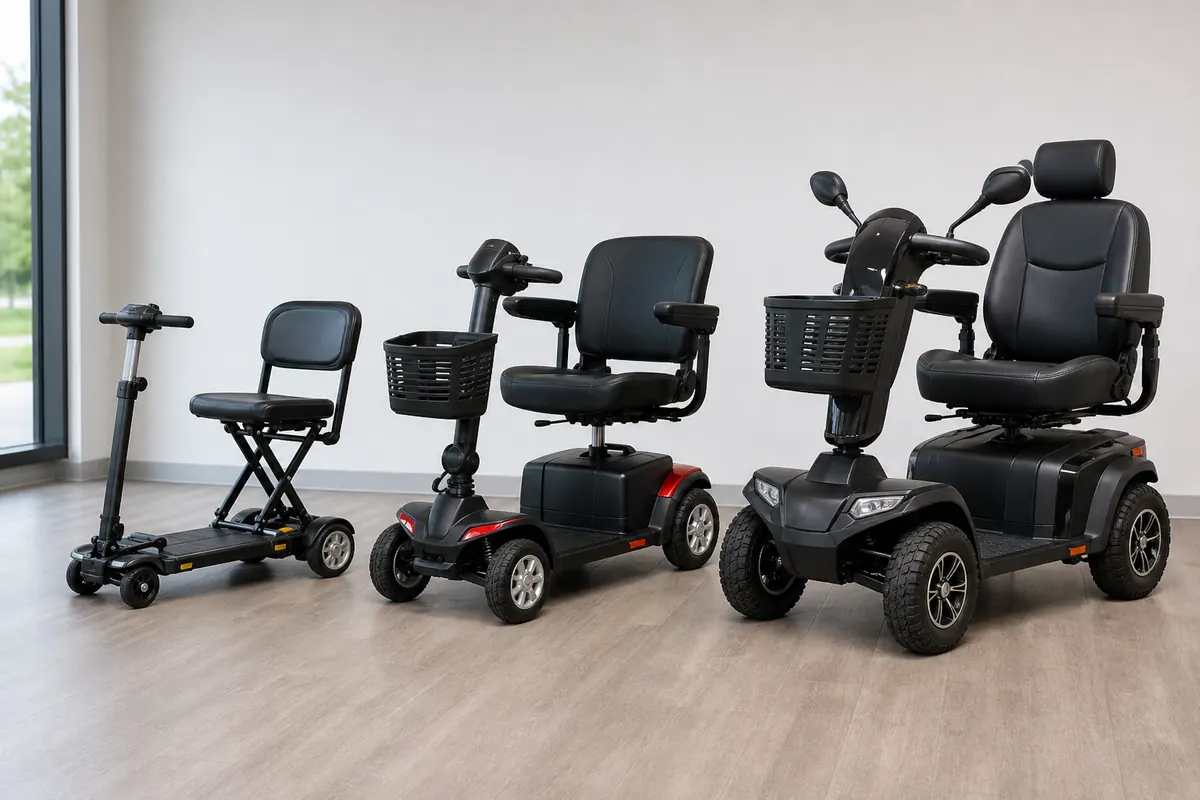
Quick answer: The main types of mobility scooters are folding scooters, disassembling travel scooters, mid-size everyday scooters, full-size outdoor scooters, and models configured around either three or four wheels. The useful distinction is not the label alone—it is how the scooter balances fit, turning space, terrain, transport weight, range, and comfort.
Manufacturers and retailers use category names differently, so two products called “travel scooters” may have very different dimensions and abilities. This guide explains the common groups and the questions that reveal what a specific model can actually do.
Mobility scooter types at a glance
| Type | Common use | Typical advantage | Typical limit |
|---|---|---|---|
| Folding | Storage, vehicle trips, short errands | Folds without complete disassembly | May still be heavy; compact seating and wheels |
| Disassembling travel | Car transport and smooth destinations | Separates into lighter components | Repeated assembly and lifting; modest clearance |
| Mid-size | Mixed indoor and outdoor use | Balance of comfort and maneuverability | More storage and vehicle space |
| Full-size/outdoor | Longer neighborhood routes and uneven pavement | Larger seating, wheels, batteries, and clearance | Wide, heavy, and difficult to transport |
| Heavy-capacity configuration | Higher complete operating loads | Frame, seat, and components rated for more load | Often larger and heavier; fit still must be checked |
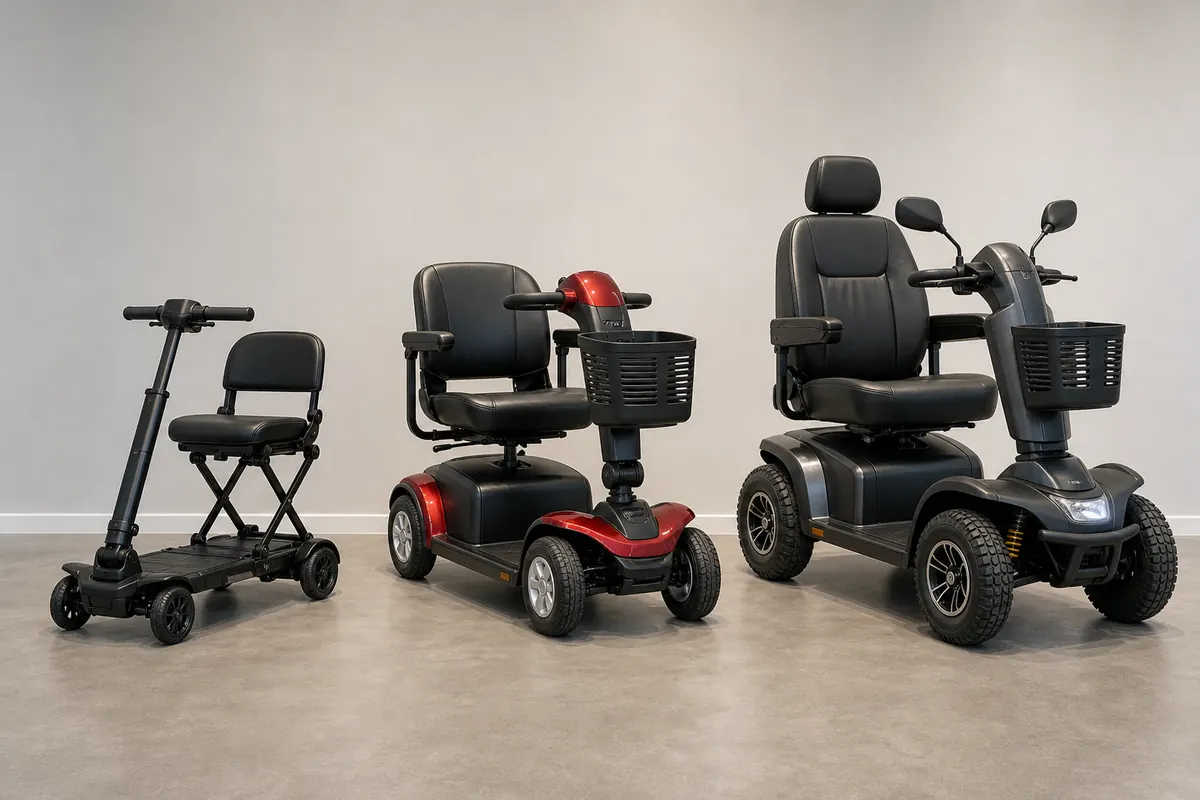
Folding mobility scooters
A folding scooter collapses its frame for storage without being separated into several major modules. Some fold manually; others use an electric folding mechanism. Compact dimensions can help in an apartment, vehicle, hotel room, or cruise cabin.
The main misconception is that folding always means lightweight. Total weight, battery weight, folded balance, handle position, and the height of the vehicle opening determine whether one person can load it. A compact seat, short wheelbase, and small tires may also reduce comfort on broken pavement. Read our detailed guide to folding mobility scooters.
Disassembling travel scooters
A take-apart travel scooter normally separates into a front or rear section, seat, battery pack, basket, and sometimes additional pieces. This can reduce the weight of an individual lift, but only if the heaviest component is manageable and the user or helper can repeat the sequence safely.
Travel models generally work best on smooth, predictable surfaces. Check clearance, tire size, seat support, and the manual’s terrain limits. Before buying, assemble the exact model and confirm that connectors, locking points, and the freewheel lever are easy to identify.
Mid-size scooters
Mid-size models often provide a larger seat, more adjustment, improved suspension, bigger wheels, and more battery capacity than compact travel products. They can be practical for a rider who travels outdoors regularly but still needs to maneuver through stores or community buildings.
The tradeoff is space. Measure full length, width, turning radius, doorway clearance, elevator depth, and storage. Vehicle transport may require a ramp, hoist, platform lift, or larger cargo area.
Full-size and outdoor scooters
Full-size scooters prioritize comfort, visibility, ground clearance, and longer routes. They may add suspension, lights, mirrors, a high-back seat, and larger tires. Those features can help on suitable outdoor routes, but they do not make every curb, slope, road, gravel path, or wet surface safe.
Use the manufacturer’s manual to confirm approved grades, obstacles, water exposure, temperature, tire pressure, and load. Large scooters need an intentional storage and charging location. They also need a transport system whose ratings match the scooter and vehicle.
Higher-capacity scooters
Capacity is the maximum stated operating load, not a target. Add the rider, clothing, mobility equipment, oxygen equipment, bags, and accessories. Choose a product with a sensible margin and verify seat dimensions, tiller reach, armrest range, deck space, and transfer height. A high capacity does not guarantee that the seat or controls fit a particular body.
A larger frame may offer a more suitable configuration, but it may also require wider doors, a larger turning area, and a rated lift. Individual seating and pressure-management needs should be addressed with an appropriate clinician or mobility professional.
Three-wheel scooters
A three-wheel layout usually places a single wheel or closely paired assembly at the front, creating a tighter turn and open space around the feet. It can work well in indoor environments when the model otherwise fits the rider and route.
Three wheels do not mean a scooter is automatically unsafe. Stability depends on the complete design, center of gravity, tire condition, load, speed, slope, surface, and rider behavior. Slow down before turns and follow the manual.
Four-wheel scooters
Four-wheel models typically have two front contact points and may feel familiar when tracking on outdoor routes. They often require more turning space. Wheel count does not replace careful measurement or safe driving.
For a detailed decision, use our 3-Wheel vs. 4-Wheel Mobility Scooters comparison.
Indoor scooters: what matters
An indoor-focused scooter should fit the narrowest door, turn, elevator, table approach, and storage location. A low minimum speed, predictable controls, compact length, and good knee clearance may matter more than top speed or range. Check thresholds and floor transitions; never assume a compact model can cross an obstacle that exceeds its manual.
Outdoor scooters: what matters
Outdoor use emphasizes wheel size, ground clearance, tire design, suspension, lighting, battery reserve, visibility, and weather limitations. Map curb ramps and crossings before the first trip. Avoid routes that force the rider into unsafe traffic. The ADA guidance on mobility devices describes access principles for covered facilities, but local traffic and facility rules still apply.
Recreational and “all-terrain” claims
“All-terrain” is a marketing phrase, not permission to use every surface. Loose gravel, sand, mud, tall grass, side slopes, curbs, and standing water can create loss of traction, tipping, electrical damage, or immobilization. Verify each limit in the manual. Do not use a mobility scooter as an off-road vehicle.
Battery type does not define the scooter type
Lead-acid and lithium-ion batteries can appear in different scooter classes. Battery chemistry affects weight, handling, charging, replacement, storage, and transportation, but it does not by itself tell you whether the frame, seat, tires, or route are suitable.
For air travel, battery identification is essential. The FAA mobility device guidance explains federal battery conditions, while the airline must still be contacted before travel. See our airline battery guide.
Seating styles across scooter types
Compact models may use a simple, lightly padded seat. Mid-size and full-size scooters may offer swivel, recline, headrest, suspension, and more adjustment. More padding is not the same as clinically appropriate seating. Check seat width and depth, back support, armrests, transfer method, and how the rider maintains posture during turns and stops.
Transport styles
- Lift into a vehicle: use the heaviest component and actual lifting height, not only total weight.
- Ramp into a vehicle: verify ramp, vehicle floor, doorway, and securement ratings.
- External carrier: verify hitch tongue weight, carrier, weather exposure, lighting, and legal requirements.
- Public transportation: ask the operator about dimensions, securement, boarding, and advance information.
- Air travel: provide size, weight, battery chemistry, watt-hours, and handling instructions to the airline.
How to choose among the types
- Confirm that the rider can safely transfer, sit, steer, and use the controls.
- Measure the body fit and complete operating load.
- Map the normal indoor and outdoor route.
- Measure doors, turns, elevators, storage, and vehicle access.
- Select the smallest class that safely meets route and comfort needs.
- Test the exact model on representative surfaces.
- Verify battery documentation, charger, warranty, and local service.
Use The Complete Mobility Scooter Buying Guide and How to Choose the Right Mobility Scooter for the full purchasing process.
Frequently asked questions
What type of scooter is easiest to transport?
It depends on the vehicle and the person doing the loading. A folding model avoids multiple pieces, while a disassembling model may reduce individual lift weights. Measure and test the exact sequence.
What type is best for rough sidewalks?
Look for a manufacturer-approved outdoor model with suitable clearance, wheels, tires, suspension, load capacity, and route limits. No scooter makes severely broken pavement automatically safe.
Can a travel scooter be used indoors?
Often, but check width, length, turning radius, control speed, knee clearance, and thresholds against the actual building.
Are larger scooters more comfortable?
They may offer more seat and suspension options, but comfort and support are individual. Complete a longer trial and obtain professional seating advice when needed.
Which type lasts longest?
Service life depends on design, load, use, weather exposure, charging, maintenance, storage, parts availability, and service—not the category name alone.
Features that cut across every scooter type
Category names do not describe every configuration. Two mid-size scooters can differ in seat suspension, tiller adjustment, tire construction, minimum speed, lighting, battery removal, ground clearance, and service access. Compare those features only after the broad class fits the rider and route.
A swivel seat can support a transfer in one setting but need extra side clearance. A delta-style tiller may change hand position. Suspension can reduce some vibration but cannot make a prohibited obstacle safe. Mirrors and lights improve awareness but do not replace a safe route.
Weather and seasonal use by scooter class
Compact travel models, mid-size scooters, and full-size outdoor models all have manufacturer limits for rain, standing water, temperature, and storage. “Outdoor” does not mean waterproof. Protect controls and batteries as directed, move to shelter when conditions deteriorate, and dry the scooter before charging when the manual requires it.
Cold can reduce available battery performance; heat can accelerate battery aging and make a stored vehicle unsafe for people and equipment. Plan a larger range reserve and a suitable indoor storage location. See battery service-life guidance for the factors that affect dependable range.
Public transportation considerations
Transit systems can set operational procedures for dimensions, weight, boarding, securement, and rider assistance. Before buying a scooter for routine bus, rail, or paratransit use, ask the local operator for current vehicle and securement information. Measure the complete scooter with normal accessories.
A small turning radius can help on a platform but does not guarantee that a lift, ramp, or securement area fits. Practice boarding through the operator’s travel-training program when available.
Four example use profiles
Apartment and rideshare storage
A folding or disassembling travel scooter may fit, provided the rider and helper can manage the real weight, seated support, and smooth destination route.
Neighborhood sidewalks and stores
A mid-size scooter may offer a balance of comfort, clearance, and maneuverability. Map broken pavement, slopes, crossings, and storage before deciding.
Long outdoor routes
A full-size outdoor model may provide the required seat, tires, suspension, lighting, and battery reserve, but it needs wider access and a rated transport solution.
Tight indoor movement with complex seating needs
A scooter may not be the correct category. Review the mobility scooter vs. power wheelchair comparison and seek an individual assessment.
Do not choose from a label alone
Use category names to create a shortlist, then return to measurements and a real trial. The exact model must safely fit the rider, complete load, controls, route, storage, charging, transport, battery, and service plan. Our step-by-step selection worksheet provides the final filter.
Match category to available assistance
The same scooter can be practical with a trained helper and unsuitable without one. Identify who will charge it, inspect tires, lift components, attach an approved carrier, arrange repairs, and help after a breakdown. Do not assume assistance will always be present; confirm which tasks the rider can complete independently and build a backup plan.
A secondary travel scooter may complement a larger everyday scooter, but it still needs safe fit, control, maintenance, and storage. Using two devices can also mean two chargers, battery routines, manuals, warranties, and service contacts. Label equipment clearly and avoid mixing chargers or removable packs.
When a product category requires repeated compromise—unsafe lifting, insufficient seating, an inaccessible route, or no local service—reconsider the category rather than treating those problems as normal. The correct type should reduce barriers without introducing unacceptable new ones.
Last reviewed: July 21, 2026. Specifications and rules change; verify the exact product manual and the current policy of any transportation provider.

Questions and reader comments